Tim Robson

Writing, ranting, drinking and dating. Ancient Rome. Whatever I damn well feel is good to write about.

  • Tim's Blog
“Fifteen minutes with you.
Well I wouldn’t say no.”

Mary Chain, Mascara, Morrissey and Me: SUSSEX UNIversity IN THE 80’s

January 23, 2021 by Tim Robson in Tim Robson, Brighton
Natalie. Or Brigitte? My next door neighbour but briefly - East Slope, Sussex University

Natalie. Or Brigitte? My next door neighbour but briefly - East Slope, Sussex University

Natalie lived next door to me. She was years older - at least four. That was an unbridgeable gap in those days. She appeared experienced and sophisticated in a way that I wasn’t then and probably am not now. And she was also French; dark haired, beautiful, sexy. I’d only gone to university and got Brigitte Bardot living next door to me!

And then, mid-term, she moved out. Our juvenile antics must have irked her. Oh - the bottomless pain of separation! The exquisite misery of emptiness! Surrounded by hundreds of eighteen year olds I was alone, so alone.

I played Hatful of Hollow endlessly. Morrissey incongruously spoke to me. ‘Please, please, please let me get what I want’ he sang through my cheap speakers. There was silence from the empty room next door.

East Slope, Sussex University, autumn term 1986.


I was driving my daughter around ‘my’ Brighton last weekend. We were stopping off and photographing all my previous addresses throughout Brighton and Hove. Some I stayed at for a matter of weeks, others for several years. Many looked decrepit, a handful were grand, very grand. I had situational memories of all of them. Job. Girlfriend. How cold they were (it was alway cold in Brighton flats).

On the way back to Burgess Hill we stopped off at Sussex University. I’d lived in three campus apartments over two years - East Slope, Kent House and Park Village. Let’s see if I could retrace once familiar steps and show my daughter, well what? Where Natalie left me bereft all those years ago? Mmm, maybe not. But where I lived certainly.

But like most universities since the 80’s, Sussex has got bigger - ‘welcoming’ more and more students in order to meet Tony Blair’s ridiculous 50% target. Add to this to the maniacal drive to recruit loads of fee paying foreign students and you have a university with near four times the number of ‘clients’ it had when I went there.*

So although we drove past many familiar buildings, there was a new feeling about the campus. It seemed very closed in whereas it always seemed spacious when I was there. Tricks of time, perhaps. Sussex was a relatively small university in the 80’s and the student body was split fairly evenly between public school tossers and the brightest and best of the comprehensive system. 4500 students in all - one third living on campus. It felt like a village. A village out in the Downs, ten minutes train ride from Brighton. It sported Sussex red brick and the architect - Basil Spence - had designed the layout so that it nodded vaguely in the direction of a classical Roman forum. (I know this stuff because I used to do campus tours for prospective parents and students in my third year. £3 a pop, I remember.)

Shades at night! TR in his Kent House student room 1988 - alas the call from the Jesus & Mary Chain never came.

Shades at night! TR in his Kent House student room 1988 - alas the call from the Jesus & Mary Chain never came.

There were the bars of course. East Slope bar was notorious because of the cheap drinks, the scrum to get those cheap drinks and the sticky floor caused by said drinks being too difficult for students to navigate the plastic glass of Kronenberg from glass to mouth without spilling. (Pints were 60-70p). Park Village Bar rates a mention as it was the home of the Julie’s Jinx a pint of every spirit going starting from a base of half a cider. These cocktails never lasted long in your stomach.

Sussex has changed since the 80’s. New high rise accommodation blocks bestride and dominate the northern end of campus. All those extra fee paying students have to live somewhere I suppose. Inside, these alien structures are probably very nice with all the mod cons our current flock of students demand. But the village feeling, the uniqueness of the first red brick university, has gone. And so has East Slope, so named because all the student accommodation was in single story flats rising gently up a hill. All gone. And yes, that flat where I met and then mourned the beautiful Natalie, now gone completely.

To be fair the other buildings from then to now, looked tired. Park Village looked in particular on its last legs with rotting woodwork, overgrown green spaces, windswept rubbish piled up in corners. Not how I remembered it at all. But then what I truly remember is the spirit, the ephemeral feeling and not just the concrete. I remember the summer of 87, and every window being open and blasting out the newly released Joshua Tree. I remember late night parties and lying on the grass in the warm June air, talking bollocks about politics and music and gossiping over plastic glasses of cheap red wine. I remember reading Wuthering Heights for the first time out on the fields next to Park Village; fields now covered with blocks of flats and car parks.

It’s the people and the time; the young people interacting, doing stuff, each other, laughing and joking that defines a place, an era. I guess I always knew that.

Park Village party, June 1988. TR lying down in white (with hair!)

Park Village party, June 1988. TR lying down in white (with hair!)

So even before further buildings are torn down, as East Slope has been, the transient spirit my cohort possessed has gone. Each successive intake make their own memories, their own version of what a university community means. But that time is heartbreakingly brief and we’re left - if we ever venture to go back - with the mere bones slowly rotting away. The flesh has long gone. The spirit died the very moment we walked out that last day Summer Term ‘88. And maybe that’s correct.

And Natalie? Fuck knows. She shacked up with some professor, moved into a flat behind the station in Brighton and - for all I know - got married, had kids and never thinks about me. But if she does I hope she plays The Smiths.

Tim Robson 17B East Slope 1986.

Tim Robson 17B East Slope 1986.

(I like live versions of songs. This solo version from Morrissey - years later, different lyrics - captures though the wistfulness of time passed. Hence me selecting it. You’re welcome.)

  • Fifteen Minutes with You… From Reel Around The Fountain, The Smiths

  • Foreign student income. Perhaps that why the British universities whined like bitches when the uneducated population voted for Brexit? Call me old fashioned (puts down pint) but shouldn’t the primary function of UK universities be to educate the children of this land first?

January 23, 2021 /Tim Robson
Sussex University, Sussex in the 80's, East Slope, Park Village Sussex
Tim Robson, Brighton
Comment
mick taylor solo.jpeg

Mick Taylor's Top Studio Tracks

January 16, 2021 by Tim Robson in Rock
“Ye shall know them by their fruits”
— Matthew 7:16 (KJV)

We all know that in the Mick Taylor Years (1969 / 74) the Rolling Stones were at their live peak. He added a real lead guitar muscle to complement their riff heavy catalogue. They went from being great to being the best. Watching the Stones in this period ranks - with me anyway - alongside watching Elvis 1969-72.  Yeah, two great acts at their peak at the same time. Saw neither. Thank goodness for YouTube.

Apparently Keith Richards once told Mick Taylor he was great live but shit in the studio. There's a ring of truth to this - even if it was overstated. Taylor certainly was less dominant in the Stones albums he played on. Maybe he knew he was being shafted for song writing credits. Maybe Mick and Keef overshadowed MT when it came to controlling who did what and when. They certainly bossed the mixing desk. Playing live they didn't have the same control.

But dig (not too deep) and you have some classic Mick Taylor performances committed to vinyl. 

I've tried to filter out songs where he was just 'one of the band' and purposefully pick songs where it's absolutely all about Mick Taylor. Agree? Disagree? Tell me in the comments.

Mick Taylor appeared on Stones albums between 1969 and 1973*. They are Let It Bleed (just a little) and then Sticky Fingers, Exile on Main Street, Goat's Head Soup and It's Only Rock n Roll plus the live album Get Yer Ya Ya's Out. 

To me, I'd probably rank them Sticky Fingers, Goat's Head Soup, Exile on Main Street, It's Only Rock n Roll. Which is strange as my favourite MT tracks appear on It's Only Rock n Roll. 

Sway - Sticky Fingers (1971)

Keith was absent and so the two Micks fooled around in the studio together, coming up with this gem. A real guitar-heavy rocker, taken at a stately pace, it's one of those Stone tracks that should be better known but it's cult like obscurity makes me feel good I'm in the know. As does my possession of an original Andy Warhol designed jeans zip cover (framed and on my wall next to 8/9 others of similar vintage). This was, for a while, my fav Stones track. Jagger sings exceptionally on this - as demonstrated by his later, pitiful, attempt on the 2013 tour. MT's guitars are hard, the solos fluid - slide and then full on rock solo as the track ends. One to look up if you don't know it.

Winter - Goats Head Soup (1973)

Winter is one of those epic ballads the Stones seemed to just knock off in their sleep in the mid 70's (Angie, Memory Motel, Fool to Cry, Coming Down Again). Just like Sway, it features no Keith Richards. What separates this from the others is the Mick Taylor guitar solo which is both powerful and incendiary. Taylor had a way of complementing Jagger's vocal lines, adding fillers and runs throughout the song. Like he would do when the Stones played live. Many people rate this his best solo. I enjoy it but, no, it would be bettered the following year.

 Can't you Hear Me Knocking - Sticky Fingers (1971)

It starts with a Keef riff and then, according to MT, when everyone was putting their instruments down at the end of the song, the groove just continued - first Bobby Keyes on sax and then, the Master Mick, the God of guitar (virtuosity be his name) started soloing. One take. Not rehearsed. As live as you can get and this is the result. The Stones should have employed this method on their recordings 69-73; just turn Mick Taylor loose. What you get is a classic and a classic because he turns the songs around and pushes it into new directions. That's one of Taylor's strength - his ability to effortlessly improvise.

All Down the Line - Exile on Main Street (1972)

Rock and rolling Stones kicking it back in the South of France, noses in bags of narcotics, dodging tax and playing some of their best music ever! Exile on Main Street was a groove, a feel, the sound of  - to steal a phrase from Sir Paul - a Band on The Run. Mick Taylor adds some sharp, rocking slide guitar, taking the solo. To see how hard MT worked on this track - watch the video below.

Til the Next Goodbye - It's Only Rock n Roll (1974)

Another acoustic ballad, another slide solo. Beautiful song and for some reason completely overlooked. Why?

Honky Tonk Women - Let it Bleed (1969) / Brown Sugar - Sticky Fingers (1971)

Two songs from 1969 (Though Brown Sugar lay in the vaults over a year). Mick Taylor's introduction to the band. Honky Tonk Women - apparently MT made a small but telling contribution. He rocked up the song from the country ballad (Country Honk) to the rock classic we know now. Brown Sugar, is another group ensemble song where MT adds to mix but doesn't stand out. Recording on the sly in 1969 in Muscles Shoals, it was Mick Taylor's suggestion that they play this unreleased song at Altamont when all was falling on the Stones' heads. Didn't make the film Gimme Shelter but the audio of this first ever version is the Stones against the wall, punching back.

Time Waits for No Man - It's Only Rock n Roll (1974)

The boss. The winner. The best track Mick Taylor and the Stones studio track. So beautiful. So wistful. And that solo at the end! An artist at the top of his game in a band throwing in a good performance. In the late 80's I wrote a shit song called 'It's Raining Again' and the only good thing about it was that I grafted a sausage fingered version of this MT's solo in the middle. The song is perfect in every way - Jagger's lyrics, Keef's spine tingling riff, Wyman, Watts, Nicky Hopkins and Ray Cooper all adding to the mix. And then Mick Taylor solos like a bastard for two / three full minutes of magic. He employs Latin influenced runs up and down the fretboard. Wow! This is what the Stones could have been. This is the Stones, timeless, standing out of time, looking at us and beckoning mere mortals forward. 

I'm done.

To read my other Mick Taylor pieces, click here...


Tim's Blog RSS


* Yeah - Waiting on A Friend was reused in the 80's.


January 16, 2021 /Tim Robson
Mick Taylor, The Rolling Stones
Rock
4 Comments
spqr.jpg

SPQR by Mary Beard - Review

January 02, 2021 by Tim Robson in Ancient Rome, Book Review

SPQR ( Senatus PopulusQue Romanus meaning, for the Senate and People of Rome, the indelible banner stamped below the eagle standards of the Roman legions) is a chunky book that traces Rome from its beginnings as a bandit village in the 750’s BC through to the grant of universal citizenship across the empire by Caracalla in 212 AD. A period of nearly a thousand years. Or, as Mary Beard writes, Rome’s first millennium. As we all know, the Western Roman Empire continued for another 250 years whereas the Eastern Roman Empire - popularly now known as the Byzantium Empire - lasted for a further 1200 years until its eventual fall in 1453.

The problem with any book spanning a thousand years of history is that - no matter how large - it can only give a surface presentation of the narrative as it moves along. There’s no in depth analysis of each event. If you want that, then specialist books are what you need and that’s what I usually prefer. I get frustrated that the author is, necessarily, constrained and so has to arbitrarily choose what to include and what to leave out. That applies here (Marius and the Cimbrian War hardly get a mention for instance). However, I was gifted this book and so once I started, I needed to finish!

The first part of SPQR, covering the foundation and growth of the Republic through to its subsequent transformation under Augustus in the latter part of the 1st century BC, is episodic but essentially follows a linear narrative. The following 200 odd years, detailing the period of the ‘Principate’ emperors, feels much more rushed and thematic. The problem with this latter half of the book is the tendency to indulge in what I call ‘magpie’ historicism - selecting random examples from a wide variety of ages to justify an argument. Part of this is due to the periodic lack of sources handed down to us across the ages. Was Rome’s most thrilling period - the fall of the Republic - so famous because it marked a major turning point or because the surviving source material is so rich?

The central question of any book covering a thousand years is why Rome went from being a tribe of brigands in central Italy to a world power. The usual suspects are present in this book - the Romans’ love of adaption - in army tactics, in building, even in gods. Mary Beard advances that Rome was unique in its ability to absorb its defeated enemies, from Veii, to the Sabines, the Samnites etc, in a loose embrace so all might prosper. The Romans weren’t fussy about local gods or systems of government, they co-opted them. What however was sine qua non was the supply of manpower for wars.

As to the question whether the Romans better in battle or just able to muster more men, Mary Beard believes that - with technology the same, the largest army was predisposed to win. It’s an argument and a plausible if obvious one. There is some truth to this. For example, the Second Punic War where Hannibal, clearly the better general, could win the battles but never the war. Rome kept recruiting armies, harassing the Carthaginians and recapturing towns, in order to continue fighting even when all seemed lost. That was, until they found their own master tactician in Scipio Africanus. Another example may be the most famous if only due to the popular adage that it spawned following the Battle of Asculum. Fighting King Pyrrhus in the 270’s BC, the Romans kept losing battles but extracted unsustainable casualties on Pyrrhus, thus giving rise to the popular phrase “Pyrrhic victory”.

I think my major objection to this type of book is that it clearly comes from an academic. Nothing wrong with that, of course. However, there is hair-splitting and ‘on the one hand, but on the other’ isms that can annoy after a while. Much of the book seems to be negative; finding a popular story or commonly held piece of knowledge and then finding issues with it. It’s a tendency I like least in academics, the pursuit of the obscure in preference to the universal. At best this can advance knowledge and provide balance to a flabby prevailing narrative, at worst, it can be obscurantist and distorting. You can lose the big picture by being needlessly pedantic. In broad based books - like this - the approach can lose the narrative thrust in a welter of qualifications.

Maybe it wasn’t the book for me but then I never expected it to be. I’ve long moved beyond large overviews of the Roman world - however scholarly - and into more niche areas like Julian or Aurelian. Or source material like Appian or Josephus.

A couple of factoids-

The word rostrum, for a speaker’s platform, comes from the Latin word for a ship’s ram (rostra). After the naval battle of Antium in 338bc, the victorious commander of the Roman fleet, Gaius Maenius, took the rams from six captured enemy ships and placed them on the platform in the Forum. Hence rostrum.

“They make a wasteland and call it peace,” said Calgacus, ancient British leader, as quoted by Roman historian Tacitus. An interesting quote (wasteland can be interrupted as ‘desert’ or ‘desolation’) which shows as much about Roman freedom of thought to write this down as it does a critique of Roman pacification efforts. Rome usually was magnanimous in victory, the exceptions (like Caesar’s massacre of the Tencteri and Usipetes) providing the exceptions to the rule. They wanted money, taxes, slaves, markets and manpower for the army.

For further Roman reviews, try Josephus and The Jewish Wars or what about my Barbarians TV series review? Or go for my history of Rome series?

January 02, 2021 /Tim Robson
SPQR, Mary Beard SPQR
Ancient Rome, Book Review
2 Comments
The Romans face the Caledonians at Mons Graupius, Scotland AD 83. @Seán Ó'Brógáin

The Romans face the Caledonians at Mons Graupius, Scotland AD 83. @Seán Ó'Brógáin

ROME: The First Century in Five Battles

January 01, 2021 by Tim Robson in Ancient Rome, Roman Empire, Rome in 5 Battles

(In which Tim maps the Roman Empire in the first century AD through five battles)

“Varus, give me back my legions!”

So the ageing Emperor Augustus is said to have shouted, driven mad by the loss of three legions at The Battle of The Teutoberg Forest in AD 9. Quinctilus Varus was the Roman commander who led those legions into the dark German forests, never to return. This is the first battle of the first century. Rome’s devastating response following the campaigns of the aptly named Germanicus shall be my next focus as exemplified by The Battle of Idistaviso in AD 16.

The invasion of Britain under the Emperor Claudius in AD 43 merits a mention. As does the defeat of Boudicca at the Battle of Watling Street in AD 61 where Rome firmly put down her revolt. The Battle of Mons Graupius in AD 83 finally consolidated Britain (minus Caledonia) into the Empire.

The siege and destruction of Jerusalem in AD 70 is an obvious landmark battle. The Jewish revolt was a major uprising and occurred during one of the few periods of outside instability the Roman Empire faced in the first century. Its impact is probably still felt today.

Whilst Titus was dealing with the Jewish revolt, his father Vespasian had marched on Rome to throw his laurel wreath into the ring to become Emperor. The ‘Year of the Four Emperors’ in AD 69 was the first Roman civil war in 100 years. Previously Emperors had just been assassinated, poisoned or committed suicide. This violent transfer of power though was limited to the unfortunate Emperor and his immediate supporters and didn’t lead to a full-scale civil war as had been the norm in the late Republic. Although, Rome soon came back to normalcy - and indeed the Emperors improved - this respite would be only temporary and civil wars would come back in a big way towards the end of the second century.

A note on the army itself: The Roman army of the 1st Century AD looked exactly like the Roman Army in popular imagination. They wore curved helmets protecting the back of their necks, segmented armour, carried long curved rectangular shields, held short thrusting swords and threw devastating volleys of weighted spears. A legion consisted around 5120 men divided into 10 cohorts (the 1st being double sized). There were 28 legions in Augustus’ time, later increased to 30. Auxiliaries assisted the legions (archers, calvary, skirmishers etc) and their number was around the same. Therefore, a reasonable assessment of the size of the Roman Army of this period is 300,000 men under arms.


The first century began with Augustus in the 28th year of his principate. Unlike much of the previous century, The Roman world was pretty much at peace with itself. The civil wars were over. Augustus stealthily added nations that were protectorates - like Egypt - to the Empire avoiding outright conquering. However, his sons-in-law - Drusus and Tiberius - added Raetia (modern Switzerland). But this Caesar - unlike his famous uncle - was content to be imperator in name if not in deed.

However, one recurring trouble spot in the Empire was the Germanic tribes beyond Gaul. Could Augustus add Germania to the Empire and, if not, where was the defensive line of the empire to be drawn? It was going to be the river Elbe but - following the loss of the legions in the forests - Rome pulled back to the Rhine where it stayed for the next four hundred years.

The Battle of the Teutoburg Forest was the shock that caused this retrenchment. Three legions (plus assorted auxiliaries and camp followers) operating beyond the Rhine, were betrayed by a supposed friendly German ally, Arminius, and massacred. Arminius led Varus into the dense forest and then sprang his trap. The army was wiped out and their totemic eagles taken.

At this point in time, Rome had just 28 legions. The loss of three meant a sizeable chunk of the available forces had just disappeared. No wonder Augustus was upset. Revenge came slowly and - as was the wont at these times - through a member of the Imperial family.

Germanicus was nephew to the new Emperor Tiberius and was sent to the Rhine to sort out the mess left after Arminius’ triumph. Fighting many battles and chasing many tribes into many forests, Germanicus skirmished and harassed the Germans time after time over three years until he finally tempted them into an open pitched battle. This was at the Weser River and became the Battle of Idistaviso AD 16. The result was a massacre of the German tribes. Arminius survived only to be beaten again that same year at The Battle of the Angrivarian Wall. (He was later killed by members of his own tribe. He is still celebrated as one of the founders of the German nation. His massive 19th has century statue stands above the Teutoburg Forest to this day.)

Rome had won the conflict but Tiberius, ever cautious, withdrew Germanicus to Rome and the Empire’s frontier was settled back at the Rhine.

Julius Caesar had come across the Channel to Britain a couple of times but he never made a serious invasion attempt - he was too busy conquering Gaul. These incursions provoked a few fights, garnered some tributes and alliances, but Caesar didn’t stick around to conquer Britain. One hundred years later though, in AD 43, the unwarlike Emperor Claudius - another nephew of Tiberius - launched the invasion of Britain.

The conquest was a slow process taking over 40 years. The south of the country was relatively passive, having interacted with the Romans for years. However, the North and West and Wales proved much more difficult. Whilst the Romans were distracted subduing the Welsh tribes in AD 60, the Iceni under Boudicca rebelled back in the conquered south. The rebellion was short, violent with the rebels burning and massacring the Roman towns of St Albans, Colchester and a little town called Londinium.

The governor, Seutonius Paulinus, gathered up a force centred around one and a half legions and met Boudicca and her army somewhere along what became known later as Watling Street. He chose his battlefield well, funnelling the Britons into a narrow front. As had happened many times previously in Roman history, well-trained legions overcame a larger but undisciplined horde. The rebels were massacred - hemmed in by their own carriages - and Boudicca committed suicide not long after.

Twenty of so years later, the Romans had turned their attention to the north of Britain. Up in Scotland, the Caledonian tribes were causing problems. However, the usual rules applied; tracking a tribe into an open pitched battle was difficult and whilst traipsing around the wet and cold of Scotland, the Roman army was prey to ambushes and lightning strikes. Governor Agricola finally lured the Caledonians into battle somewhere in the mountains of Scotland (the precise site is unknown). The Battle of Mons Graupius AD 83 was unique in that the Romans won it using only their highly trained Germans auxiliaries with assistance from the cavalry.

Tacitus, who wrote the account of the battle, famously put words into mouth of the Caledonian leader, Calgacus, “They make a desolation and call it peace.” All Britain was conquered. For now.

The Siege and Destruction of Jerusalem, by David Roberts (1850)

The Siege and Destruction of Jerusalem, by David Roberts (1850)

Back a few years, and we have the brutal Siege of Jerusalem in AD 70 part of the First Jewish-Roman war. Pompey had added Judea to the empire back in the Republican days. He’d even successfully laid siege to Jerusalem. This time though, the struggle was more bitter as a hardcore sect of rebels within the city - the Zealots - refused to surrender. As Vespasian had left for Rome, his son Titus (later emperor too) led the four legion assault on the city. Starvation, disease and the terrors of war were meted out to the inhabitants of the city, bolstered as they were by hundreds of thousands of refugees escaping the wider war. The end was a massacre:-

“They poured into the street sword in hand, slaughtering indiscriminately all they came across and burning houses with those who had fled there still inside… Since the troops had run out of victims to kill or property to loot, Caesar ordered the army to raze to the ground the whole city and the temple…” Josephus, The Jewish War (Book 6:404 / Book 7:1)

Jerusalem and its population was destroyed. This was quite a consequential siege in history.


Read more ROME: Five Battles here.

January 01, 2021 /Tim Robson
Idistaviso, Germanicus, The Siege of Jerusalem, Mons Graupius
Ancient Rome, Roman Empire, Rome in 5 Battles
Comment
Battle of Strasbourg

Battle of Strasbourg

Rome: The 4th Century in Five Battles

January 01, 2021 by Tim Robson in Roman Empire, Rome in 5 Battles

(In which Tim discusses the five most important battles within the wider history of the 4th Century Roman Empire)

The fourth century was bookended by two famous ‘Christian’ battles - The Milvian Bridge in 312 and The Frigidus in 394. They mark - apocryphally - both the entry point of Christianity into the Roman Empire and its ultimate victory. Each led to climatic events; The Milvian Bridge led directly to the Nicene Council of 325 which formalised the Christian creed. The Frigidus began the series of events that ended with Alaric’s sack of Rome just sixteen years later.

So we have our beginning and end. What in between? Adrianople, of course. The defeat of Valens and the Eastern Roman Empire’s army at the hands of the Goths in 378 is popularly associated with the eventual downfall of the empire itself. Can’t argue that it’s important.

For me, Julian is the most interesting fourth century Emperor. His metamorphosis from bookish princeling to ass-kickin’ Caesar began in Gaul. The most famous battle in his journey to pacify the province was his victory over the Alamanni in the Battle of Strasbourg 357.

Our fifth battle is The Battle of Mursa 351 where the forces of Constantius II defeated those of the usurper Magnentius in the biggest and bloodiest battle of the century. As an exercise in damaging futility this was the daddy of them all.

*****

The Empire at the beginning of the fourth century was a very different animal to that ruled over by Septimius Severus one hundred years earlier. The crisis of the third century had brought about chaos, short lived emperors, and the temporary division into three mini empires. The gradual restoration of control was brought about by the Illyrian emperors Claudius Gothicus, Aurelian, Probus and finally Diocletian.

Diocletian instituted the tetrarchy - a system where two senior Augustii and two junior Caesars ruled quadrants of the Empire. It was a neat idea. It didn’t last. Diocletian, who resigned along with his co-Augustus Maximian, lived long enough to see not only his fine cabbages grow in his retirement home in Split, but his system of government fall apart as his successors squabbled amongst themselves to gain and maintain power.

Constantine (The Great), son of one of Diocletian’s successors Constantius I, was chief amongst those squabbling. He was annoyed that he was left out of Diocletian’s succession plans and, on the death of his ailing father in York in 306, declared himself emperor. This led ultimately to the first battle of our series - The Milvian Bridge.

In this battle, Constantine marched into Italy in 312 - then under the rule of one of the many post-Diocletian claimants - Maxentius. With a smaller army, Constantine’s troops feared losing the climatic battle outside Rome the next day. That night Constantine dreamed of a cross in the sky. So the story goes, he had his army paint the Christian symbol on their shields and, with God on their side, they routed Maxentius and his army the next day at The Milvian Bridge.

The Arch of Constantine was completed to mark this famous victory. The fact that it was originally going to be the Arch of Maxentius and repurposed bas reliefs from earlier monuments, is now somewhat forgotten. He who wins writes the history and gets the arches. It still stands today under the shadow of the Colosseum.

The next twelve years were a history of Rome fighting itself as Constantine gradually consolidated his power to become sole emperor in 324 with his defeat of Licinius. Famously, Constantine left three legacies to the Empire when he died - after converting on his deathbed to Christianity - in 337:

  • The Council of Nicene which produced a unified - though disputed for many years - Christian doctrine still in use today,

  • The founding of Constantinople as the ‘new Rome’ on the site of the Greek city of Byzantium,

  • An utterly chaotic carve up of the Empire between his three sons and two nephews which set the scene for nearly twenty years of civil wars.

The intrigues between the three sons of Constantine deserve a blog of all their own. The imaginatively named Constantine, Constans and Constantius battled it out for years until only the latter remained standing as Constantius II. The second of our landmark battles occurs in this period when Constantius - in the East - took on his brother Constans’ murderer, Magnentius at Mursa in 351.

Mursa was a triumph for Constantius but a tragedy for the empire. Crack units of the East and Western Roman armies fought each other in a bloodbath in Pannonia (modern day Croatia). The battle saw the flowering of the late Roman cataphracts - heavily armoured cavalry - as they mowed down Magnentius’ legions. It was a victory but a pyrrhic one.

One of the consequences of Rome turning in on itself was that units were inevitably withdrawn from the Empire’s borders. The tribes living beyond took advantage of this and increasingly began to run amok amongst the frontiers. Constantius proved Diocletian’s theory that the Empire was too big for just one ruler and so appointed first his cousin Gallus, and then his other cousin, Julian, as junior Caesar. Gallus proved himself unfit to rule and so was executed. Julian however, proved himself quite the opposite.

Bookish, sceptical and a lover of philosophy, Julian was an unlikely warrior Caesar. Sent to Gaul to restore order, Julian did just that. And more. Let down by his supporting army (who may have been acting on the orders of Constantius) Julian was left facing a much larger force of Alamanni near Strasbourg in 357. The battle was a complete rout with the Alamanni destroyed by Julian’s infantry and then chased all the way back to the Rhine where many survivors drowned. Over the following years, Julian followed up by a process of forward-defence - raids into enemy territory whilst repairing and reinforcing the border.

Inevitably the two last descendants of Constantine The Great squared off against each other in 361 (see previous blogpost). Luckily for the Empire, Constantius died on the way to confront Julian allowing the latter to become the undisputed ruler of the whole empire. Julian met his ‘spear of destiny’ just two years later fighting the Persians and bringing to an end Constantine’s line and any anti-Christian fight back. Rome was henceforth a Christian empire.

The Empire now fell into the hands of Valentinian who appointed his brother Valens Augustus of the East. This proved a fatal decision as Valens allowed a massive Gothic migration into his lands in 376. The Goths crossed the Danube to escape the growing power of the Huns expanding and terrorising from the east. Stupidity, betrayal and pride (Valens refused to wait for the army of his nephew Gratian - now Emperor of the West) led Valens and the Eastern Roman army to take on the Goths alone at Adrianople (now part of European Turkey) in 378.

Adrianople was a disaster for the Romans. Their army was destroyed by the Goths and the emperor himself allegedly died after been burnt alive in a peasant house while attempting to flee the battlefield. The defeat left the Eastern empire defenceless and leaderless and at the mercy of the Goths who now rampaged at will throughout Thrace and Greece.

Slowly, piece by piece, Roman general and later emperor Theodosius (The Great) put the East back together. He fought defensive actions and eventually made peace with the Goths in 382 allowing them to stay within the empire’s borders. Once inside the Goths became a combustable element, fighting for the Empire when it suited them but, equally likely to go marauding and looting.

Over in the Western half, Valentinian’s younger son Valentinian II - now Emperor - allegedly hanged himself. His all-powerful advisor and military commander Arbogast was more than implicated. Arbogast was a Frank by birth and so ineligible to take the throne himself and so he chose Eugenius, an obscure Roman official to be the new Emperor in the West. Over in the East, Theodosius bided his time. But when Arbogast and Eugenius started to favour the old Roman gods over Christianity, Theodosius reacted. The showdown took place at The Battle of The Frigidus (modern day Slovenia) in 394.

This two day battle was notable for several things.

  • Theodosius won the battle becoming the last sole Emperor of East and West. Not for long though as he died in 395.

  • The battle marked the final victory of Christianity over paganism. Much is made of the high winds that allegedly blew at Arbogast’s forces on day two of the battle rendering their missiles useless. A divine wind, it was claimed.

  • Theodosius’ use of Gothic auxiliaries (foederati) was controversial. He put them in the front line and used them as cheap cannon fodder. It allowed him to win the battle but incensed his surviving allies. One of the Gothic leaders fighting for Theodosius that day was a young noble named Alaric. Sixteen years later, Alaric led the Goths into Italy and sacked Rome for the first time in eight hundred years. It wasn’t the end of the Roman Empire but it marked the beginning of the last stages of the Western half.

The fourth century ends with the young sons of Theodosius - Honorius and Arcadius - in charge of the West and East respectively. Both of them were weak, dominated by advisors and unfit for their times. It was a sad end to such a lively century.

So what have learnt in this brief canter through the years 300-399?

First, and most obvious, the rise and rise of Christianity. A persecuted sect at the start of the century - the worst repression occurred under Diocletian for example - it was the undisputed religion of the Empire by the end.

The Roman military was still powerful throughout much of the century. Although the legions were no longer the primary unit, it still packed a punch. Borrowing from Palmyra and Persia, the military incorporated heavy calvary units alongside smaller vexallations of infantry. When it worked, armies could criss-cross the empire and successfully see off threats. Under strong leaders - Constantine, Julian - the army could be formidable.

The increased use of foederati - allied non Roman troops. By the end of the century, the traditional auxiliary units - trained and led by Romans - had largely been replaced by unincorporated bands of barbarians who fought under their own banners and leaders.

Civil wars were as deadly to the empire as attacks by outside forces. Roman v Roman battles were as common and - pace Mursa - could be much more deadly.

The idea of a single emperor ruling the whole empire was the exception rather than the rule throughout the fourth century. It was a rare period that saw just one ruler.

Read other Rome: In Five Battles here.


(I attach David Bowie’s Velvet Goldmine. When I was younger, reading about the later Roman Empire, I always associated this song with the heavily armed Cataphracts riding East to West, West to East, protecting the Empire. I misheard a line so it read “I’ll be your faithful prince who will ride for you again and again.” Unfortunately I now know that’s not the lyrics!)

January 01, 2021 /Tim Robson
Julian the Apostate, Constantius II, Constantine the Great, Theodosius I, Battle of Frigidus, Mursa, Battle of Strasbourg, Fourth Century Battles
Roman Empire, Rome in 5 Battles
Comment
Vercingetorix surrenders to Caesar after the siege of Alesia

Vercingetorix surrenders to Caesar after the siege of Alesia

ROME: The First Century BC in Five Battles

January 01, 2021 by Tim Robson in Ancient Rome, Rome in 5 Battles

Everybody know the first century BC; it is, without doubt, the most well-known period from ancient Rome. Films, TV series and books all tend to focus in on this era*. And usually the timeframe of interest is just the thirty year period between 60-30BC.

The last stages of the fall of the Roman Republic - and its transformation to imperial rule - are well known; Caesar, Pompey, Crassus, Cicero, Cato, Cleopatra, Mark Antony, Octavian / Augustus, Brutus, Agrippa, Cassius… Some pretty big names - well known even now. Rightly so. There’s much to discuss. However, the century is more detailed, nuanced and action packed than just those central years. Lots more happened in the century before Jesus than Caesar crossing The Rubicon. Telling the story in just five battles is going to be difficult!

I’m dividing 100BC - 1BC into three eras. Most of the battles will, of course, come from that climatic middle thirty-year period. Can’t help that.

1) Marius and Sulla, The Social and Mithridatic Wars 100-60BC.

A confrontation between more than just two men, Marius and Sulla, this internecine struggle for the soul and power of the Republic led ultimately to the first Roman invasion of, well, er, Rome. The Battle of the Colline Gate 82BC comes from this period as Sulla marched on the capital and fought a huge battle outside the walls of the city.

Also from this period, Rome fights, defeats and then grants citizenship to its Italian allies in The Social War.

Rome defeats a slave revolt at home (you may have heard of this. Tony Curtis and Kirk Douglas take on the might of the British Empire. Sorry Roman Empire) and Lucullus and Pompey fight King Mithridates over a twenty five year period and add huge swaths of the Levant to the Empire.

2) The Fall of the Republic 60-31BC. Caesar invades and conquers Gaul, returns and fights Pompey and the Senate, wins, establishes himself as dictator, is assassinated, the assassins are caught and killed by Octavian and Antony, who divide up the empire, fall out and square off. Octavian defeats Antony, becomes Emperor and changes his name to Augustus. Bye bye Republic. From this busy period we have The Battle of Carrhae 53BC - Crassus’ disastrous folly taking on the Parthans, Caesar’s triumph over the Gauls at Alesia in 52BC, Caesar defeating Pompey at Pharsalus 48 BC and the climatic battle of Actium 31BC which finishes off the civil wars.

3) The Augustian settlement - 31BC to the end of century. Augustus as primus unter pares. There were wars, there were battles. Large amounts of territory were formally added to the Empire (Egypt & Switzerland for example), but the modus operanti of empire reverted to the old Roman model - bit by bit, as circumstances dictated. Beginning of the German wars. I have selected no battles from this era. The gates of Janus - opened when Rome was at war, and they usually were, were closed three times during this period.


Civic life in the Republic had been getting progressively worse, and more violent, over the last third of the 2nd century BC. The causes of this degradation were many; paradoxically Rome’s victories abroad - culminating in the twin victories over Carthage and Corinth in 146 BC - sowed the mauvaises herbes back at home. These, and other triumphs over the past half century, brought home too much money and too many slaves. The new funds tended to go to aristocrats who bought up the farmsteads of their countrymen, creating large estates, using slave labour to work them. Rome’s small scale agrarian economy was already disrupted by the demands placed on its citizen army who had to put down their ploughs and serve in the military, sometimes faraway and often for years at a time. So foreign success had tilted the equilibrium in Roman society between the haves and the have nots.

Marius was a nouvo homme who had held the consulship an unprecedented six times whilst fighting off the menace of The Cimbri and the Teutones at the end of the second century BC. He reformed the army, making it a paid profession and not a citizen duty. This had important ramifications for the future of the republic and, perhaps, into the Imperial era. Admittedly, the reforms stabilised and professionalised the army - making it an even more fearsome force. But they also severed a link between the army and the state. From now on, armies fought more for their general and less for Rome, with devastating results to the stability of the state. Throw in class warfare, demagogues, constant wars and the republic’s days were numbered.

Sulla - one of Marius’ ex lieutenants, came to symbolise the reactionary optimates through opposition to land reform and resentment at the increasingly bold populist interventions from the people’s tribunes. This party disdained where Rome was going, the wealth, the lack of morals, the appeal to the masses. The clash has familiar strains with one side wanting to return to the purity and stability of earlier Republican days and the other looking to reform a faltering system.

The wars between these two visions of the republic took place against the backdrop of the First Mithridatic War. Sulla - the consul at the time - was appointed to lead Rome’s army in the near east and, whilst he was away, the forces of Marius took over Rome. This happened twice. The second time provoked a full scale civil war culminating outside the walls of Rome itself at The Battle of The Colline Gate 82 BC.

Though Marius was dead by this point, his son had picked up his causes and factions. Returning from the east, Sulla rushed to Rome where the Marian party - with Etruscan and Samnite allies were holed up. The battle lasted from mid afternoon onwards and into the night. It was a bloody and confused affair taking place in front, and within, Rome. It is said that 50,000 men died that night as gradually Sulla’s forces forced their way into Rome.

The ramifications - proscriptions, the massacre of 8000 Samnite prisoners, dictatorship - were fearful. Sulla was a contradiction as a man. He took dictatorial powers only to resign them - Cincinnatus style - months later before standing himself for election. During that time he reformed the constitution, giving more power to the Senate, less to the Tribunes of the people but also making it harder for people like him to seize control. It didn’t last.

“No friend ever served me, and no enemy ever wronged me, whom I have not repaid in full.” Sulla.

Externally, Rome fought a long running war with Mithridates VI, King of Pontus (in modern day Turkey). The wars - there were three - lasted from 88 BC to 63 BC and took place against a backdrop of increasing violence back in Rome which worked to Mithradates advantage. The conflict started with the massacre of all Romans in the East by Mithradates and ended with his suicide - alone and defeated - as Pompey created a huge Eastern Empire (modern Turkey, Syria and the Levant). This new general-led conquest model spread. When Pompey formed the First Triumvirate with Crassus and Caesar in 59 BC, the other two were eager to replicate his successes. They had - shall we say - variable results.

Crassus first. There are three or four really large and consequential Roman defeats across the thousand or so years of the Empire. Along with Hannibal’s Cannae slaughter and, say, the wipe out of three legions at the Teutoburg Forest or Valens’ defeat at the hands of the Goths at Adrianople 378 AD, Crassus’ defeat at Carrhae 53BC was one of the largest Roman defeats ever. A poor general let his troops down.

Over on the Eastern border of the Empire, the Parthian Empire abutted the expanding Romans. Crassus was eager to take advantage of a proxy dispute with the Parthians over succession within the buffer state of Armenia. He set off to Mesopotamian with seven legions and associated auxiliaries. Many marched out. Hardly any came back. The few survivors of the battle were nearly all captured never to return.**

The legions died hard under a hail of arrows at Carrhae.

The legions died hard under a hail of arrows at Carrhae.

It was arrogance and stupidity that caused the Roman army under Crassus to die in such numbers. Foolishly taking a short cut across the desert, where they were vulnerable and with little cavalry support, the legions were attacked by wave after wave of horse archers and heavily armoured cataphracts. They were literally picked off. Crassus himself was killed whilst trying to parlay with the Persians. It was a total disaster and one brought about needlessly by a poor general seeking personal glory. This was not the Roman way.

However, someone else who could also be accused of putting personal aggrandisement ahead of the state’s interests, was one Gaius Julius Caesar. However, unlike Crassus, Caesar was a ruthlessly good general, able to both inspire his troops and be inspirational in battle. After his consulship in 59BC, Caesar’s reward was the Roman province of Cisalpine Gaul. Most governors were happy to grow fat on the taxes of their province but not Caesar! From this springboard he spent the next eight years conquering the whole of Gaul - a massive area consisting of modern day France, Belgium and parts of Germany. He even ventured to Britain a couple of times.

The Gauls had long been a mythical foe to the Romans; they sacked Rome in 390 BC and as recent as 100BC threatened to overwhelm the Italian peninsular before being turned back by Marius. So Caesar’s victories and conquests were astounding to the Roman people. He won victory after victory throughout Gaul, rushing here and there to urge on his spread out forces suffering only the occasional reverse. The Gauls didn’t unite until it was almost too late. Finally they rallied behind Vercingetorix who massed forces and destroyed crops to starve Caesar’s troops.

Caesar pinned down Vercingetorix and 80,000 of his troops in the hilltop fortress of Alesia 52BC. He had around eleven legions under his command plus various allies. Probably around 65,000 men. He built a wall all around the hilltop fortress but, when the relief force of 250,000 Gauls turned up, he then built a second wall facing the other way. He was now besieged himself and fighting on both fronts.***

But the Romans held against frequent double sided attacks. Caesar was everywhere rallying his troops and making sure the defences held. They did. The besieging army was driven off with huge casualties and the starving Gauls in the hilltop fortress had no option but to surrender to Caesar (see main picture). Vercingetorix was sent to Rome and held in prison for five years before taking part in one of Caesar’s triumphal parades. He was then ritually throttled to death.

Gaul was conquered. Alesia was Caesar’s greatest victory.

“Then after a short interval they renewed their charge, threw their javelins and, as ordered by Caesar, quickly drew their swords. Nor indeed did the Pompeians fail to meet the occasion; they stood up to the hail of missiles and bore the onset of the legions; they kept their ranks, threw their javelins, and then resorted to their swords.”
— Caesar - The Civil War describing The Battle of Pharsalus

His term as proconsul in Gaul up, Caesar famously crossed the Rubican River into Italy, muttered something in Greek about dice, and headed off to Rome with his army. His speed and audacity caught his rivals in the Senate and Pompey by surprise. They didn’t have an army to hand and so bolted from the city and crossed the Adriatic in order to gather troops from the East. Civil war had again begun.

Caesar firstly destroyed the Senate’s forces in Spain and then, the following year followed Pompey over the Adriatic. There was an inconclusive battle at Dyrrhachium before the decisive showdown at Pharsalus in Greece. Caesar was outnumbered, his troops were starving and he’d been tactically boxed in. The smart move for the Senate forces would have been to starve him out. But they weren’t smart.

Caesar’s troops were battle hardened veterans from the long Gallic Wars whereas many of Pompey’s were raw recruits. As described by Caesar in the quote above, although outnumbered, his troops charged Pompey’s lines taking the initiative against the larger force. Pompey’s overwhelming calvary charged Caesar’s cavalry as expected but were in turn cut down by a fourth line of infantry Caesar had concealed. From there, Caesar’s forces routed Pompey’s legions and chased them and their general back to their camp. As the camp was in danger, Pompey threw off his general’s cloak and escaped through the rear gate. He crossed to Egypt where he was traitorously beheaded by Ptolemy XIII, Cleopatra’s brother.

Following his victory at Pharsalus, Caesar spent the next couple of years tracking down the remains of the Senate party before returning to Rome as dictator for life. Which is when he was assassinated in 44BC. The next couple of years were a wearying round of civil wars and proscriptions as Antony and Octavian tracked down and defeated the assassins - Brutus and Cassius. With Lepidus, they formed the second triumvirate in 43 BC and carved up the Roman world between the three of them.

The following ten years were relatively peaceful militarily but gradually the two head triumvirs - Octavian and Antony - perhaps inevitably - fell out. They prepared huge armies for war in a winner-takes-all campaign in Greece.

Technically, Actium wasn’t the last battle of the Roman Republic. That honour goes to the Battle of Alexandria the year after in 30 BC where Octavian chased down Antony and Cleopatra. But this decisive victory off the coast of Greece made the ending inevitable and anti-climatic.

Antony was the better general. He’d proved this many times under Gabinius in the East and then Caesar in Gaul and, following the latter’s death, in the wars against the assassins. One shouldn’t get too hung up on his latter day portrayal as a lovestruck drunk who fell for Cleopatra and let her rule him. But certainly the quality of his generalship declined in the years 40-30BC. He received the East in the carve up between himself, Lepidus and Octavian following the Battle of Philippi and, as overlord, attempted without success to avenge the loss of Carrhae against the Persians.

Actium was a sea battle but it was a sea battle only because Octavian’s general, Agrippa, was using his fleet to blockade Antony’s land forces on Western coast of Greece. The Battle of Actium was Antony’s attempt to break this blockade. The forces were evenly matched - Agrippa had more ships, Antony had heavier ships. The battle went back and forth until, inexplicably, the squadron under Cleopatra made a break for it and headed off back to Egypt. Antony, transferring to a lighter and faster ship, followed, leaving his remaining forces to fend for themselves.

Agrippa’s fleet then destroyed Antony’s fleet and Antony’s army of nineteen legions (yes, 19!), left stranded without provisions in Greece, surrendered. Octavian, dealing with some troop mutinies and pirates, only followed up on this success the following year. Landing in Egypt, he easily defeated Antony’s remnants of an army. We know what happened next; Antony committed suicide, and Cleopatra, sensing Octavian wanted her as prize exhibit in a subsequent triumph through Rome, did likewise. The civil wars were over.

Octavian, became Augustus (majestic) and gradually consolidated his powers over the Roman people with the willing help of the Senate - purged, cowed and sick of war. The previous century of civil wars, proscriptions, and turmoil had taken the heart out of the Republic. Although Augustus was careful to keep up the facade of the Republic’s institutions (consuls, senate, pontiffs etc) there was no doubt who was really in charge. Augustus faced no serious challenges to this ascendency or rule.

So the first century BC was a transitional period for Rome as it moved away from hundreds of years of Republican rule to five hundred more years (or fifteen hundred including the Byzantine Empire) of quasi monarchy. Despite the internal turmoil and wars, externally, Rome consolidated her power, grew her Empire and was, by the end, much more powerful than she was at the beginning.

“I found a Rome of bricks; I leave to you one of marble,” said Augustus on his deathbed. Architecturally, he may have been right, certainly many fine public buildings were built during his era. It could also - as has been pointed out - be taken metaphorically; he took chaos and brought order at the expense of liberty.

Read other Rome: In Five Battles here.


NOTES


* Or 180 AD and the hand over from Marcus Aurelius to his son Commodus - The Fall of the Roman Empire & more recently Gladiator.

** Cassius (of Caesar assassin fame) led the few forces not killed or captured back to Roman Syria. There are rumours that some of the survivors left in Mesopotamia were forced marched by the Persians to their Eastern border to man the defences against incursions. There are even stories of Roman prisoners making their way to China.

*** You should always be wary about numbers listed in ancient sources. Caesar, writing in his campaign book - The Civil Wars - probably overestimates. It was a common practice.


January 01, 2021 /Tim Robson
Julius Caesar, Actium, Colline Gate, Alesia, Carrhae, Battle of Pharsalus
Ancient Rome, Rome in 5 Battles
Comment
binky.jpg

Face of Yesterday : The Curious Tale of Renaissance

December 28, 2020 by Tim Robson in Rock, Music


I knew two things about British folkie prog rock group Renaissance:

1) I loved the rollicking 1978 single Northern Lights. Annie Haslam’s soaring vocals were a great counterpoint to all the punk around at the time. I bought the single.

2) As a big Yardbirds fan at university, I knew after the group broke up, vocalist Keith Relf and drummer Jim McCarty formed Renaissance with Relf’s sister Jane whilst Jimmy Page went off on his own and formed Led Zeppelin.

I’d never been curious enough to link these two facts. I knew Relf electrocuted himself in 1976 so he couldn’t have been part of the Northern Lights set up. And that’s where things stood until Christmas.


Occasionally YouTube throws something interesting at you. I was probably down a Yardbirds wormhole a few days ago and then YouTube threw ‘Kings and Queens’ from Renaissance’s first album at me. It shows a hippy-ish Keith Relf playing guitar, with his sister singing, Jim McCarty whacking the skins, some prominent piano work on a long prog-rock type song. Interesting but not really my scene.

Later, whilst I was in the bath, I asked Amazon to shuffle songs by Renaissance. Again, diverting but not really my scene. Until one song came on - Face of Yesterday - which I thought was interesting enough to put on a playlist. A playlist I listened to whilst walking up Wolstonbury Hill. Yes, this confirmed it, Face of Yesterday was my new favourite song!

It’s a dreamy ballad with classical influences and some excellent scat vocalism

And this is where things get a little murky.

The album Illusion. One group created it, another toured it and then disappeared to be replaced by another group with the same name. Confused?

The album Illusion. One group created it, another toured it and then disappeared to be replaced by another group with the same name. Confused?

Face of Yesterday was recorded in 1970 for the album Illusion. It’s Jane Relf singing. But YouTube threw another curve ball at me; the video of the band shows quite a different lady singing the song. She has a completely different voice - lower, maybe more timorous but compelling nethertheless. And this lady is an absolute stunner! And also, she’s not Annie Haslam. A third female vocalist…

Well, it appears the vocalist on the video is Binky Cullom. And the band? They’re all new guys too and none of the original five appear in the video. How’s that even possible? Well, it seems that Relf, Relf, McCarty et al one by one dropped out during 1970 during the recording of Illusion. Relf and McCarty remained interested enough to recruit new musicians to replace them. And they did. Five times.

So, the six members of Renaissance on the video of 1970 touring the Illusion album are not the original five. Clear?

Not finished yet.

Over the next year, next month for Binky, five of the six also left. New members, came and went until 1972/1973 when the Renaissance that I knew, the Northern Lights Renaissance with Annie Haslam, came into being. This lineup was stable and lasted for years and produced a certain sound built around Annie’s vocals. But it was different sound. And a different group.

Final plot twist, four of the original five, minus Keith Relf, as he was dead, got together again in 1977. But as another group had the Renaissance name, they called themselves Illusion, yes, after that chaotic second album where they all walked out first time.

And what Renaissance song did Illusion re-record? Face of Yesterday!


December 28, 2020 /Tim Robson
Renaissance, History of Renaissance, Binky Collum, Keith Relf, Jim McCarty, Face of Yesterday
Rock, Music
8 Comments
68219ED4-5933-4061-B038-61C5D0AFE6E9_1_201_a.jpeg

A Walk Up Wolstonbury Hill in Winter

December 27, 2020 by Tim Robson in Sussex, Walks

A bracing December walk on the Downs, up an ancient hill, trudging above the rainclouds, looking down on the misty haze of the Sussex weald, listening to my Desert Island playlist, remembering the times I met Margaret Thatcher.

What’s that last thing, Tim?

Margaret Thatcher? Random thoughts you get as you hike on your own. I looked into those cold blue eyes once - doltishly described by Mitterand as akin to Caligula’s. Piercing, soul searching, intimidating perhaps; you could see she took no shit from anyone. If only she - a trained scientist - were in charge now instead of the blundering third raters we have today.

Such thoughts I have, ascending, and descending Wolstonbury Hill, Clayton, West Sussex.

Getting out, hiking, exploring, invigorates the mind, stimulates the memory and shakes the box of possibilities. If there has been one good thing to take from this awful 2020, it’s that I’m deliberately walking more around my beautiful county. I say deliberately; before this en-cagement, I used to do 10,000 - 12,000 steps a day naturally, just getting to and from work. (You think my lithe and toned frame occurs naturally?). Once the lockdown began in March, I realised that if I didn’t consciously go on walks, I’d quickly morph into a supersized Tim.

So, I began walking, firstly around Burgess Hill. I think I know the streets and pathways and countryside around my town pretty well now nine months on. How have I lived here so long and not known anything about where I lived? Embarrassing really. But, seek and you shall find, and I have been seeking a lot recently. I’ll share some of these discoveries here over the coming days.

Wolstonbury Hill is part of the defensive screen of rises that separates the Sussex weald from the coast. It lies above the parish of Clayton, famous for the Jack and Jill windmills but also the castle folly bestriding the railway tunnel that takes the London trains under the hills to Brighton beyond.

The Clayton Tunnel takes the London to Brighton trains under this remarkable 19th Century castle folly.

The Clayton Tunnel takes the London to Brighton trains under this remarkable 19th Century castle folly.

I followed the National Trust map for my walk. The instructions were clear until I hit the environs of Danny Hall - a large country house used by Churchill and his war cabinet. Instead of walking around the hill and climbing obliquely, I went too early and ended up clambering up the steep slope directly. I puffed and panted up the hill aware that an attractive, and much younger lady, was coming up fast behind me.

So I increased my pace and hit the top red faced and wheezing, all ready to smile benignly at my pursuer. I mean, how does anyone meet anyone these days? Perhaps a real-life ‘hello’ is better than being ghosted on a dating app? Probably, maybe, dunno; the lady - quite rightly - ghosted me in real-life and whizzed past and onwards into the flock of bell wearing sheep. Yes, like Switzerland.

It’s a racy blog I write.

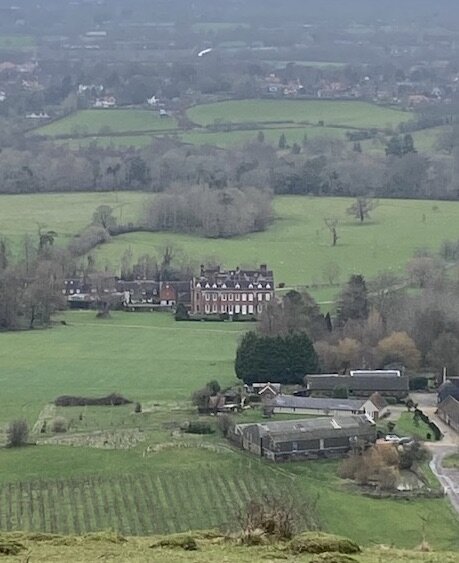
The view from the hill : Danny House in the foreground

The view from the hill : Danny House in the foreground

The views down to the coast or across to the Jack and Jill windmills were obscured by the mist. Still, what I could see - Hassocks, Burgess Hill, Hurstpierpoint - was well worth the climb. This being December, the pathways through the various woods were clogged with mud. I suppose, that’s what you expect in winter, out on the Downs. I think next time, I’ll don the wellies and sacrifice looking good for remaining dry. Spring and summer will bring their own delights.

My route down was milder, more winding, more reflective. The rain came down slightly and that, combined with my playlist and the bells of the sheep, made this more Christmas-y than I expected. I don’t need snow or twinkling lights. Just bleakness and the dark trunks of lifeless trees. Yes, I’m more Corelli than Carey.

Christmas is a time of memory - lost family Christmases, departed relatives, forgotten friends, little children now grown up. Memories of Margaret Thatcher... In the mist, in the rain, walking the chalk scarred hilltops of Sussex, you can think of these things.

I’ll be back.

The return from Wolstonbury Hill.

The return from Wolstonbury Hill.


Playlist

  • Sixpence None The Wiser - Kiss Me

  • Everything but the Girl - On My Mind

  • Van Morrison - Beside You

  • Eurythmics - Here Comes the Rain Again

  • Frank Sinatra - You’re Sensational

  • The Rolling Stones - Time Waits for No-One

  • Abba - The Winner Takes it All

December 27, 2020 /Tim Robson
Wolstonbury Hill Walk, Danny House
Sussex, Walks
Comment
The Bank of England prepares a hi-tech financial instrument to support the UK economy.

The Bank of England prepares a hi-tech financial instrument to support the UK economy.

Shake The Magic Money Tree!

December 27, 2020 by Tim Robson in Economics

There comes a time, sometimes later, sometimes sooner, when you realise that much of what underpins the modern world exists because we choose to believe it exists. Primarily, but not solely, I’m thinking about money here. (1)

You see, money may be experiencing an existentialist crisis.

This year, the Bank of England has created, almost unremarked upon, £450B of new money. This is in addition to the £445B already created in the last ten or so years. Printing money has become increasingly the go-to policy for government / BoE financing. (2)

But what the hell is the Bank of England - and other central banks - doing printing money? We all thought - until recently anyway - that printing money was the preserve of failed states where a richly embroidered President for Life might fire up the state money machine to pay for his next golden toilet whilst his people ate shit from garbage heaps?

In other words, what is the difference between the infamous hyper inflation of the Weimar Republic or Zimbabwe, and a modern, oh so sophisticated, economy like the UK?

One hundred years and a new terminology frankly.

We don’t print money anymore, we ‘quantitively ease’ (QE). Lofty economists hide money creation behind high sounding phrases designed to obfuscate. They distain the commonly held view that printing money is generally a bad thing. “Don’t you know,” they will pontificate - probably with half moon spectacles sliding down their nose in the manner of clever people everywhere - “Commercial banks create money all the time? What do you think fractional reserve banking is?”

Good point. We all know, via the credit crunch of 2008, that banks - sometimes recklessly - take a pound and lend out ten. Hence fractional reserve banking. The argument for QE is that, in bad times, banks lend less and so the creation of money is tightened. Hence the need for quantitive easing, i.e. creating money to persuade banks and others to lend money to get the economy moving. At some theoretical date in the future - never defined or realised - central banks will unwind their position and pass back their holdings from their balance sheet. This is to avoid the perils of hyper inflation.

And what are those centrally held holdings on the BoE’s balance sheet? What do they buy with all this new money? Well - since you ask - mainly government debt.

Oh.

So, this is quantitive easing; a government wants to inject money into the economy, they issue debt, the banks and insurance companies buy the debt, the central bank buys it back, the markets make a small ‘turn’ on this as the price is rising due to demand, meaning the yield falls on those bonds so servicing the debt is now cheaper for the government. Happy days! Doubles all round. Some corporate bonds are bought, but, not so much. Mainly government gilts. (3)

Well, that’s ‘vintage’ quantitive easing.. We’ve progressed since the good old days of the credit crunch. Now, in 2020, the central banks and government can’t be arsed in issuing and re-purchasing gilts and so just think - ‘fuck it’ - and go route 1 and cut out the middle man. So the BoE directly buys government debt with their newly created money.

Think about that for a moment; the government spends like a pissed up sailor on leave with a stolen credit card and, fearing the usual methods of raising income - boring stuff like raising taxes, borrowing or, here’s a novel one - growth - just prints the money it needs.

It’s a bold strategy, an ‘unconventional monetary approach’ in the jargon. These are unprecedented times, okay? But, erm, tap tap on the shoulder, is this right? Legal? Even moral?

Personally, I don’t like short cuts. We all know state fiat currency is make believe - it exists because we choose to believe it exists. But you like to comfort yourself that behind the mist there are real things dimly in view - productivity, innovation, balance of payments, demand. You know, the stuff of the actual economy. It’s why we get up in the morning and work.

But what’s the point if you can just fire up the printing presses and create money? It’s easier than actually earning the money. And who doesn’t like free stuff? This is a shortcut that undermines the real economy. As we all trade in the same currency (money) the actions of the government must surely degrade the productive part of the economy.

The classical economic view is that if you increase the supply of something, the price will drop. For money, we call this inflation. Inflation is a tax that we all pay. Print loads of money and you get hyper inflation and we all have to get out the wheelbarrows to buy a loaf of bread. The economy falls apart causing real and sustained damage.

So I’ll end with two scenarios and a comment:-

1) We have entered a new norm. Inflation has been conquered. The masters of the universe have defied the economic gravity and are floating above what used to be held as a truism; that printing money is bad and will cause hyper inflation and crash the economy. We are truly living an age of giant economists who shame those pygmies Keynes, Friedman and Hayek.

2) We are living on borrowed time. The poison is acting slowly but will eventually start to work. It’s only a matter of time before the inflation kicks in and then we’re all screwed.

2020, we all appear to be living through scenario one. But I fear scenario two is our ultimate destination. QE, printing money, is a fool’s shortcut. Intrinsically, we all know this. Why don’t our political and financial masters know it too?


NOTES

1) Big Tech, Elections, Fractional Reserve Banking, MSM News

2) UK Government / Bank of England. I use the terms interchangeably. They are, in effect, one and the same thing.

3) Governments - and oppositions - have been talking up the advantages of cheap interest rates on state debt for a good ten years. The argument seems to go, it would be irresponsible not to borrow when money is so cheap. These typically tend to be same people who say, governments can run large debts because a country is not like a household. Said with a sneer. We shall see.


December 27, 2020 /Tim Robson
QE, Printing Money, Quantitive Easing, COVID debt
Economics
Comment
Mick and Keef. The other Mick

Mick and Keef. The other Mick

Mick Taylor and that Guitar Solo

December 26, 2020 by Tim Robson in Music, Mick Taylor

They say the Devil has all the good tunes (except when he goes down to Georgia, of course!). But perhaps just sympathising with Old Nick also conjures up a decent tune too.

I remember the first Stones album I bought myself. I was 15. Coming off the back of a couple of Greatest Hits compilations, I went and bought the live album Get Yer Ya Ya's Out. Live albums can often be a mistake as they tend to offer thin, over-emoting, out-of-tune and unnecessarily long versions of well-loved – and crafted - studio songs.

But not so Get Yer Ya Ya's Out...

It's a tour album commemorating the infamous 1969 US Tour - yes the one that ended with the screw up that was Altamont. I come back to this album frequently. I can safely say; I learnt to play guitar strumming along with this album. Recorded at Madison Square Garden, it captures the Stones as they transitioned away from Brian Jones and into the demi-god led outfit that included Mick Taylor. Finally, the Stones had some serious lead guitar muscle to complement the Human Riff, Keef. They would get better in the next couple of years, but this is the only official live album of the Stones Mark 2 line up.

My fav track was Track 1 / Side 2: Sympathy for the Devil. (“Paint It Black you devils! Do Paint It Black!”) E-D-A verses dropping to B for the chorus. Brilliant to play along with and attempt the extended guitar solo at the end of the track. Yes, I learnt my pitiful lead axeman skills from this track. Well at least for the first minutes of the solo anyway! Because suddenly the solo gets hard - real hard. What is a rhythm guitarist's best ever solo morphs into a shit-hot guitar hero work-out. You can hear the change about 4:30 into the track. It’s almost as though Keef took a snort half way through and felt emboldened to shout "Oi! Hendrix, Clapton - come and have a go if you think you’re hard enough!"

But YouTube and the internet have revealed the mystery behind the split personality on Sympathy for the Devil’s guitar solo. For of course – Keef plays the first half and then hands over to Mick Taylor. In less than two minutes, Mick Taylor pisses on Richards and - in the cock-measuring contest that was the Stones – for the next five years, never again would Keith attempt to challenge Taylor. There has only ever been one lead guitarist in the Stones and his name was Mick Taylor.

I’ll write in due course more about this golden era of the Stones. When they really deserved the moniker ‘The Greatest Rock n Roll Band in the World’. But for now, listen to this audio and you’ll see what I mean. Keef starts soloing at 3:18. Mick Taylor takes over the baton at 4:30 and from 5:20 streaks down the back straight to take both the tape and the Gold Medal.

As I said, the Stones would get better after 1969. Taylor would get more confident – aware that his fluid, melodic soloing would propel songs like Midnight Rambler, Gimme Shelter, Street Fighting Man to ever higher levels. But Get Your Ya Ya’s Out is where it began and, on Sympathy for the Devil, you can hear him shyly but definitely, take over the band’s sound.

Enjoy.

To read other Mick Taylor related articles, click here...

or

Mick Taylor’s greatest Stone song? Try this!

Tim's Blog RSS


December 26, 2020 /Tim Robson
The Rolling Stones, Mick Taylor, Get Yer Ya Ya's Out, Sympathy for the Devil
Music, Mick Taylor
6 Comments

Robsonramblings.com

December 26, 2020 by Tim Robson

New Name!

December 26, 2020 /Tim Robson
68219ED4-5933-4061-B038-61C5D0AFE6E9_1_201_a.jpeg

A Walk Up Wolstonbury Hill in Winter

December 23, 2020 by Tim Robson in Sussex, Walks

A bracing December walk on the Downs, up an ancient hill, trudging above the rainclouds, looking down on the misty haze of the Sussex weald, listening to my Desert Island playlist, remembering the times I met Margaret Thatcher.

What’s that last thing, Tim?

Margaret Thatcher? Random thoughts you get as you hike on your own. I looked into those cold blue eyes once - doltishly described by Mitterand as akin to Caligula’s. Piercing, soul searching, intimidating perhaps; you could see she took no shit from anyone. If only she - a trained scientist - were in charge now instead of the blundering third raters we have today.

Such thoughts I have, ascending, and descending Wolstonbury Hill, Clayton, West Sussex.

Getting out, hiking, exploring, invigorates the mind, stimulates the memory and shakes the box of possibilities. If there has been one good thing to take from this awful 2020, it’s that I’m deliberately walking more around my beautiful county. I say deliberately; before this en-cagement, I used to do 10,000 - 12,000 steps a day naturally, just getting to and from work. (You think my lithe and toned frame occurs naturally?). Once the lockdown began in March, I realised that if I didn’t consciously go on walks, I’d quickly morph into a supersized Tim.

So, I began walking, firstly around Burgess Hill. I think I know the streets and pathways and countryside around my town pretty well now nine months on. How have I lived here so long and not known anything about where I lived? Embarrassing really. But, seek and you shall find, and I have been seeking a lot recently. I’ll share some of these discoveries here over the coming days.

Wolstonbury Hill is part of the defensive screen of rises that separates the Sussex weald from the coast. It lies above the parish of Clayton, famous for the Jack and Jill windmills but also the castle folly bestriding the railway tunnel that takes the London trains under the hills to Brighton beyond.

The Clayton Tunnel takes the London to Brighton trains under this remarkable 19th Century castle folly.

The Clayton Tunnel takes the London to Brighton trains under this remarkable 19th Century castle folly.

I followed the National Trust map for my walk. The instructions were clear until I hit the environs of Danny Hall - a large country house used by Churchill and his war cabinet. Instead of walking around the hill and climbing obliquely, I went too early and ended up clambering up the steep slope directly. I puffed and panted up the hill aware that an attractive, and much younger lady, was coming up fast behind me.

So I increased my pace and hit the top red faced and wheezing, all ready to smile benignly at my pursuer. I mean, how does anyone meet anyone these days? Perhaps a real-life ‘hello’ is better than being ghosted on a dating app? Probably, maybe, dunno; the lady - quite rightly - ghosted me in real-life and whizzed past and onwards into the flock of bell wearing sheep. Yes, like Switzerland.

It’s a racy blog I write.

The view from the hill : Danny House in the foreground

The view from the hill : Danny House in the foreground

The views down to the coast or across to the Jack and Jill windmills were obscured by the mist. Still, what I could see - Hassocks, Burgess Hill, Hurstpierpoint - was well worth the climb. This being December, the pathways through the various woods were clogged with mud. I suppose, that’s what you expect in winter, out on the Downs. I think next time, I’ll don the wellies and sacrifice looking good for remaining dry. Spring and summer will bring their own delights.

My route down was milder, more winding, more reflective. The rain came down slightly and that, combined with my playlist and the bells of the sheep, made this more Christmas-y than I expected. I don’t need snow or twinkling lights. Just bleakness and the dark trunks of lifeless trees. Yes, I’m more Corelli than Carey.

Christmas is a time of memory - lost family Christmases, departed relatives, forgotten friends, little children now grown up. Memories of Margaret Thatcher... In the mist, in the rain, walking the chalk scarred hilltops of Sussex, you can think of these things.

I’ll be back.

The return from Wolstonbury Hill.

The return from Wolstonbury Hill.


Playlist

  • Sixpence None The Wiser - Kiss Me

  • Everything but the Girl - On My Mind

  • Van Morrison - Beside You

  • Eurythmics - Here Comes the Rain Again

  • Frank Sinatra - You’re Sensational

  • The Rolling Stones - Time Waits for No-One

  • Abba - The Winner Takes it All

December 23, 2020 /Tim Robson
Wolstonbury Hill Walk, Danny House
Sussex, Walks
Comment
Screenshot 2020-10-31 at 08.33.24.png

How Negative Interest Rates Are the New Flares

October 31, 2020 by Tim Robson in Economics

Economists are herd creatures. Admittedly there may be more than one herd but they like to get with their fellow economists and chew the cud.

Like all social sciences, it has fads, fashions and theories that, like flares, come and go. So, why do I say negative interest rates are the new flares?

Well, for a start, it’s an exciting phrase, one that allows you to visualise some long haired loser from the 70’s nodding along earnestly as some prog rock group embark on a twenty minute keyboard and drum solo on the theme of The Hobbit. But extend that zoom focus; all the kids are wearing flares. Yes, these flappy trousered kids are the economists.

And negative interest rates are Emerson, Lake and Palmer?

Er, no. Yes. Perhaps. I know. I took the analogy too far. It happens.

Anyway, the thing is, what I really mean, yours are the sweetest eyes I’ve ever seen. No, what I mean is, economists follow fashions like 70’s kids bopping to progressive rock. And today, the fashion has turned to negative interest rates.

In my Linkedin article I write (though not as I do now, yes I’m versatile) about the growing cult of negative interests rates. How banks, companies and people might be charged for storing balances within the financial system. To be fair, this idea has been around for a while. Following the central bank responses to the last recession - aka The Credit Crunch - interest rates were left on the floor. Real screw the savers territory.

So what to do? The central banks, by bringing rates to zero, had effectively got rid of one of the two arrows they have in their economic quiver (the other being printing money. They like that one too - it’s so virile. Of course, the viagra soon wears off and leaves just a headache. I’m told).

But, some bright spark might have said, what if zero wasn’t the end? What if we, like, took rates to negative? “So we’d charge people for giving us money?” his boss might have asked afraid of not getting down with the kids. “Yeah, exactly! We’ll make money a hot potato. Pass it on on quick!”

And so, the theory of negative interest rates was born.

For me though, big theories of economics - from the General Theory, counter cyclical demand management, The Austrian School, Monetarism, The invisible hand, the incomes augmented Philips curve, return to the Gold Standard, baggism, shaggism, thisism, thatism - they’re all a bit ‘theoretical’. Grand theories are a parlour game played without reference to life outside the cosy prism.

But it reduce it to the micro level. You and me.

Economics is about incentives. If you charge people to store their money you will dis-incentivise them from doing so. Some people will put money under the mattress. Others though will buy holidays and spend their savings and so be vulnerable should they get old, or sick or lose their job.

Money is amoral. It is a means of exchange. No more. No less. However, I'm not sure debt and consumption are wise replacements for prudence and deferred gratification. Negative interest rates seem to tip monetary policy from amorality into immorality. And that can’t be right.

Now. Where’s my flares?


October 31, 2020 /Tim Robson
Negative Interest Rates, Gentle Giant
Economics
Comment
Vercingetorix surrenders to Caesar after the siege of Alesia

Vercingetorix surrenders to Caesar after the siege of Alesia

The First Century BC in Five Battles

October 27, 2020 by Tim Robson in Ancient Rome, Rome in 5 Battles

The first century BC is without doubt the most well-known period from ancient Rome. Films, TV series and books all tend to focus in on this era*. And usually the timeframe of interest is just the thirty year period between 60-30BC.

The last stages of the fall of the Roman Republic - and its transformation to imperial rule - are well known; Caesar, Pompey, Crassus, Cicero, Cato, Cleopatra, Mark Antony, Octavian / Augustus, Brutus, Agrippa, Cassius… Some pretty big names - well known even now. Rightly so. There’s much to discuss. However, the century is more detailed, nuanced and action packed than just those central years. Lots more happened in the century before Jesus than Caesar crossing The Rubicon. Telling the story in just five battles is going to be difficult!

I’m dividing 100BC - 1BC into three eras. Most of the battles will, of course, come from that climatic middle thirty-year period. Can’t help that.

1) Marius and Sulla, The Social and Mithridatic Wars 100-60BC.

A confrontation between more than just two men, Marius and Sulla, this internecine struggle for the soul and power of the Republic led ultimately to the first Roman invasion of, well, er, Rome. The Battle of the Colline Gate 82BC comes from this period as Sulla marched on the capital and fought a huge battle outside the walls of the city.

Also from this period, Rome fights, defeats and then grants citizenship to its Italian allies in The Social War.

Rome defeats a slave revolt at home (you may have heard of this. Tony Curtis and Kirk Douglas take on the might of the British Empire. Sorry Roman Empire) and Lucullus and Pompey fight King Mithridates over a twenty five year period and add huge swaths of the Levant to the Empire.

2) The Fall of the Republic 60-31BC. Caesar invades and conquers Gaul, returns and fights Pompey and the Senate, wins, establishes himself as dictator, is assassinated, the assassins are caught and killed by Octavian and Antony, who divide up the empire, fall out and square off. Octavian defeats Antony, becomes Emperor and changes his name to Augustus. Bye bye Republic. From this busy period we have The Battle of Carrhae 53BC - Crassus’ disastrous folly taking on the Parthans, Caesar’s triumph over the Gauls at Alesia in 52BC, Caesar defeating Pompey at Pharsalus 48 BC and the climatic battle of Actium 31BC which finishes off the civil wars.

3) The Augustian settlement - 31BC to the end of century. Augustus as primus unter pares. There were wars, there were battles. Large amounts of territory were formally added to the Empire (Egypt & Switzerland for example), but the modus operanti of empire reverted to the old Roman model - bit by bit, as circumstances dictated. Beginning of the German wars. I have selected no battles from this era. The gates of Janus - opened when Rome was at war, and they usually were, were closed three times during this period.


Civic life in the Republic had been getting progressively worse, and more violent, over the last third of the 2nd century BC. The causes of this degradation were many; paradoxically Rome’s victories abroad - culminating in the twin victories over Carthage and Corinth in 146 BC - sowed the mauvaises herbes back at home. These, and other triumphs over the past half century, brought home too much money and too many slaves. The new funds tended to go to aristocrats who bought up the farmsteads of their countrymen, creating large estates, using slave labour to work them. Rome’s small scale agrarian economy was already disrupted by the demands placed on its citizen army who had to put down their ploughs and serve in the military, sometimes faraway and often for years at a time. So foreign success had tilted the equilibrium in Roman society between the haves and the have nots.

Marius was a nouvo homme who had held the consulship an unprecedented six times whilst fighting off the menace of The Cimbri and the Teutones at the end of the second century BC. He reformed the army, making it a paid profession and not a citizen duty. This had important ramifications for the future of the republic and, perhaps, into the Imperial era. Admittedly, the reforms stabilised and professionalised the army - making it an even more fearsome force. But they also severed a link between the army and the state. From now on, armies fought more for their general and less for Rome, with devastating results to the stability of the state. Throw in class warfare, demagogues, constant wars and the republic’s days were numbered.

Sulla - one of Marius’ ex lieutenants, came to symbolise the reactionary optimates through opposition to land reform and resentment at the increasingly bold populist interventions from the people’s tribunes. This party disdained where Rome was going, the wealth, the lack of morals, the appeal to the masses. The clash has familiar strains with one side wanting to return to the purity and stability of earlier Republican days and the other looking to reform a faltering system.

The wars between these two visions of the republic took place against the backdrop of the First Mithridatic War. Sulla - the consul at the time - was appointed to lead Rome’s army in the near east and, whilst he was away, the forces of Marius took over Rome. This happened twice. The second time provoked a full scale civil war culminating outside the walls of Rome itself at The Battle of The Colline Gate 82 BC.

Though Marius was dead by this point, his son had picked up his causes and factions. Returning from the east, Sulla rushed to Rome where the Marian party - with Etruscan and Samnite allies were holed up. The battle lasted from mid afternoon onwards and into the night. It was a bloody and confused affair taking place in front, and within, Rome. It is said that 50,000 men died that night as gradually Sulla’s forces forced their way into Rome.

The ramifications - proscriptions, the massacre of 8000 Samnite prisoners, dictatorship - were fearful. Sulla was a contradiction as a man. He took dictatorial powers only to resign them - Cincinnatus style - months later before standing himself for election. During that time he reformed the constitution, giving more power to the Senate, less to the Tribunes of the people but also making it harder for people like him to seize control. It didn’t last.

“No friend ever served me, and no enemy ever wronged me, whom I have not repaid in full.” Sulla.

Externally, Rome fought a long running war with Mithridates VI, King of Pontus (in modern day Turkey). The wars - there were three - lasted from 88 BC to 63 BC and took place against a backdrop of increasing violence back in Rome which worked to Mithradates advantage. The conflict started with the massacre of all Romans in the East by Mithradates and ended with his suicide - alone and defeated - as Pompey created a huge Eastern Empire (modern Turkey, Syria and the Levant). This new general-led conquest model spread. When Pompey formed the First Triumvirate with Crassus and Caesar in 59 BC, the other two were eager to replicate his successes. They had - shall we say - variable results.

Crassus first. There are three or four really large and consequential Roman defeats across the thousand or so years of the Empire. Along with Hannibal’s Cannae slaughter and, say, the wipe out of three legions at the Teutoburg Forest or Valens’ defeat at the hands of the Goths at Adrianople 378 AD, Crassus’ defeat at Carrhae 53BC was one of the largest Roman defeats ever. A poor general let his troops down.

Over on the Eastern border of the Empire, the Parthian Empire abutted the expanding Romans. Crassus was eager to take advantage of a proxy dispute with the Parthians over succession within the buffer state of Armenia. He set off to Mesopotamian with seven legions and associated auxiliaries. Many marched out. Hardly any came back. The few survivors of the battle were nearly all captured never to return.**

The legions died hard under a hail of arrows at Carrhae.

The legions died hard under a hail of arrows at Carrhae.

It was arrogance and stupidity that caused the Roman army under Crassus to die in such numbers. Foolishly taking a short cut across the desert, where they were vulnerable and with little cavalry support, the legions were attacked by wave after wave of horse archers and heavily armoured cataphracts. They were literally picked off. Crassus himself was killed whilst trying to parlay with the Persians. It was a total disaster and one brought about needlessly by a poor general seeking personal glory. This was not the Roman way.

However, someone else who could also be accused of putting personal aggrandisement ahead of the state’s interests, was one Gaius Julius Caesar. However, unlike Crassus, Caesar was a ruthlessly good general, able to both inspire his troops and be inspirational in battle. After his consulship in 59BC, Caesar’s reward was the Roman province of Cisalpine Gaul. Most governors were happy to grow fat on the taxes of their province but not Caesar! From this springboard he spent the next eight years conquering the whole of Gaul - a massive area consisting of modern day France, Belgium and parts of Germany. He even ventured to Britain a couple of times.

The Gauls had long been a mythical foe to the Romans; they sacked Rome in 390 BC and as recent as 100BC threatened to overwhelm the Italian peninsular before being turned back by Marius. So Caesar’s victories and conquests were astounding to the Roman people. He won victory after victory throughout Gaul, rushing here and there to urge on his spread out forces suffering only the occasional reverse. The Gauls didn’t unite until it was almost too late. Finally they rallied behind Vercingetorix who massed forces and destroyed crops to starve Caesar’s troops.

Caesar pinned down Vercingetorix and 80,000 of his troops in the hilltop fortress of Alesia 52BC. He had around eleven legions under his command plus various allies. Probably around 65,000 men. He built a wall all around the hilltop fortress but, when the relief force of 250,000 Gauls turned up, he then built a second wall facing the other way. He was now besieged himself and fighting on both fronts.***

But the Romans held against frequent double sided attacks. Caesar was everywhere rallying his troops and making sure the defences held. They did. The besieging army was driven off with huge casualties and the starving Gauls in the hilltop fortress had no option but to surrender to Caesar (see main picture). Vercingetorix was sent to Rome and held in prison for five years before taking part in one of Caesar’s triumphal parades. He was then ritually throttled to death.

Gaul was conquered. Alesia was Caesar’s greatest victory.

“Then after a short interval they renewed their charge, threw their javelins and, as ordered by Caesar, quickly drew their swords. Nor indeed did the Pompeians fail to meet the occasion; they stood up to the hail of missiles and bore the onset of the legions; they kept their ranks, threw their javelins, and then resorted to their swords.”
— Caesar - The Civil War describing The Battle of Pharsalus

His term as proconsul in Gaul up, Caesar famously crossed the Rubican River into Italy, muttered something in Greek about dice, and headed off to Rome with his army. His speed and audacity caught his rivals in the Senate and Pompey by surprise. They didn’t have an army to hand and so bolted from the city and crossed the Adriatic in order to gather troops from the East. Civil war had again begun.

Caesar firstly destroyed the Senate’s forces in Spain and then, the following year followed Pompey over the Adriatic. There was an inconclusive battle at Dyrrhachium before the decisive showdown at Pharsalus in Greece. Caesar was outnumbered, his troops were starving and he’d been tactically boxed in. The smart move for the Senate forces would have been to starve him out. But they weren’t smart.

Caesar’s troops were battle hardened veterans from the long Gallic Wars whereas many of Pompey’s were raw recruits. As described by Caesar in the quote above, although outnumbered, his troops charged Pompey’s lines taking the initiative against the larger force. Pompey’s overwhelming calvary charged Caesar’s cavalry as expected but were in turn cut down by a fourth line of infantry Caesar had concealed. From there, Caesar’s forces routed Pompey’s legions and chased them and their general back to their camp. As the camp was in danger, Pompey threw off his general’s cloak and escaped through the rear gate. He crossed to Egypt where he was traitorously beheaded by Ptolemy XIII, Cleopatra’s brother.

Following his victory at Pharsalus, Caesar spent the next couple of years tracking down the remains of the Senate party before returning to Rome as dictator for life. Which is when he was assassinated in 44BC. The next couple of years were a wearying round of civil wars and proscriptions as Antony and Octavian tracked down and defeated the assassins - Brutus and Cassius. With Lepidus, they formed the second triumvirate in 43 BC and carved up the Roman world between the three of them.

The following ten years were relatively peaceful militarily but gradually the two head triumvirs - Octavian and Antony - perhaps inevitably - fell out. They prepared huge armies for war in a winner-takes-all campaign in Greece.

Technically, Actium wasn’t the last battle of the Roman Republic. That honour goes to the Battle of Alexandria the year after in 30 BC where Octavian chased down Antony and Cleopatra. But this decisive victory off the coast of Greece made the ending inevitable and anti-climatic.

Antony was the better general. He’d proved this many times under Gabinius in the East and then Caesar in Gaul and, following the latter’s death, in the wars against the assassins. One shouldn’t get too hung up on his latter day portrayal as a lovestruck drunk who fell for Cleopatra and let her rule him. But certainly the quality of his generalship declined in the years 40-30BC. He received the East in the carve up between himself, Lepidus and Octavian following the Battle of Philippi and, as overlord, attempted without success to avenge the loss of Carrhae against the Persians.

Actium was a sea battle but it was a sea battle only because Octavian’s general, Agrippa, was using his fleet to blockade Antony’s land forces on Western coast of Greece. The Battle of Actium was Antony’s attempt to break this blockade. The forces were evenly matched - Agrippa had more ships, Antony had heavier ships. The battle went back and forth until, inexplicably, the squadron under Cleopatra made a break for it and headed off back to Egypt. Antony, transferring to a lighter and faster ship, followed, leaving his remaining forces to fend for themselves.

Agrippa’s fleet then destroyed Antony’s fleet and Antony’s army of nineteen legions (yes, 19!), left stranded without provisions in Greece, surrendered. Octavian, dealing with some troop mutinies and pirates, only followed up on this success the following year. Landing in Egypt, he easily defeated Antony’s remnants of an army. We know what happened next; Antony committed suicide, and Cleopatra, sensing Octavian wanted her as prize exhibit in a subsequent triumph through Rome, did likewise. The civil wars were over.

Octavian, became Augustus (majestic) and gradually consolidated his powers over the Roman people with the willing help of the Senate - purged, cowed and sick of war. The previous century of civil wars, proscriptions, and turmoil had taken the heart out of the Republic. Although Augustus was careful to keep up the facade of the Republic’s institutions (consuls, senate, pontiffs etc) there was no doubt who was really in charge. Augustus faced no serious challenges to this ascendency or rule.

So the first century BC was a transitional period for Rome as it moved away from hundreds of years of Republican rule to five hundred more years (or fifteen hundred including the Byzantine Empire) of quasi monarchy. Despite the internal turmoil and wars, externally, Rome consolidated her power, grew her Empire and was, by the end, much more powerful than she was at the beginning.

“I found a Rome of bricks; I leave to you one of marble,” said Augustus on his deathbed. Architecturally, he may have been right, certainly many fine public buildings were built during his era. It could also - as has been pointed out - be taken metaphorically; he took chaos and brought order at the expense of liberty.


NOTES


* Or 180 AD and the hand over from Marcus Aurelius to his son Commodus - The Fall of the Roman Empire & more recently Gladiator.

** Cassius (of Caesar assassin fame) led the few forces not killed or captured back to Roman Syria. There are rumours that some of the survivors left in Mesopotamia were forced marched by the Persians to their Eastern border to man the defences against incursions. There are even stories of Roman prisoners making their way to China.

*** You should always be wary about numbers listed in ancient sources. Caesar, writing in his campaign book - The Civil Wars - probably overestimates. It was a common practice.


October 27, 2020 /Tim Robson
Parsalus, Julius Caesar, Actium, Colline Gate, Alesia, Carrhae
Ancient Rome, Rome in 5 Battles
Comment
Gold Roman coings: https://www.ancient.eu/image/5954/corbridge-hoard--jug/

Gold Roman coings: https://www.ancient.eu/image/5954/corbridge-hoard--jug/

The crash of 33AD

September 20, 2020 by Tim Robson in Ancient Rome, Roman Empire

In these days of no history, where everything is apparently unprecedented and has never happened before throughout humanity’s countless years on this planet, where we have reached peak morality as a species and can pronounce on the past with a lofty distain, it’s worth plucking out some embers from the smouldering fires of our collective history. Who knows? Might be instructive!

Over-leveraged financial houses, external shocks, a run on banks, shortage of credit; the financial crisis of 33AD - which shook the Roman world - had them all. Throw in a first century version of quantitive easing and the picture is complete.

The Emperor Tiberius (14-37 AD) is popularly remembered as a miserly old pervert whose one redeeming feature was that, whilst far worse than his predecessor Augustus, he was inestimably better than his successor, Caligula.

Tiberius, wearying of the stresses of Rome’s day-to-day administration, went off to live in Capri leaving his Praetorian enforcer Sejanus in charge back in the capital. Ambitious and unscrupulous, Sejanus arrogated so much power during his master’s absence that Tiberius had him and his allies executed. Once executed, these rich persons’ estates reverted to the Imperial Treasury. This had the concomitant affect of withdrawing large sums of money from the economy. Money was already circulating at a low level in the economy as, fiscally, Tiberius tended towards hoarding and not spending. For example, he cut back on Augustus’ lavish public building policy and avoided, if possible, costly military campaigns. He withdrew from Germania even after the revenge-spanking of Arminius at the battles of Idistaviso and Angrivarian Wall.1

But these savings came at a price. The Roman economy was pretty much a cash economy “thus, when the state ran a budget surplus (as it did under Tiberius) it caused a direct contraction of the money supply.” 2

But now we come to the proximate causes of the credit crunch…

An Egyptian banking house - Seuthe and Son- invested in some ships carrying cargoes of spices which - unfortunately for them - sank during a hurricane in the Red Sea. Think Lehman Brothers. The interconnectedness of the Roman finance world was proven back on Rome’s Via Sacra** - which was equivalent to the the ancient world’s Wall Street (with added temples and hookers). Financial houses in the capital now went bust as a result of lending to Seuthe and Son. One by one they closed up, calling in loans which caused more and more pressure on liquidity.

Timing is all in a financial crash. Two other factors - perhaps small in themselves - ratcheted up the pressure.

Firstly, this was just the moment when a longstanding edict of Tiberius’ came into force: all senators had to invest a third of their wealth in Italian land. They needed money to purchase property and so created a rush on the stricken financial houses (3) and debtors who either couldn’t or wouldn’t pay up the required capital. Secondly, a rebellion amongst the Belgae in Northern Gaul, out on the fringes of the empire, had meant those investing in that high risk but high reward area had lost their money. In the modern world, think of Argentina reneging on her debts and dragging down those eager-for-profit institutions who had lent them the money.

Demand for liquidity far exceeded supply. Rumours of instability exacerbated the fast growing crisis. Banks wouldn’t trust each other. Money was hoarded. The empire’s financial and trade worlds froze. A classic (and classical) credit crunch! Oh shit!

The relevant quaester (essentially finance minister) passed the problem onto the Senate who, long used to being ineffective, passed the problem onto Tiberius over in Capri. Taking time out from his paranoia and perversions however, Tiberius acted quickly. His response was emphatic; the liquidity crisis was to be met by a massive injection of imperial funds into the Roman financial world. Yes, quantitive easing in a toga! One hundred million sestertii from the imperial treasury was released into the banking system at zero percent rate of interest. Additionally, collateral for these loans was accepted at twice market rates which stabilised the property market and brought confidence back to the credit market.

Tiberius’ swift response - creating both liquidity and shoring up confidence in the finance markets - meant that the crisis worked itself through quickly. He was dead within four years and bequeathed his successor Caligula, a full Treasury. Caligula, did not have a problem spending money but that is another story!

The parallels with financial crashes that we may be familiar with are striking but the underlying factors - unpredictable events, state fiscal and monetary policy, financial contagion, and confidence in the system - are also well known to us. The crash of 33 AD however, is not.

I suppose that it is at this point that you would expect me to deliver a worthy homily about history repeating itself or that it rhymes or that it’s all been done before. I could but I won’t. That would be too easy and - in its way - overly trite.

What is more interesting is not the repetitive nature of history but that each age tends to believe it is unique. Each individual is of course unique and unless you believe in reincarnation, a belief in uniqueness is a forgivable fault. But still a fault when history is weighed in the aggregate. As I’ve tried to demonstrate with the crash of 33 AD, give or take a few togas and a lack of internet, the crisis wasn’t too different from our recent credit crunch of 2007/2009.

It’s not the forgetfulness that gets you, it’s the unknowing arrogance. From wars to diseases, from monetary crisis to the venality of politicians, ‘now’ is - perhaps inevitably - judged to be the only time in history these things have ever happened and so we blunder around marvelling at the wheel we’ve just reinvented. Sadly the past is not only a different country, but an increasingly forgotten place. I would argue - and do - that a little humility goes a long way and brings that rarest of all qualities - perspective.

Perspective adds depth and moderates over-reaction. From our own personal experience, we all know this to be true.

When we were young - and knew nothing and had experienced less - we carried the twin curses of ignorance and certainty. We didn’t know anything but - by God! - were we sure of our opinion. But we gradually matured as individuals, adding experience to assessment, judgement to decision. It’s part of life’s journey.

I wish we matured as a society in a similar way but, each generation is ever reborn as a teenager. Certain. Ignorant. Fated to be more wrong than right.

Next week I’ll carry this thought process into a ham-fisted look at Justinian’s reconquering of the Italian peninsula and how it was stymied by the plague. Masks are most definitely optional!

NOTES

1) Following the massacre of three legions in the Tueoburg Forest in 9 AD, the battles of Idistaviso and Angrivarian Wall by Tiberius’ nephew Germanicus, did much to restore Roman pride. Tiberius still pulled the troops back to the near side of the Rhine.

2) How Excess Government Killed Ancient Rome - Bruce Bartlett. The Cato Institute 1994

3) Ancient Rome did have a primitive banking system - though ‘banks’ and ‘banking’ is not a term they’d have recognised (though for convenience I may use these terms - the latin is argentarii). Depositors placed their money with reputable firms who, in turn, lent it out to those needing capital, principally to finance goods being shipped around the empire. The interest was set by the state (12% being the norm). These financial firms were clustered around the Forum along the Via Sacra which has been described as Rome’s Wall Street. It was also the site of many temples - temples being in ancient times often linked to banking (people deposited money there for safekeeping). To facilitate trade across the empire, banking centres were present in many other major cities across the Empire which foreshadows a modern sense of interconnectedness.

September 20, 2020 /Tim Robson
Crash of 33 AD, Tiberius, Seuthe and Son, Roman Banking
Ancient Rome, Roman Empire
Comment
“Fifteen minutes with you.
Well I wouldn’t say no.”

Mary Chain, Mascara, Morrissey and Me: SUSSEX UNI IN THE 80’s

September 06, 2020 by Tim Robson in Tim Robson, Brighton
Natalie. Or Brigitte? My next door neighbour but briefly - East Slope, Sussex University

Natalie. Or Brigitte? My next door neighbour but briefly - East Slope, Sussex University

Natalie lived next door to me. She was years older - at least four. That was an unbridgeable gap in those days. She appeared experienced and sophisticated in a way that I wasn’t then and probably am not now. Also she was French; dark haired, beautiful, effortlessly sexy. I’d only gone to university and found Brigitte Bardot living in the next room!

And then, mid-term, she moved out. Our juvenile antics must have irked her. Oh - the bottomless pain of separation! The exquisite misery of emptiness! Surrounded by hundreds of eighteen year olds I was alone, so alone.

I played Hatful of Hollow endlessly. Morrissey incongruously spoke to me. ‘Please, please, please let me get what I want’ he sang through my cheap speakers. There was silence from the empty room next door.

East Slope, Sussex University, autumn term 1986.


I was driving my daughter around ‘my’ Brighton before one of the recent interminable lockdowns. We were stopping off and photographing all my previous addresses throughout Brighton and Hove. Some I stayed at for a matter of weeks, others for several years. Many looked decrepit, a handful were grand, very grand. I had situational memories of all of them. Job. Girlfriend. How cold they were (it was alway cold in Brighton flats).

On the way back to Burgess Hill we stopped off at Sussex University. I’d lived in three campus apartments over two years - East Slope, Kent House and Park Village. Let’s see if I could retrace once familiar steps and show my daughter, well what? Where Natalie left me bereft all those years ago? Mmm, maybe not. But to get a sense of where I lived certainly.

But like most universities since the 80’s, Sussex has got bigger - ‘welcoming’ more and more students in order to meet Tony Blair’s ridiculous 50% target. Add to this to the maniacal drive to recruit loads of fee paying foreign students and you have a university with near four times the number of ‘clients’ it had when I went there.*

So although we drove past many familiar buildings, there was a new feeling about the campus. It seemed very closed in whereas I remembered it as much more spacious when I was there. Tricks of time, perhaps. Sussex was a relatively small university in the 80’s and the student body was split fairly evenly between public school tossers and the brightest and best of the comprehensive system. 4500 students in all - one third living on campus. It felt like a village. A village out in the Downs, ten minutes train ride from Brighton. It sported Sussex red brick and the architect - Basil Spence - had designed the layout so that it nodded vaguely in the direction of a classical Roman forum. (I know this stuff because I used to do campus tours for prospective parents and students in my third year. £3 a pop, I remember.)

Shades at night! TR in his Kent House student room 1988 - alas the call from the Jesus & Mary Chain never came.

Shades at night! TR in his Kent House student room 1988 - alas the call from the Jesus & Mary Chain never came.

There were the bars of course. East Slope bar was notorious because of the cheap drinks, the scrum to get those cheap drinks and the sticky floor caused by said drinks being too difficult for students to navigate the plastic glass of Kronenberg from glass to mouth without spilling. (Pints were 60-70p). Park Village Bar merits a mention as it was the home of the Julie’s Jinx, a pint of every spirit behind the bar starting from a base of half a cider. These cocktails never lasted long in your stomach.

Sussex has changed since the 80’s. New high rise accommodation blocks bestride and dominate the northern end of campus. All those extra fee paying students have to live somewhere I suppose. Inside, these alien structures are probably very nice replete with all the mod cons our current flock of students demand. But the village feeling, the uniqueness of the first red brick university, has gone. And so has East Slope, so named because all the student accommodation was in single story flats rising gently up a hill. All gone. And yes, that campus flat where I met - and then mourned - the beautiful Natalie, now gone completely. A metaphor there, probably.

To be fair the remaining buildings from then to now, looked tired. Park Village specifically seemed on its last legs with rotting woodwork, overgrown green spaces, windswept rubbish piled up in corners. Not how I remembered it at all. But then what I truly remember is the spirit, the ephemeral feeling and not just the concrete. I remember the summer of ‘87, and every window being open and blasting out the newly released Joshua Tree. I remember late night parties and lying on the grass in the warm June air, talking bollocks about politics and music and gossiping over plastic glasses of cheap red wine. I remember reading Wuthering Heights for the first time out on the fields next to Park Village; fields now covered with blocks of flats and car parks.

It’s the people and the time; the young people interacting, doing stuff, each other, laughing and joking that defines a place, an era. I guess I always knew that.

Park Village party, June 1988. TR lying down in white (with hair!)

Park Village party, June 1988. TR lying down in white (with hair!)

So even before further buildings are torn down, as East Slope has been, the transient spirit my cohort possessed has gone. Each successive intake make their own memories, their own version of what a university community means. But that time is heartbreakingly brief and we’re left - if we ever venture to go back - with the mere bones slowly rotting away. The flesh has long gone. The spirit died the very moment we walked out that last day Summer Term ‘88. And maybe that’s as it should be. Life is ever onwards and never static.

And Natalie? Fuck knows. She shacked up with some professor, moved into a flat behind the station in Brighton and - for all I know - got married, had kids and never thinks about me. But if she does I hope she plays The Smiths occasionally and suffers a momentary flashback to her time at Sussex University as the unwitting star of a movie she’s never seen.

Tim Robson 17B East Slope 1986.

Tim Robson 17B East Slope 1986.

(I like live versions of songs. This solo version from Morrissey - years later, different lyrics - captures though the wistfulness of time passed. Hence me selecting it. You’re welcome.)

  • Fifteen Minutes with You… From Reel Around The Fountain, The Smiths

  • Foreign student income. Perhaps that why the British universities whined like bitches when the uneducated population voted for Brexit? Call me old fashioned (puts down pint) but shouldn’t the primary function of UK universities be to educate the children of this land first?

September 06, 2020 /Tim Robson
Sussex University, Sussex in the 80's, East Slope, Park Village Sussex
Tim Robson, Brighton
Comment
congress.jpg

Is the US the new Rome?

August 31, 2020 by Tim Robson

Amongst classical scholars there’s long been an interesting thought experiment; is the US the re-incarnation of Rome?

Let’s go through the checklist:-

The era of kings // British imperial rule.

Throwing out the kings and the early republic // the American revolution and the foundation of the Republic (the Senate - now where did that come from?)

The unification of the Italian peninsula under Roman rule // the spread westwards of the US republic through the Louisiana Purchase, Mexican War and the pioneer trails beyond the Appalachians

Battle between the senatorial class and the plebeians - creation of the People’s Assembly and tribunes // the extension of the franchise to women and the abolition of slavery

An existential war against Carthage // fight against Communism

The fall of the republic - increasing political violence, The Gracchi, increasing disparity of wealth, vicious two party system, Marius / Sulla, the crossing of the Rubicon // gridlock, decrease of working ‘across the aisle’ increasing political violence, intolerance for opposing views, non-acceptance of political norms.

The Imperial era brought into being stability and stopped the political violence. The price was dictatorship. Increase in welfare, reliance on slaves, beginnings of feudalism. Christianity. The empire split into two. Collapse. // …


I’ve been aware of the theory for years - it is an intellectual game; history is instructive not necessary predictive and making parallels from one era to another is typically odious. But still…

I’m currently writing about the 1st century BC as part of my five battles per century history of Rome series. This is the century where the Roman Republic became increasingly violent and all the norms of political discourse and traditional checks and balances were thrown aside. It led to ceaseless civil wars before Augustus ended the republic and became Emperor.

It took fifty years from the populism of Tiberius Gracchus to Sulla’s victory outside the walls of Rome in the Battle of the Colline Gate. Reputedly 50,000 died in just that one battle. It was another fifty years between Sulla’s victory and subsequent proscriptions and (short-lived) dictatorship to Augustus’ victory over Antony at Actium and the effective ending of the republic.

One hundred years of violence and death.

I tend to seek refuge in ancient history - it’s a comforting and a harmless pursuit. But as I researched and wrote the history of the first century BC, many awful parallels became more urgent.

Those that don’t know their history are doomed to repeat it, goes a familiar refrain. I would amend that to read, “Those that don’t know their history are doomed to make achingly bad allusions to the collapse of the Weimar Republic and the rise of fascism.” It’s society’s go to - everything’s Hitler, every opponent is his reincarnation. I suppose it’s not that long ago in the scheme of things and history’s a long and complex body of knowledge, never complete, often paradoxical. Collapses can be quick or they can be slow but there are some commonalities.

Civic norms are flimsier than they appear and, it seems to me, violence is never far away from the human condition. Once violence is introduced into a society’s bloodstream, then events afterwards become unpredictable, often dark, very dark. A good place to avoid this is to accept defeat gracefully, concede that your opponents are not necessary evil people, and that the mob, once unleashed, is hard to curtail and unpredictable. Those who let loose the dogs of war do so at their own peril.

As I said, the US being the new Rome is a parlour game, an intellectual exercise. The US is not an empire - though it does often project violence worldwide. It does still have, hopefully, a functioning democracy which will be severely tested this November. I just hope that the result is accepted and that Trump gets a less acrimonious second term or that there is a peaceful and good-natured transfer of power to the Democrats. The road to Actium does not have to be retraced.


August 31, 2020 /Tim Robson
The Romans face the Caledonians at Mons Graupius, Scotland AD 83. @Seán Ó'Brógáin

The Romans face the Caledonians at Mons Graupius, Scotland AD 83. @Seán Ó'Brógáin

The First Century in Five Battles

July 21, 2020 by Tim Robson in Ancient Rome, Roman Empire, Rome in 5 Battles

(In which Tim maps the Roman Empire in the first century AD through five battles)

“Varus, give me back my legions!”

So the ageing Emperor Augustus is said to have shouted, driven mad by the loss of three legions at The Battle of The Teutoberg Forest in AD 9. Quinctilus Varus was the Roman commander who led those legions into the dark German forests, never to return. This is the first battle of the first century. Rome’s devastating response following the campaigns of the aptly named Germanicus shall be my next focus as exemplified by The Battle of Idistaviso in AD 16.

The invasion of Britain under the Emperor Claudius in AD 43 merits a mention. As does the defeat of Boudicca at the Battle of Watling Street in AD 61 where Rome firmly put down her revolt. The Battle of Mons Graupius in AD 83 finally consolidated Britain (minus Caledonia) into the Empire.

The siege and destruction of Jerusalem in AD 70 is an obvious landmark battle. The Jewish revolt was a major uprising and occurred during one of the few periods of outside instability the Roman Empire faced in the first century. Its impact is probably still felt today.

Whilst Titus was dealing with the Jewish revolt, his father Vespasian had marched on Rome to throw his laurel wreath into the ring to become Emperor. The ‘Year of the Four Emperors’ in AD 69 was the first Roman civil war in 100 years. Previously Emperors had just been assassinated, poisoned or committed suicide. This violent transfer of power though was limited to the unfortunate Emperor and his immediate supporters and didn’t lead to a full-scale civil war as had been the norm in the late Republic. Although, Rome soon came back to normalcy - and indeed the Emperors improved - this respite would be only temporary and civil wars would come back in a big way towards the end of the second century.

A note on the army itself: The Roman army of the 1st Century AD looked exactly like the Roman Army in popular imagination. They wore curved helmets protecting the back of their necks, segmented armour, carried long curved rectangular shields, held short thrusting swords and threw devastating volleys of weighted spears. A legion consisted around 5120 men divided into 10 cohorts (the 1st being double sized). There were 28 legions in Augustus’ time, later increased to 30. Auxiliaries assisted the legions (archers, calvary, skirmishers etc) and their number was around the same. Therefore, a reasonable assessment of the size of the Roman Army of this period is 300,000 men under arms.


The first century began with Augustus in the 28th year of his principate. Unlike much of the previous century, The Roman world was pretty much at peace with itself. The civil wars were over. Augustus stealthily added nations that were protectorates - like Egypt - to the Empire avoiding outright conquering. However, his sons-in-law - Drusus and Tiberius - added Raetia (modern Switzerland). But this Caesar - unlike his famous uncle - was content to be imperator in name if not in deed.

However, one recurring trouble spot in the Empire was the Germanic tribes beyond Gaul. Could Augustus add Germania to the Empire and, if not, where was the defensive line of the empire to be drawn? It was going to be the river Elbe but - following the loss of the legions in the forests - Rome pulled back to the Rhine where it stayed for the next four hundred years.

The Battle of the Teutoburg Forest was the shock that caused this retrenchment. Three legions (plus assorted auxiliaries and camp followers) operating beyond the Rhine, were betrayed by a supposed friendly German ally, Arminius, and massacred. Arminius led Varus into the dense forest and then sprang his trap. The army was wiped out and their totemic eagles taken.

At this point in time, Rome had just 28 legions. The loss of three meant a sizeable chunk of the available forces had just disappeared. No wonder Augustus was upset. Revenge came slowly and - as was the wont at these times - through a member of the Imperial family.

Germanicus was nephew to the new Emperor Tiberius and was sent to the Rhine to sort out the mess left after Arminius’ triumph. Fighting many battles and chasing many tribes into many forests, Germanicus skirmished and harassed the Germans time after time over three years until he finally tempted them into an open pitched battle. This was at the Weser River and became the Battle of Idistaviso AD 16. The result was a massacre of the German tribes. Arminius survived only to be beaten again that same year at The Battle of the Angrivarian Wall. (He was later killed by members of his own tribe. He is still celebrated as one of the founders of the German nation. His massive 19th has century statue stands above the Teutoburg Forest to this day.)

Rome had won the conflict but Tiberius, ever cautious, withdrew Germanicus to Rome and the Empire’s frontier was settled back at the Rhine.

Julius Caesar had come across the Channel to Britain a couple of times but he never made a serious invasion attempt - he was too busy conquering Gaul. These incursions provoked a few fights, garnered some tributes and alliances, but Caesar didn’t stick around to conquer Britain. One hundred years later though, in AD 43, the unwarlike Emperor Claudius - another nephew of Tiberius - launched the invasion of Britain.

The conquest was a slow process taking over 40 years. The south of the country was relatively passive, having interacted with the Romans for years. However, the North and West and Wales proved much more difficult. Whilst the Romans were distracted subduing the Welsh tribes in AD 60, the Iceni under Boudicca rebelled back in the conquered south. The rebellion was short, violent with the rebels burning and massacring the Roman towns of St Albans, Colchester and a little town called Londinium.

The governor, Seutonius Paulinus, gathered up a force centred around one and a half legions and met Boudicca and her army somewhere along what became known later as Watling Street. He chose his battlefield well, funnelling the Britons into a narrow front. As had happened many times previously in Roman history, well-trained legions overcame a larger but undisciplined horde. The rebels were massacred - hemmed in by their own carriages - and Boudicca committed suicide not long after.

Twenty of so years later, the Romans had turned their attention to the north of Britain. Up in Scotland, the Caledonian tribes were causing problems. However, the usual rules applied; tracking a tribe into an open pitched battle was difficult and whilst traipsing around the wet and cold of Scotland, the Roman army was prey to ambushes and lightning strikes. Governor Agricola finally lured the Caledonians into battle somewhere in the mountains of Scotland (the precise site is unknown). The Battle of Mons Graupius AD 83 was unique in that the Romans won it using only their highly trained Germans auxiliaries with assistance from the cavalry.

Tacitus, who wrote the account of the battle, famously put words into mouth of the Caledonian leader, Calgacus, “They make a desolation and call it peace.” All Britain was conquered. For now.

The Siege and Destruction of Jerusalem, by David Roberts (1850)

The Siege and Destruction of Jerusalem, by David Roberts (1850)

Back a few years, and we have the brutal Siege of Jerusalem in AD 70 part of the First Jewish-Roman war. Pompey had added Judea to the empire back in the Republican days. He’d even successfully laid siege to Jerusalem. This time though, the struggle was more bitter as a hardcore sect of rebels within the city - the Zealots - refused to surrender. As Vespasian had left for Rome, his son Titus (later emperor too) led the four legion assault on the city. Starvation, disease and the terrors of war were meted out to the inhabitants of the city, bolstered as they were by hundreds of thousands of refugees escaping the wider war. The end was a massacre:-

“They poured into the street sword in hand, slaughtering indiscriminately all they came across and burning houses with those who had fled there still inside… Since the troops had run out of victims to kill or property to loot, Caesar ordered the army to raze to the ground the whole city and the temple…” Josephus, The Jewish War (Book 6:404 / Book 7:1)

Jerusalem and its population was destroyed. This was quite a consequential siege in history.


July 21, 2020 /Tim Robson
Idistaviso, Germanicus, The Siege of Jerusalem, Mons Graupius
Ancient Rome, Roman Empire, Rome in 5 Battles
Comment
11LITTLERICHARD-3-articleLarge.jpg

Little Richard

June 11, 2020 by Tim Robson in Obituary

(An appreciation of Little Richard)

Back in the 70’s, my parents owned five records.* Two Beatles albums - “before they got weird” - With The Beatles and Rubber Soul. The Carpenters greatest hits 1970-74, Abba’s Greatest Hits (72-76 - yeah, before the really good ones!) and K-Tel’s Rockin’ Rollin’ Greats. I played them all but mainly the latter record. It’s what convinced my parents to buy me firstly Jerry Lee Lewis’ Greatest Hits and then, The King himself, Elvis’ 40 Greatest Hits.

So, my first exposure to rock n’ roll was that K-Tel compilation. Twenty years after rock n roll burst on the scene. They were mostly all there : Bill Haley. Gene Vincent. Carl Perkins. The Everlys. Johnny Kidd and the Pirates and Tommy Roe (bizarrely). Oh and Roy Orbison and his sublime, snare drum and riff led, Oh Pretty Woman.

And of course, Little Richard.

K-Tel being the skinflints they were, the two Little Richard cuts (Long Tall Sally and Lucille) were live performances culled from a later 1967 live album. Ordinarily, that would be a problem. Not Richard. He was, as we all know, damn good live and both songs rocked out of the speakers.

This isn’t going to be a long obit. Richard Penniman’s career itself, as a top selling artist, wasn’t long. His career as an icon, an inspirer and live performer though lasted much longer than his initial two / three years of seminal hits.

You know when a little Richard song comes on. The brash piano intro, the brass, the riff, the instinctive three chords and some cleaned up bawdy lyrics. And that voice. A howl. A scream. A falsetto. There is no one like him. He just makes you smile, tap your feet and, if you want to get people going at a function, just slap on ‘Tutti Frutti’ and watch them park their drinks and head to the dance-floor. I know, I’ve done it. Yes, I used to DJ.

So if Elvis combined country hill billy with rhythm and blues, Richard was pure rhythm and blues tinged with gospel. He had the element of a charismatic preacher about him. As we know his personal journey took him to God - he was an ordained priest - and you see within him the struggles he faced. One of the best rock books I’ve ever read is his biography - in which he fully collaborated - which is candid about his sexuality, his drug use, his predilections, but also his warmth as a human being. It is well worth a read and damn funny.

He’s immortalised in the rock movie The Girl Can’t Help It singing the title track (plus Ready Teddy and She’s Got It). Immaculately coiffured, standing astride his long suffering piano, he steals the show from the other musical acts (though I do have a soft spot for Julie London’s Cry Me A River).

And man, did he look good! Hair piled up, snaking moustache and increasingly flamboyant outfits, you can see where former bandmate Jimi Hendrix (who he fired), Otis Redding, James Brown and later Prince, got their inspiration from. He toured with the Beatles and the Stones early in their career, passing on the torch and teaching Paul the nuances of the Little Richard style. As we know, the Fab Four always ended their concerts with their tribute to Richard, a raucous version of Long Tall Sally.

RIP Richard, one of the great ones.

(And yes, Little Richard was included in my permitted obits as listed four years ago.)


Footnote * - Of course they didn’t own just five records. But there was only five I was interested in (at that time). My Mum listened to classical. My Dad listened to swing. The radio played Terry Wogan on Radio 2. We watched Top of the Pops on Thursday nights.


June 11, 2020 /Tim Robson
Little Richard
Obituary
Comment
Battle of Strasbourg

Battle of Strasbourg

The 4th Century in Five Battles

June 06, 2020 by Tim Robson in Roman Empire, Rome in 5 Battles

(In which Tim discusses the five most important battles within the wider history of the 4th Century Roman Empire)

The fourth century was bookended by two famous ‘Christian’ battles - The Milvian Bridge in 312 and The Frigidus in 394. They mark - apocryphally - both the entry point of Christianity into the Roman Empire and its ultimate victory. Each led to climatic events; The Milvian Bridge led directly to the Nicene Council of 325 which formalised the Christian creed. The Frigidus began the series of events that ended with Alaric’s sack of Rome just sixteen years later.

So we have our beginning and end. What in between? Adrianople, of course. The defeat of Valens and the Eastern Roman Empire’s army at the hands of the Goths in 378 is popularly associated with the eventual downfall of the empire itself. Can’t argue that it’s important.

For me, Julian is the most interesting fourth century Emperor. His metamorphosis from bookish princeling to ass-kickin’ Caesar began in Gaul. The most famous battle in his journey to pacify the province was his victory over the Alamanni in the Battle of Strasbourg 357.

Our fifth battle is The Battle of Mursa 351 where the forces of Constantius II defeated those of the usurper Magnentius in the biggest and bloodiest battle of the century. As an exercise in damaging futility this was the daddy of them all.

*****

The Empire at the beginning of the fourth century was a very different animal to that ruled over by Septimius Severus one hundred years earlier. The crisis of the third century had brought about chaos, short lived emperors, and the temporary division into three mini empires. The gradual restoration of control was brought about by the Illyrian emperors Claudius Gothicus, Aurelian, Probus and finally Diocletian.

Diocletian instituted the tetrarchy - a system where two senior Augustii and two junior Caesars ruled quadrants of the Empire. It was a neat idea. It didn’t last. Diocletian, who resigned along with his co-Augustus Maximian, lived long enough to see not only his fine cabbages grow in his retirement home in Split, but his system of government fall apart as his successors squabbled amongst themselves to gain and maintain power.

Constantine (The Great), son of one of Diocletian’s successors Constantius I, was chief amongst those squabbling. He was annoyed that he was left out of Diocletian’s succession plans and, on the death of his ailing father in York in 306, declared himself emperor. This led ultimately to the first battle of our series - The Milvian Bridge.

In this battle, Constantine marched into Italy in 312 - then under the rule of one of the many post-Diocletian claimants - Maxentius. With a smaller army, Constantine’s troops feared losing the climatic battle outside Rome the next day. That night Constantine dreamed of a cross in the sky. So the story goes, he had his army paint the Christian symbol on their shields and, with God on their side, they routed Maxentius and his army the next day at The Milvian Bridge.

The Arch of Constantine was completed to mark this famous victory. The fact that it was originally going to be the Arch of Maxentius and repurposed bas reliefs from earlier monuments, is now somewhat forgotten. He who wins writes the history and gets the arches. It still stands today under the shadow of the Colosseum.

The next twelve years were a history of Rome fighting itself as Constantine gradually consolidated his power to become sole emperor in 324 with his defeat of Licinius. Famously, Constantine left three legacies to the Empire when he died - after converting on his deathbed to Christianity - in 337:

  • The Council of Nicene which produced a unified - though disputed for many years - Christian doctrine still in use today,

  • The founding of Constantinople as the ‘new Rome’ on the site of the Greek city of Byzantium,

  • An utterly chaotic carve up of the Empire between his three sons and two nephews which set the scene for nearly twenty years of civil wars.

The intrigues between the three sons of Constantine deserve a blog of all their own. The imaginatively named Constantine, Constans and Constantius battled it out for years until only the latter remained standing as Constantius II. The second of our landmark battles occurs in this period when Constantius - in the East - took on his brother Constans’ murderer, Magnentius at Mursa in 351.

Mursa was a triumph for Constantius but a tragedy for the empire. Crack units of the East and Western Roman armies fought each other in a bloodbath in Pannonia (modern day Croatia). The battle saw the flowering of the late Roman cataphracts - heavily armoured cavalry - as they mowed down Magnentius’ legions. It was a victory but a pyrrhic one.

One of the consequences of Rome turning in on itself was that units were inevitably withdrawn from the Empire’s borders. The tribes living beyond took advantage of this and increasingly began to run amok amongst the frontiers. Constantius proved Diocletian’s theory that the Empire was too big for just one ruler and so appointed first his cousin Gallus, and then his other cousin, Julian, as junior Caesar. Gallus proved himself unfit to rule and so was executed. Julian however, proved himself quite the opposite.

Bookish, sceptical and a lover of philosophy, Julian was an unlikely warrior Caesar. Sent to Gaul to restore order, Julian did just that. And more. Let down by his supporting army (who may have been acting on the orders of Constantius) Julian was left facing a much larger force of Alamanni near Strasbourg in 357. The battle was a complete rout with the Alamanni destroyed by Julian’s infantry and then chased all the way back to the Rhine where many survivors drowned. Over the following years, Julian followed up by a process of forward-defence - raids into enemy territory whilst repairing and reinforcing the border.

Inevitably the two last descendants of Constantine The Great squared off against each other in 361 (see previous blogpost). Luckily for the Empire, Constantius died on the way to confront Julian allowing the latter to become the undisputed ruler of the whole empire. Julian met his ‘spear of destiny’ just two years later fighting the Persians and bringing to an end Constantine’s line and any anti-Christian fight back. Rome was henceforth a Christian empire.

The Empire now fell into the hands of Valentinian who appointed his brother Valens Augustus of the East. This proved a fatal decision as Valens allowed a massive Gothic migration into his lands in 376. The Goths crossed the Danube to escape the growing power of the Huns expanding and terrorising from the east. Stupidity, betrayal and pride (Valens refused to wait for the army of his nephew Gratian - now Emperor of the West) led Valens and the Eastern Roman army to take on the Goths alone at Adrianople (now part of European Turkey) in 378.

Adrianople was a disaster for the Romans. Their army was destroyed by the Goths and the emperor himself allegedly died after been burnt alive in a peasant house while attempting to flee the battlefield. The defeat left the Eastern empire defenceless and leaderless and at the mercy of the Goths who now rampaged at will throughout Thrace and Greece.

Slowly, piece by piece, Roman general and later emperor Theodosius (The Great) put the East back together. He fought defensive actions and eventually made peace with the Goths in 382 allowing them to stay within the empire’s borders. Once inside the Goths became a combustable element, fighting for the Empire when it suited them but, equally likely to go marauding and looting.

Over in the Western half, Valentinian’s younger son Valentinian II - now Emperor - allegedly hanged himself. His all-powerful advisor and military commander Arbogast was more than implicated. Arbogast was a Frank by birth and so ineligible to take the throne himself and so he chose Eugenius, an obscure Roman official to be the new Emperor in the West. Over in the East, Theodosius bided his time. But when Arbogast and Eugenius started to favour the old Roman gods over Christianity, Theodosius reacted. The showdown took place at The Battle of The Frigidus (modern day Slovenia) in 394.

This two day battle was notable for several things.

  • Theodosius won the battle becoming the last sole Emperor of East and West. Not for long though as he died in 395.

  • The battle marked the final victory of Christianity over paganism. Much is made of the high winds that allegedly blew at Arbogast’s forces on day two of the battle rendering their missiles useless. A divine wind, it was claimed.

  • Theodosius’ use of Gothic auxiliaries (foederati) was controversial. He put them in the front line and used them as cheap cannon fodder. It allowed him to win the battle but incensed his surviving allies. One of the Gothic leaders fighting for Theodosius that day was a young noble named Alaric. Sixteen years later, Alaric led the Goths into Italy and sacked Rome for the first time in eight hundred years. It wasn’t the end of the Roman Empire but it marked the beginning of the last stages of the Western half.

The fourth century ends with the young sons of Theodosius - Honorius and Arcadius - in charge of the West and East respectively. Both of them were weak, dominated by advisors and unfit for their times. It was a sad end to such a lively century.

So what have learnt in this brief canter through the years 300-399?

First, and most obvious, the rise and rise of Christianity. A persecuted sect at the start of the century - the worst repression occurred under Diocletian for example - it was the undisputed religion of the Empire by the end.

The Roman military was still powerful throughout much of the century. Although the legions were no longer the primary unit, it still packed a punch. Borrowing from Palmyra and Persia, the military incorporated heavy calvary units alongside smaller vexallations of infantry. When it worked, armies could criss-cross the empire and successfully see off threats. Under strong leaders - Constantine, Julian - the army could be formidable.

The increased use of foederati - allied non Roman troops. By the end of the century, the traditional auxiliary units - trained and led by Romans - had largely been replaced by unincorporated bands of barbarians who fought under their own banners and leaders.

Civil wars were as deadly to the empire as attacks by outside forces. Roman v Roman battles were as common and - pace Mursa - could be much more deadly.

The idea of a single emperor ruling the whole empire was the exception rather than the rule throughout the fourth century. It was a rare period that saw just one ruler.


(I attach David Bowie’s Velvet Goldmine. When I was younger, reading about the later Roman Empire, I always associated this song with the heavily armed Cataphracts riding East to West, West to East, protecting the Empire. I misheard a line so it read “I’ll be your faithful prince who will ride for you again and again.” Unfortunately I now know that’s not the lyrics!)

June 06, 2020 /Tim Robson
Julian the Apostate, Constantius II, Constantine the Great, Theodosius I, Battle of Frigidus, Mursa, Battle of Strasbourg, Fourth Century Battles
Roman Empire, Rome in 5 Battles
  • Newer
  • Older

Didn't know I could edit this!