
Face of Yesterday : The Curious Tale of Renaissance

Binky singing Face of Yesterday
Out of the Yardbirds
I knew two things about British folkie prog rock group Renaissance:
1) I loved the rollicking 1978 single Northern Lights. Annie Haslam’s soaring vocals were a great counterpoint to all the punk around at the time. I bought the single.
2) As a big Yardbirds fan at university, I knew after the group broke up, vocalist Keith Relf and drummer Jim McCarty formed Renaissance with Relf’s sister Jane whilst Jimmy Page went off on his own and formed Led Zeppelin.
I’d never been curious enough to link these two facts. I knew Relf electrocuted himself in 1976 so he couldn’t have been part of the Northern Lights set up. And that’s where things stood until Christmas.
Occasionally YouTube throws something interesting at you. I was probably down a Yardbirds wormhole a few days ago and then YouTube threw ‘Kings and Queens’ from Renaissance’s first album at me. It shows a hippy-ish Keith Relf playing guitar, with his sister singing, Jim McCarty whacking the skins, some prominent piano work on a long prog-rock type song. Interesting but not really my scene.
Later, whilst I was in the bath, I asked Amazon to shuffle songs by Renaissance. Again, diverting but not really my scene. Until one song came on - Face of Yesterday - which I thought was interesting enough to put on a playlist. A playlist I listened to whilst walking up Wolstonbury Hill. Yes, this confirmed it, Face of Yesterday was my new favourite song!
It’s a dreamy ballad with classical influences and some excellent scat vocalism
And this is where things get a little murky.

The album Illusion. One group created it, another toured it and then disappeared to be replaced by another group with the same name. Confused?
Face of Yesterday
Face of Yesterday was recorded in 1970 for the album Illusion. It’s Jane Relf singing. But YouTube threw another curve ball at me; the video of the band shows quite a different lady singing the song. She has a completely different voice - lower, maybe more timorous but compelling nethertheless. And this lady is an absolute stunner! And also, she’s not Annie Haslam. A third female vocalist…
Well, it appears the vocalist on the video is Binky Cullom. And the band? They’re all new guys too and none of the original five appear in the video. How’s that even possible? Well, it seems that Relf, Relf, McCarty et al one by one dropped out during 1970 during the recording of Illusion. Relf and McCarty remained interested enough to recruit new musicians to replace them. And they did. Five times.
So, the six members of Renaissance on the video of 1970 touring the Illusion album are not the original five. Clear?
Not finished yet.
Over the next year, next month for Binky, five of the six also left. New members, came and went until 1972/1973 when the Renaissance that I knew, the Northern Lights Renaissance with Annie Haslam, came into being. This lineup was stable and lasted for years and produced a certain sound built around Annie’s vocals. But it was different sound. And a different group.
Final plot twist, four of the original five, minus Keith Relf, as he was dead, got together again in 1977. But as another group had the Renaissance name, they called themselves Illusion, yes, after that chaotic second album where they all walked out first time.
And what Renaissance song did Illusion re-record? Face of Yesterday!
Read On / Rock On
Comment below if you enjoyed. Want to read more music related articles? Then press the button below.
A Walk Up Wolstonbury Hill in Winter

A Hike Up Wolstonbury Hill
A bracing December walk on the Downs, up an ancient hill, trudging above the rainclouds, looking down on the misty haze of the Sussex weald, listening to my Desert Island playlist, remembering the times I met Margaret Thatcher.
What’s that last thing, Tim?
Margaret Thatcher? Random thoughts you get as you hike on your own. I looked into those cold blue eyes once - doltishly described by Mitterand as akin to Caligula’s. Piercing, soul searching, intimidating perhaps; you could see she took no shit from anyone. If only she - a trained scientist - were in charge now instead of the blundering third raters we have today.
Such thoughts I have, ascending, and descending Wolstonbury Hill, Clayton, West Sussex.
Getting out, hiking, exploring, invigorates the mind, stimulates the memory and shakes the box of possibilities. If there has been one good thing to take from this awful 2020, it’s that I’m deliberately walking more around my beautiful county. I say deliberately; before this en-cagement, I used to do 10,000 - 12,000 steps a day naturally, just getting to and from work. (You think my lithe and toned frame occurs naturally?). Once the lockdown began in March, I realised that if I didn’t consciously go on walks, I’d quickly morph into a supersized Tim.
So, I began walking, firstly around Burgess Hill. I think I know the streets and pathways and countryside around my town pretty well now nine months on. How have I lived here so long and not known anything about where I lived? Embarrassing really. But, seek and you shall find, and I have been seeking a lot recently. I’ll share some of these discoveries here over the coming days.
Wolstonbury Hill is part of the defensive screen of rises that separates the Sussex weald from the coast. It lies above the parish of Clayton, famous for the Jack and Jill Windmills but also the castle folly bestriding the railway tunnel that takes the London trains under the hills to Brighton beyond.

The Clayton Tunnel takes the London to Brighton trains under this remarkable 19th Century castle folly.
A View Over Danny Hall
I followed the National Trust map for my walk. The instructions were clear until I hit the environs of Danny Hall - a large country house used by Churchill and his war cabinet. Instead of walking around the hill and climbing obliquely, I went too early and ended up clambering up the steep slope directly. I puffed and panted up the hill aware that an attractive, and much younger lady, was coming up fast behind me.
So I increased my pace and hit the top red faced and wheezing, all ready to smile benignly at my pursuer. I mean, how does anyone meet anyone these days? Perhaps a real-life ‘hello’ is better than being ghosted on a dating app? Probably, maybe, dunno; the lady - quite rightly - ghosted me in real-life and whizzed past and onwards into the flock of bell wearing sheep. Yes, like Switzerland.
It’s a racy blog I write.
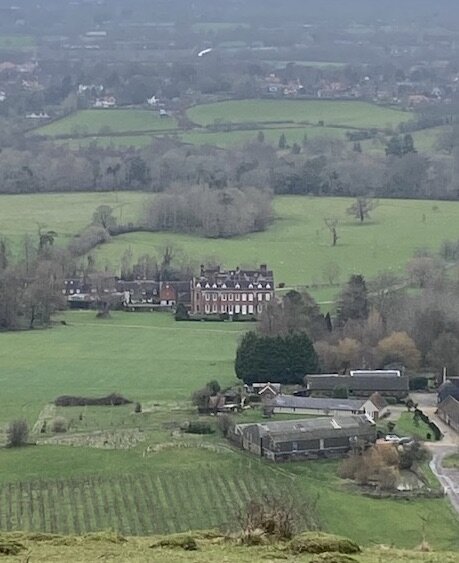
The view from the hill : Danny House in the foreground
The views down to the coast or across to the Jack and Jill windmills were obscured by the mist. Still, what I could see - Hassocks, Burgess Hill, Hurstpierpoint - was well worth the climb. This being December, the pathways through the various woods were clogged with mud. I suppose, that’s what you expect in winter, out on the Downs. I think next time, I’ll don the wellies and sacrifice looking good for remaining dry. Spring and summer will bring their own delights.
My route down was milder, more winding, more reflective. The rain came down slightly and that, combined with my playlist and the bells of the sheep, made this more Christmas-y than I expected. I don’t need snow or twinkling lights. Just bleakness and the dark trunks of lifeless trees. Yes, I’m more Corelli than Carey.
Christmas is a time of memory - lost family Christmases, departed relatives, forgotten friends, little children now grown up. Memories of Margaret Thatcher... In the mist, in the rain, walking the chalk scarred hilltops of Sussex, you can think of these things.
I’ll be back.

The return from Wolstonbury Hill.
Playlist
Sixpence None The Wiser - Kiss Me
Everything but the Girl - On My Mind
Van Morrison - Beside You
Eurythmics - Here Comes the Rain Again
Frank Sinatra - You’re Sensational
The Rolling Stones - Time Waits for No-One
Abba - The Winner Takes it All

Bluebells by the track going up Wolstonbury Hill
Postscript April 2026: Bluebells
This walk is well known for the bluebells in springtime. Here my friends is a picture of that very thing last week!
More Walking Stories? Click Below.
Shake The Magic Money Tree!

The Bank of England prepares a hi-tech financial instrument to support the UK economy.
There comes a time, sometimes later, sometimes sooner, when you realise that much of what underpins the modern world exists because we choose to believe it exists. Primarily, but not solely, I’m thinking about money here. (1)
You see, money may be experiencing an existentialist crisis.
This year, the Bank of England has created, almost unremarked upon, £450B of new money. This is in addition to the £445B already created in the last ten or so years. Printing money has become increasingly the go-to policy for government / BoE financing. (2)
But what the hell is the Bank of England - and other central banks - doing printing money? We all thought - until recently anyway - that printing money was the preserve of failed states where a richly embroidered President for Life might fire up the state money machine to pay for his next golden toilet whilst his people ate shit from garbage heaps?
In other words, what is the difference between the infamous hyper inflation of the Weimar Republic or Zimbabwe, and a modern, oh so sophisticated, economy like the UK?
One hundred years and a new terminology frankly.
We don’t print money anymore, we ‘quantitively ease’ (QE). Lofty economists hide money creation behind high sounding phrases designed to obfuscate. They distain the commonly held view that printing money is generally a bad thing. “Don’t you know,” they will pontificate - probably with half moon spectacles sliding down their nose in the manner of clever people everywhere - “Commercial banks create money all the time? What do you think fractional reserve banking is?”
Good point. We all know, via the credit crunch of 2008, that banks - sometimes recklessly - take a pound and lend out ten. Hence fractional reserve banking. The argument for QE is that, in bad times, banks lend less and so the creation of money is tightened. Hence the need for quantitive easing, i.e. creating money to persuade banks and others to lend money to get the economy moving. At some theoretical date in the future - never defined or realised - central banks will unwind their position and pass back their holdings from their balance sheet. This is to avoid the perils of hyper inflation.
And what are those centrally held holdings on the BoE’s balance sheet? What do they buy with all this new money? Well - since you ask - mainly government debt.
Oh.
So, this is quantitive easing; a government wants to inject money into the economy, they issue debt, the banks and insurance companies buy the debt, the central bank buys it back, the markets make a small ‘turn’ on this as the price is rising due to demand, meaning the yield falls on those bonds so servicing the debt is now cheaper for the government. Happy days! Doubles all round. Some corporate bonds are bought, but, not so much. Mainly government gilts. (3)
Well, that’s ‘vintage’ quantitive easing.. We’ve progressed since the good old days of the credit crunch. Now, in 2020, the central banks and government can’t be arsed in issuing and re-purchasing gilts and so just think - ‘fuck it’ - and go route 1 and cut out the middle man. So the BoE directly buys government debt with their newly created money.
Think about that for a moment; the government spends like a pissed up sailor on leave with a stolen credit card and, fearing the usual methods of raising income - boring stuff like raising taxes, borrowing or, here’s a novel one - growth - just prints the money it needs.
It’s a bold strategy, an ‘unconventional monetary approach’ in the jargon. These are unprecedented times, okay? But, erm, tap tap on the shoulder, is this right? Legal? Even moral?
Personally, I don’t like short cuts. We all know state fiat currency is make believe - it exists because we choose to believe it exists. But you like to comfort yourself that behind the mist there are real things dimly in view - productivity, innovation, balance of payments, demand. You know, the stuff of the actual economy. It’s why we get up in the morning and work.
But what’s the point if you can just fire up the printing presses and create money? It’s easier than actually earning the money. And who doesn’t like free stuff? This is a shortcut that undermines the real economy. As we all trade in the same currency (money) the actions of the government must surely degrade the productive part of the economy.
The classical economic view is that if you increase the supply of something, the price will drop. For money, we call this inflation. Inflation is a tax that we all pay. Print loads of money and you get hyper inflation and we all have to get out the wheelbarrows to buy a loaf of bread. The economy falls apart causing real and sustained damage.
So I’ll end with two scenarios and a comment:-
1) We have entered a new norm. Inflation has been conquered. The masters of the universe have defied the economic gravity and are floating above what used to be held as a truism; that printing money is bad and will cause hyper inflation and crash the economy. We are truly living an age of giant economists who shame those pygmies Keynes, Friedman and Hayek.
2) We are living on borrowed time. The poison is acting slowly but will eventually start to work. It’s only a matter of time before the inflation kicks in and then we’re all screwed.
2020, we all appear to be living through scenario one. But I fear scenario two is our ultimate destination. QE, printing money, is a fool’s shortcut. Intrinsically, we all know this. Why don’t our political and financial masters know it too?
NOTES
1) Big Tech, Elections, Fractional Reserve Banking, MSM News
2) UK Government / Bank of England. I use the terms interchangeably. They are, in effect, one and the same thing.
3) Governments - and oppositions - have been talking up the advantages of cheap interest rates on state debt for a good ten years. The argument seems to go, it would be irresponsible not to borrow when money is so cheap. These typically tend to be same people who say, governments can run large debts because a country is not like a household. Said with a sneer. We shall see.
A Walk Up Wolstonbury Hill in Winter
A bracing December walk on the Downs, up an ancient hill, trudging above the rainclouds, looking down on the misty haze of the Sussex weald, listening to my Desert Island playlist, remembering the times I met Margaret Thatcher.
What’s that last thing, Tim?
Margaret Thatcher? Random thoughts you get as you hike on your own. I looked into those cold blue eyes once - doltishly described by Mitterand as akin to Caligula’s. Piercing, soul searching, intimidating perhaps; you could see she took no shit from anyone. If only she - a trained scientist - were in charge now instead of the blundering third raters we have today.
Such thoughts I have, ascending, and descending Wolstonbury Hill, Clayton, West Sussex.
Getting out, hiking, exploring, invigorates the mind, stimulates the memory and shakes the box of possibilities. If there has been one good thing to take from this awful 2020, it’s that I’m deliberately walking more around my beautiful county. I say deliberately; before this en-cagement, I used to do 10,000 - 12,000 steps a day naturally, just getting to and from work. (You think my lithe and toned frame occurs naturally?). Once the lockdown began in March, I realised that if I didn’t consciously go on walks, I’d quickly morph into a supersized Tim.
So, I began walking, firstly around Burgess Hill. I think I know the streets and pathways and countryside around my town pretty well now nine months on. How have I lived here so long and not known anything about where I lived? Embarrassing really. But, seek and you shall find, and I have been seeking a lot recently. I’ll share some of these discoveries here over the coming days.
Wolstonbury Hill is part of the defensive screen of rises that separates the Sussex weald from the coast. It lies above the parish of Clayton, famous for the Jack and Jill windmills but also the castle folly bestriding the railway tunnel that takes the London trains under the hills to Brighton beyond.
The Clayton Tunnel takes the London to Brighton trains under this remarkable 19th Century castle folly.
I followed the National Trust map for my walk. The instructions were clear until I hit the environs of Danny Hall - a large country house used by Churchill and his war cabinet. Instead of walking around the hill and climbing obliquely, I went too early and ended up clambering up the steep slope directly. I puffed and panted up the hill aware that an attractive, and much younger lady, was coming up fast behind me.
So I increased my pace and hit the top red faced and wheezing, all ready to smile benignly at my pursuer. I mean, how does anyone meet anyone these days? Perhaps a real-life ‘hello’ is better than being ghosted on a dating app? Probably, maybe, dunno; the lady - quite rightly - ghosted me in real-life and whizzed past and onwards into the flock of bell wearing sheep. Yes, like Switzerland.
It’s a racy blog I write.
The view from the hill : Danny House in the foreground
The views down to the coast or across to the Jack and Jill windmills were obscured by the mist. Still, what I could see - Hassocks, Burgess Hill, Hurstpierpoint - was well worth the climb. This being December, the pathways through the various woods were clogged with mud. I suppose, that’s what you expect in winter, out on the Downs. I think next time, I’ll don the wellies and sacrifice looking good for remaining dry. Spring and summer will bring their own delights.
My route down was milder, more winding, more reflective. The rain came down slightly and that, combined with my playlist and the bells of the sheep, made this more Christmas-y than I expected. I don’t need snow or twinkling lights. Just bleakness and the dark trunks of lifeless trees. Yes, I’m more Corelli than Carey.
Christmas is a time of memory - lost family Christmases, departed relatives, forgotten friends, little children now grown up. Memories of Margaret Thatcher... In the mist, in the rain, walking the chalk scarred hilltops of Sussex, you can think of these things.
I’ll be back.
The return from Wolstonbury Hill.
Playlist
Sixpence None The Wiser - Kiss Me
Everything but the Girl - On My Mind
Van Morrison - Beside You
Eurythmics - Here Comes the Rain Again
Frank Sinatra - You’re Sensational
The Rolling Stones - Time Waits for No-One
Abba - The Winner Takes it All
How Negative Interest Rates Are the New Flares

Economists are herd creatures. Admittedly there may be more than one herd but they like to get with their fellow economists and chew the cud.
Like all social sciences, it has fads, fashions and theories that, like flares, come and go. So, why do I say negative interest rates are the new flares?
Well, for a start, it’s an exciting phrase, one that allows you to visualise some long haired loser from the 70’s nodding along earnestly as some prog rock group embark on a twenty minute keyboard and drum solo on the theme of The Hobbit. But extend that zoom focus; all the kids are wearing flares. Yes, these flappy trousered kids are the economists.
And negative interest rates are Emerson, Lake and Palmer?
Er, no. Yes. Perhaps. I know. I took the analogy too far. It happens.
Anyway, the thing is, what I really mean, yours are the sweetest eyes I’ve ever seen. No, what I mean is, economists follow fashions like 70’s kids bopping to progressive rock. And today, the fashion has turned to negative interest rates.
In my Linkedin article I write (though not as I do now, yes I’m versatile) about the growing cult of negative interests rates. How banks, companies and people might be charged for storing balances within the financial system. To be fair, this idea has been around for a while. Following the central bank responses to the last recession - aka The Credit Crunch - interest rates were left on the floor. Real screw the savers territory.
So what to do? The central banks, by bringing rates to zero, had effectively got rid of one of the two arrows they have in their economic quiver (the other being printing money. They like that one too - it’s so virile. Of course, the viagra soon wears off and leaves just a headache. I’m told).
But, some bright spark might have said, what if zero wasn’t the end? What if we, like, took rates to negative? “So we’d charge people for giving us money?” his boss might have asked afraid of not getting down with the kids. “Yeah, exactly! We’ll make money a hot potato. Pass it on on quick!”
And so, the theory of negative interest rates was born.
For me though, big theories of economics - from the General Theory, counter cyclical demand management, The Austrian School, Monetarism, The invisible hand, the incomes augmented Philips curve, return to the Gold Standard, baggism, shaggism, thisism, thatism - they’re all a bit ‘theoretical’. Grand theories are a parlour game played without reference to life outside the cosy prism.
But it reduce it to the micro level. You and me.
Economics is about incentives. If you charge people to store their money you will dis-incentivise them from doing so. Some people will put money under the mattress. Others though will buy holidays and spend their savings and so be vulnerable should they get old, or sick or lose their job.
Money is amoral. It is a means of exchange. No more. No less. However, I'm not sure debt and consumption are wise replacements for prudence and deferred gratification. Negative interest rates seem to tip monetary policy from amorality into immorality. And that can’t be right.
Now. Where’s my flares?
The crash of 33AD

Gold Roman coins: https://www.ancient.eu/image/5954/corbridge-hoard--jug/
It’s all happened before…
In these days of no history, where everything is apparently unprecedented and has never happened before throughout humanity’s countless years on this planet, where we have reached peak morality as a species and can pronounce on the past with a lofty distain, it’s worth plucking out some embers from the smouldering fires of our collective history. Who knows? Might be instructive!
Over-leveraged financial houses, external shocks, a run on banks, shortage of credit; the financial crisis of 33AD - which shook the Roman world - had them all. Throw in a first century version of quantitive easing and the picture is complete.
The Emperor Tiberius (14-37 AD) is popularly remembered as a miserly old pervert whose one redeeming feature was that, whilst far worse than his predecessor Augustus, he was inestimably better than his successor, Caligula.
Tiberius, wearying of the stresses of Rome’s day-to-day administration, went off to live in Capri leaving his Praetorian enforcer Sejanus in charge back in the capital. Ambitious and unscrupulous, Sejanus arrogated so much power during his master’s absence that Tiberius had him and his allies executed. Once executed, these rich persons’ estates reverted to the Imperial Treasury. This had the concomitant affect of withdrawing large sums of money from the economy. Money was already circulating at a low level in the economy as, fiscally, Tiberius tended towards hoarding and not spending. For example, he cut back on Augustus’ lavish public building policy and avoided, if possible, costly military campaigns. He withdrew from Germania even after the revenge-spanking of Arminius at the battles of Idistaviso and Angrivarian Wall. (Notes 1).
But these savings came at a price. The Roman economy was pretty much a cash economy “thus, when the state ran a budget surplus (as it did under Tiberius) it caused a direct contraction of the money supply.” (Notes 2)
But now we come to the proximate causes of the credit crunch…
An Egyptian banking house - Seuthe and Son- invested in some ships carrying cargoes of spices which - unfortunately for them - sank during a hurricane in the Red Sea. Think Lehman Brothers. The interconnectedness of the Roman finance world was proven back on Rome’s Via Sacra** - which was equivalent to the the ancient world’s Wall Street (with added temples and hookers). Financial houses in the capital now went bust as a result of lending to Seuthe and Son. One by one they closed up, calling in loans which caused more and more pressure on liquidity.
Timing is all in a financial crash. Two other factors - perhaps small in themselves - ratcheted up the pressure.
Firstly, this was just the moment when a longstanding edict of Tiberius’ came into force: all senators had to invest a third of their wealth in Italian land. They needed money to purchase property and so created a rush on the stricken financial houses (Notes 3) and debtors who either couldn’t or wouldn’t pay up the required capital. Secondly, a rebellion amongst the Belgae in Northern Gaul, out on the fringes of the empire, had meant those investing in that high risk but high reward area had lost their money. In the modern world, think of Argentina reneging on her debts and dragging down those eager-for-profit institutions who had lent them the money.
Demand for liquidity far exceeded supply. Rumours of instability exacerbated the fast growing crisis. Banks wouldn’t trust each other. Money was hoarded. The empire’s financial and trade worlds froze. A classic (and classical) credit crunch! Oh shit!
Tiberius to the rescue
The relevant quaester (essentially finance minister) passed the problem onto the Senate who, long used to being ineffective, passed the problem onto Tiberius over in Capri. Taking time out from his paranoia and perversions however, Tiberius acted quickly. His response was emphatic; the liquidity crisis was to be met by a massive injection of imperial funds into the Roman financial world. Yes, quantitive easing in a toga! One hundred million sestertii from the imperial treasury was released into the banking system at zero percent rate of interest. Additionally, collateral for these loans was accepted at twice market rates which stabilised the property market and brought confidence back to the credit market.
Tiberius’ swift response - creating both liquidity and shoring up confidence in the finance markets - meant that the crisis worked itself through quickly. He was dead within four years and bequeathed his successor Caligula, a full Treasury. Caligula, did not have a problem spending money but that is another story!
The parallels with financial crashes that we may be familiar with are striking but the underlying factors - unpredictable events, state fiscal and monetary policy, financial contagion, and confidence in the system - are also well known to us. The crash of 33 AD however, is not.
Lessons Forgot
I suppose that it is at this point that you would expect me to deliver a worthy homily about history repeating itself or that it rhymes or that it’s all been done before. I could but I won’t. That would be too easy and - in its way - overly trite.
What is more interesting is not the repetitive nature of history but that each age tends to believe it is unique. Each individual is of course unique and unless you believe in reincarnation, a belief in uniqueness is a forgivable fault. But still a fault when history is weighed in the aggregate. As I’ve tried to demonstrate with the crash of 33 AD, give or take a few togas and a lack of internet, the crisis wasn’t too different from our recent credit crunch of 2007/2009.
It’s not the forgetfulness that gets you, it’s the unknowing arrogance. From wars to diseases, from monetary crisis to the venality of politicians, ‘now’ is - perhaps inevitably - judged to be the only time in history these things have ever happened and so we blunder around marvelling at the wheel we’ve just reinvented. Sadly the past is not only a different country, but an increasingly forgotten place. I would argue - and do - that a little humility goes a long way and brings that rarest of all qualities - perspective.
Perspective adds depth and moderates over-reaction. From our own personal experience, we all know this to be true.
When we were young - and knew nothing and had experienced less - we carried the twin curses of ignorance and certainty. We didn’t know anything but - by God! - were we sure of our opinion. But we gradually matured as individuals, adding experience to assessment, judgement to decision. It’s part of life’s journey.
I wish we matured as a society in a similar way but, each generation is ever reborn as a teenager. Certain. Ignorant. Fated to be more wrong than right.
Read on
For more Roman articles - try my 5 battles series. Or maybe Julian the Apostate?
Or more economics? QE - the OPEC of modern times.
NOTES
1) Following the massacre of three legions in the Teutoburg Forest in 9 AD, the battles of Idistaviso and Angrivarian Wall by Tiberius’ nephew Germanicus, did much to restore Roman pride. Tiberius still pulled the troops back to the near side of the Rhine.
2) How Excess Government Killed Ancient Rome - Bruce Bartlett. The Cato Institute 1994
3) Ancient Rome did have a primitive banking system - though ‘banks’ and ‘banking’ is not a term they’d have recognised (though for convenience I may use these terms - the latin is argentarii). Depositors placed their money with reputable firms who, in turn, lent it out to those needing capital, principally to finance goods being shipped around the empire. The interest was set by the state (12% being the norm). These financial firms were clustered around the Forum along the Via Sacra which has been described as Rome’s Wall Street. It was also the site of many temples - temples being in ancient times often linked to banking (people deposited money there for safekeeping). To facilitate trade across the empire, banking centres were present in many other major cities across the Empire which foreshadows a modern sense of interconnectedness.
Is the US the new Rome?

Amongst classical scholars there’s long been an interesting thought experiment; is the US the re-incarnation of Rome?
Let’s go through the checklist:-
The era of kings // British imperial rule.
Throwing out the kings and the early republic // the American revolution and the foundation of the Republic (the Senate - now where did that come from?)
The unification of the Italian peninsula under Roman rule // the spread westwards of the US republic through the Louisiana Purchase, Mexican War and the pioneer trails beyond the Appalachians
Battle between the senatorial class and the plebeians - creation of the People’s Assembly and tribunes // the extension of the franchise to women and the abolition of slavery
An existential war against Carthage // fight against Communism
The fall of the republic - increasing political violence, The Gracchi, increasing disparity of wealth, vicious two party system, Marius / Sulla, the crossing of the Rubicon // gridlock, decrease of working ‘across the aisle’ increasing political violence, intolerance for opposing views, non-acceptance of political norms.
The Imperial era brought into being stability and stopped the political violence. The price was dictatorship. Increase in welfare, reliance on slaves, beginnings of feudalism. Christianity. The empire split into two. Collapse. // …
I’ve been aware of the theory for years - it is an intellectual game; history is instructive not necessary predictive and making parallels from one era to another is typically odious. But still…
I’m currently writing about the 1st century BC as part of my five battles per century history of Rome series. This is the century where the Roman Republic became increasingly violent and all the norms of political discourse and traditional checks and balances were thrown aside. It led to ceaseless civil wars before Augustus ended the republic and became Emperor.
It took fifty years from the populism of Tiberius Gracchus to Sulla’s victory outside the walls of Rome in the Battle of the Colline Gate. Reputedly 50,000 died in just that one battle. It was another fifty years between Sulla’s victory and subsequent proscriptions and (short-lived) dictatorship to Augustus’ victory over Antony at Actium and the effective ending of the republic.
One hundred years of violence and death.
I tend to seek refuge in ancient history - it’s a comforting and a harmless pursuit. But as I researched and wrote the history of the first century BC, many awful parallels became more urgent.
Those that don’t know their history are doomed to repeat it, goes a familiar refrain. I would amend that to read, “Those that don’t know their history are doomed to make achingly bad allusions to the collapse of the Weimar Republic and the rise of fascism.” It’s society’s go to - everything’s Hitler, every opponent is his reincarnation. I suppose it’s not that long ago in the scheme of things and history’s a long and complex body of knowledge, never complete, often paradoxical. Collapses can be quick or they can be slow but there are some commonalities.
Civic norms are flimsier than they appear and, it seems to me, violence is never far away from the human condition. Once violence is introduced into a society’s bloodstream, then events afterwards become unpredictable, often dark, very dark. A good place to avoid this is to accept defeat gracefully, concede that your opponents are not necessary evil people, and that the mob, once unleashed, is hard to curtail and unpredictable. Those who let loose the dogs of war do so at their own peril.
As I said, the US being the new Rome is a parlour game, an intellectual exercise. The US is not an empire - though it does often project violence worldwide. It does still have, hopefully, a functioning democracy which will be severely tested this November. I just hope that the result is accepted and that Trump gets a less acrimonious second term or that there is a peaceful and good-natured transfer of power to the Democrats. The road to Actium does not have to be retraced.
Little Richard

An appreciation of Little Richard
Back in the 70’s, my parents owned five records.* Two Beatles albums - “before they got weird” - With The Beatles and Rubber Soul. The Carpenters greatest hits 1970-74, Abba’s Greatest Hits (72-76 - yeah, before the really good ones!) and K-Tel’s Rockin’ Rollin’ Greats. I played them all but mainly the latter record. It’s what convinced my parents to buy me firstly Jerry Lee Lewis’ Greatest Hits and then, The King himself, Elvis’ 40 Greatest Hits.
So, my first exposure to rock n’ roll was that K-Tel compilation. Twenty years after rock n roll burst on the scene. They were mostly all there : Bill Haley. Gene Vincent. Carl Perkins. The Everlys. Johnny Kidd and the Pirates and Tommy Roe (bizarrely). Oh and Roy Orbison and his sublime, snare drum and riff led, Oh Pretty Woman.
And of course, Little Richard.
K-Tel being the skinflints they were, the two Little Richard cuts (Long Tall Sally and Lucille) were live performances culled from a later 1967 live album. Ordinarily, that would be a problem. Not Richard. He was, as we all know, damn good live and both songs rocked out of the speakers.
This isn’t going to be a long obit. Richard Penniman’s career itself, as a top selling artist, wasn’t long. His career as an icon, an inspirer and live performer though lasted much longer than his initial two / three years of seminal hits.
The Little Richard Style
You know when a little Richard song comes on. The brash piano intro, the brass, the riff, the instinctive three chords and some cleaned up bawdy lyrics. And that voice. A howl. A scream. A falsetto. There is no one like him. He just makes you smile, tap your feet and, if you want to get people going at a function, just slap on ‘Tutti Frutti’ and watch them park their drinks and head to the dance-floor. I know, I’ve done it. Yes, I used to DJ.
So if Elvis combined country hill billy with rhythm and blues, Richard was pure rhythm and blues tinged with gospel. He had the element of a charismatic preacher about him. As we know his personal journey took him to God - he was an ordained priest - and you see within him the struggles he faced. One of the best rock books I’ve ever read is his biography - in which he fully collaborated - which is candid about his sexuality, his drug use, his predilections, but also his warmth as a human being. It is well worth a read and damn funny.
He’s immortalised in the rock movie The Girl Can’t Help It singing the title track (plus Ready Teddy and She’s Got It). Immaculately coiffured, standing astride his long suffering piano, he steals the show from the other musical acts (though I do have a soft spot for Julie London’s Cry Me A River).
And man, did he look good! Hair piled up, snaking moustache and increasingly flamboyant outfits, you can see where former bandmate Jimi Hendrix (who he fired), Otis Redding, James Brown and later Prince, got their inspiration from. He toured with the Beatles and the Stones early in their career, passing on the torch and teaching Paul the nuances of the Little Richard style. As we know, the Fab Four always ended their concerts with their tribute to Richard, a raucous version of Long Tall Sally.
RIP Little Richard, one of the great ones.
(And yes, Little Richard was included in my permitted obits as listed four years ago.)
Footnote * - Of course they didn’t own just five records. But there was only five I was interested in (at that time). My Mum listened to classical. My Dad listened to swing. The radio played Terry Wogan on Radio 2. We watched Top of the Pops on Thursday nights.
Read More / Rock More
For more musical appreciation what about David Crosby or Taylor Swift? Or press the button to see all!
GREATEST MOVIE SONGS

You’re watching a film. A song comes on the soundtrack - either heard or sung. And it’s memorable. And perfect. And right for the film, the time and the place. Might not be your favourite song but there - in the moment, watching the film - it is.
Here is my list of the greatest film songs.
Isn’t this a Lovely Day (Top Hat) - 1935
“The weather is frightening. The thunder and lightening seem to be having their way…”
If there’s a better song, I don’t know it. There’s probably not a day that passes where I don’t sing a couple of bars from this Irving Berlin classic. The movie poster hangs in my bedroom. In the film, Fred and Ginger are caught in a rainstorm and take refuge in a bandstand. As they sing and dance to this clever song, the rain outside pours. Their little shelter becomes a cacoon of flirtation, courtship and growing new love. To a great melody. We probably all wish for this. They weren’t complicated, Hollywood musicals of the 30’s. They went to the point. And what a lovely - make believe - world that was.
Sometimes, My Bloody Valentine - Lost in Translation 2001
Top five favourite movie. What’s not to like? Bill Murray. Bill Murray singing ‘More than This’ in a Japanese karaoke bar. Scarlett Johansson. Yes, Scarlett. A chaste romantic film. Clever. Laid back. The whirlwind of romance away from home. They go out with her friends. A club. A chase. A party. A karaoke bar. They drink and smoke and then get a taxi home. The early morning ennui following a night out. Dozy. Comfortable. With someone special. And this song plays. A surprisingly tender tune for a song with cranked up guitars. It floats along with the hazy reality of a blissful 3am with a girl. In a taxi. On the way back.
Get Back, The Beatles with Billy Preston - Let it Be (1970) Not the single. The final song from the movie.
The Beatles going down fighting. A cold January in 1969. The Beatles are nearly broken up and somewhat lethargic about their latest album. They decide to play one last impromptu concert on the roof of their building because they can’t be arsed going anywhere or organising anything else. So they play their latest songs across London to the unsuspecting office workers. The police get called after half an hour bringing this rooftop concert to an end. But there’s one more song. Get Back. John and George’s amp gets turned off after the first verse. And then ‘fuck it’ they switch it back on and their guitars come back with added urgency. This is it. The last song ever played live by the greatest group ever. It’s scrappy, it’s raw but it’s the fucking Beatles man. Going down fighting.
You’re Sensational, Frank Sinatra - High Society (1956)
“I’ve no proof. When people say, “You’re more or less aloof.”
Ah, Cole Porter… What a song writer. Famously, he wrote both the music and the witty and intelligent lyrics to his songs. High Society is one of my happy places. Happy memories of the family watching a good movie back in the 70’s. Of course, I like The Philadelphia Story too, but I grew up with the colour, musical version. From Louis Armstrong kicking it off on the bus, the hip jazz lingo, Bing Crosby being Bing, right through to the loveliness that was Grace Kelly. It’s a classic movie with a ‘sensational’ score. So many great moments; Bing and Grace harmonising on ‘True Love’, “now that’s jazz”, Frank and Bing duetting drunk, the breakfast outside on the patio. And the effortless class of ‘You’re Sensational’. I know I say it lot, but hardly a day goes by without my singing or humming its opening lines quoted above.
Bela Lugosi’s Dead, The Hunger (1983)
This is the classic opening for Tony Scott’s stylistic vampire movie The Hunger. The music is strange, other worldly and the perfect accompaniment to an unsettling, hip nightclub where Catherine Deneuve and David Bowie go out a’hunting for victims. Long coats, shades, cigarettes; the foundations of Goth are right there up on screen. Of course, in real life, Goths were just smelly losers in bad clothes and worse make-up hiding their acne. But in their mind, they were Peter Murphy, the chisel cheeked lead singer of Bauhaus who dominates this first scene from behind the bars of a cage (see below). Right song. Right movie. Well framed and shot. Hence, on the list!
Sweet Transvestite, Tim Curry - Rocky Horror Picture Show (1975)
Cracking song in one weird musical. Great was the day I found this movie. Suddenly everyone in sixth form was a sweet transvestite as both an insult, a compliment and - at the Christmas disco - a costume. I liked this song so much, I got my group to learn it and we’d chuck it in every now and then to get the crowd going. Or to stop them going. Whatever. At our final gig, at the Hare and Hounds in Brighton in early 1996, this was the last song we ever played. Pissed. Out of tune. Camping it up. And then I pulled a strop and sacked the band and went solo. There’s a metaphor in there somewhere. Good song though.
There She Goes, The La’s - The Parent Trap (1998)
One of the greats. Of course this song stands on its own. Lee Mavers’ beautiful, beautiful indie twinkling guitar ditty packs three minutes of audio gold. And here, in a mainstream kids movie, it’s framed perfectly. As Lynsay Lohan’s American twin is driven around London - in a vintage Rolls Royce of course - images of London flash by as There She Goes blasts out. The two go together like an American travel agent’s perfect ad of quirky, historical, sunny London. With a iconoclastic soundtrack.
The Hills are Alive with the Sound of Music, Julie Andrews - The Sound of Music (1965)
Yeah, I know. A bit route one. Too obvious. What’s your favourite band? The Beatles. Favourite piece of classic music? Beethoven’s Fifth. Favourite movie song? As Time Goes By, Casablanca. They’re culturally ubiquitous for a reason, no? They’re the Stairways to Heaven of their field. Same here. I’ve tried to give a wide range of movie songs in this piece but - hey! - indulge me one indulgence. A toss up between the Dooley Wilson classic (If she can stand it, I can. Play it!) and this one. I went with Julie running around the Austrian Alps singing about mountains. And music. What makes it so special though, apart from the song, of course, is the helicopter shots, the gradual build up before Julie finally comes into shot. It is a classic, musically and cinematographically. Once seen, never forgot. Job done.
The Best Unknown 60's Songs
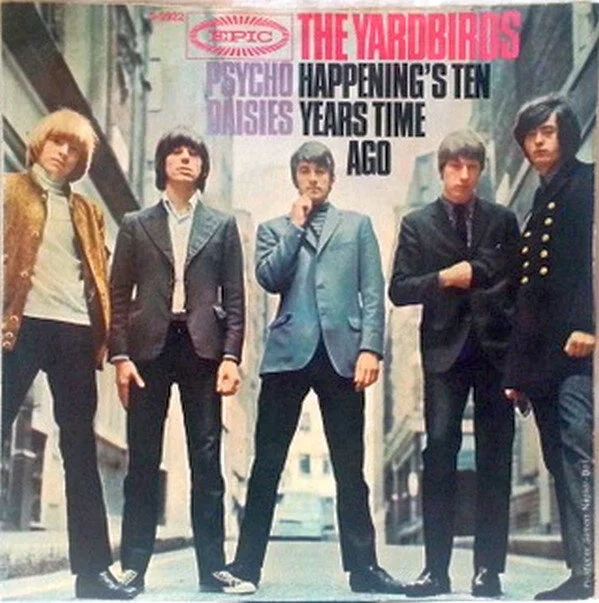
The Best Unknown 60’s Songs - It’s All Subjective!
The best hidden 60’s songs - in musical terms - is a slippery concept. I say ‘best’, you say ‘deservedly obscure’. You say “but what about this one’ and I say something about your mother. Ah, dear readers, I remember pub conversations.
But unknown songs, some by famous groups like the Beatles or Stones, are always a joy to find. It appeals to the musical snob in me. We all like to feel that our shadowy light in the forest is the one true path to musical esteem.
It’s all subjective, of course.
(In the list below I mainly feature obscure tracks by well-known bands with a few unknowns in there to keep you on your toes. It would be easy to pack the list with Gene Clark demos but that wouldn’t be fair. Read my Part 2 of Best Unknown 60’s Songs for that!)
Lady Friend - The Byrds 1967
A joyous, rollicking single written by David Crosby, ignored at the time and now totally forgotten. Undeservedly so. The Byrds storm through a cracking tune with trademark Rickenbackers, floating harmonies, light and shade. Oh, and trumpets. There was a time, years ago, single and with tousled hair and Roger Mcguinn shades, this and Eight Miles High soundtracked my life. It was the beautiful dawning of a sadly short day… This is at the Byrds at their best and no-one knows this.
Reconsider Baby - Elvis 1960
Elvis would occasionally ‘do’ the blues. Exhibit A, his definitive take on Trouble in King Creole is perhaps his greatest ever vocal. Steamroller Blues is a highlight of his Aloha from Hawaii concert and album. Mess of Blues is one of my favourite ever tracks (but perhaps too famous for this list!) So, fresh out of the army, Elvis straps on his guitar and gets down and dirty with Lowell Fulsion’s driving lament. Yeah, that’s E on lead-rhythm. This version is famous for its two-in-the-morning feel epitomised by Boots Randolph’s extended strip club sax solo. Elvis is Back indeed!
The Who - Circles (1966)
An A side, a B side, and song of many names (Instant Party for example), Circles is a song with a complicated release history. What is not complicated though is that it is a great piece of mid 60’s psychedelia. Hypnotic, the tune apes the song title in that the guitar chug spirals round and round creating a musical embrace drawing you in. That’s John Entwhistle on French horn providing the persistent drone which pushes the track away from the Who’s previous RnB sound towards the more experimental I Can See For Miles. I used to mash up this track with Neil Diamond’s even more obscure ‘Shot Down’ to audiences between Brighton and London. Well, audiences in Brighton. And London.
Child of the Moon - The Rolling Stones (1968)
Hidden in plain sight, Child of the Moon is the B side of Jumping Jack Flash. I have the original single, lovingly bought at Rochdale’s Champness Hall monthly secondhand record fair back in the 80’s. “The wind blows rain into my face” begins Mick over an ominous drone kicked off with producer Jimmy Miller screaming out some inaudible words. It’s a bit hippyish, a bit psychedelic, slightly reminiscent of the Beatles (also obscure) B side Rain but it’s catchy and I like it. And the video. Weird. Slightly unsettling. See below.
My Girl the Month of May - Dion and the Belmonts (1966)
Yes, the guy who did The Wanderer and Runaround Sue, released this swinging-60’s record years after The Beatles had rendered him and Belmonts obsolete. It’s full of mid 60's hip strangeness, some spirited singing from Dion and a chuck in the everything including the kitchen sink approach to production. ‘Little girl of mine, youngest flowers of springtime, you're the month of May.” And what month is better than May? Got nowhere in the charts and so this is a delight to find. You’re welcome.
Born to be a Rolling Stone - Gene Vincent (1967)
Gene ‘Be-bop-a-lula’ Vincent relocated to the UK in the mid 60’s. Tax reasons. Women problems. A draw on the live circuit, he didn’t however record anymore hits. His moment had passed. But he recorded some obscure mid-60’s singles that are quite beautiful. Born to be a Rolling Stone (b side the almost equally sublime Hurtin’ for you Baby) is stop-start Byrds influenced, guitar led song with a riff that I’ve ripped off ever since. On one level, it’s a slight piece as the singer tells us in a couple of verses why he’s born to be a rolling stone. But music is often as not a feeling, a sense of time and place from where you first heard it. Gene’s mid 60’s output came along at the right time for me.
Happenings Ten Years Time Ago - The Yardbirds (1966)
“Why you all got long hair? Bet you’re pulling the crumpet, ain’t ya?”
It doesn’t get better than this. Jimmy Page and Jeff Beck on twin attack lead guitar smouldering through some hard rocking mid 60’s psychedelia. This is peak Yardbirds. They went up fast and fell almost as swiftly before re-emerging as the global phenomenon Led Zeppelin. So, much to write about this song. Jeff and Jimmy playing in unison, the catchy tune, the hard riff, the avant-gard spoken piece in the middle. Together with Stroll On, the dual lead guitar Yardbirds lasted for only a few months in 1966. Such months!
Juliet - Neil Diamond (1969)
I could write a whole article on fantastic Neil Diamond lost gems from the 60’s. Across both Bang and Capital labels he produced some wondrous songs from ‘66 onwards. Always good, he seemed to lose his way a bit from the mid 70’s until The Jazz Singer (1979). He’s now battling Parkinsons and I wish him well against that horrible disease. I’ve already written about Neil Diamond Song Number 1 Solitary Man, but there’s plenty of rivals from the 60’s. I chose Juliet because of the feel, the words, his range from baritione to falsetto, the cosy feeling of new love. “Lay your eyes on me, girl, wanderin’ inside a grown man, no more than a small boy, sweet Juliet.” The whole Sweet Caroline album is filled with some of my favourite music. I could have picked the sublime Glory Road, Hurtin’ You Don’t Come Easy, And The Grass Won’t Pay No Mind. The title track isn’t bad either.
Rain - The Beatles (1966)
An obscure Beatles track? Surely no such thing! Well, probably not, but a non-album B side is about as close as you can get. Rain was the B side of Paperback Writer. It’s the Beatles going full-on psychedelic. Snappy, stop-start drums and a persistent drone kick off this little beauty. It all works. Paul’s bass is fluid and a co-lead instrument. Check out the bass solo towards the end propelling the song into its backwards coda. “Raaaaaaiiiinnnnn” sing John and Paul never more in harmony than here. If you’ve not heard it, you’re in for a treat. In terms of Beatles B sides, it’s in the top three (along with Don’t Let Me Down and You Can’t Do That). A John song, of course.
Rudy’s in Love - The Locomotive (1968)
“No gun shootin’ for Rudi, no retributin’.”
A minor hit. British blue beat. Ska. The Birmingham sound. I first came across this song on a compilation 60’s cassette tape that came free with, I dunno, Vox magazine in the early 90’s. It’s a cheerful ditty about a rude boy who finds love and so doesn’t want to do gangster type stuff anymore. Basic boy meets girl stuff. Driven by a horn section and an organ, this is the ska sound that the Specials picked up ten years later. Syncopated. Danceable. Fun fact; until I checked this out I always assumed at least the singer was black. Apparently not, bunch of Brummie white boys. Who knew?
So there we go. It’s a list. Clearly I’ll argue with it tomorrow. Read Part II where I clearly disagree!
The Real Obscure Stuff of the 60’s?
Real obscure stuff - Gene Clark, The Toggery Five, The 13th Floor Elevators, Jackson Frank you can check out in Part 2 of Obscure 60’s tracks.
Or read me, living the music, introduced as Eric Clapton at Kingston Mines, Chicago.
Walking on Lavender Hill

Old fashioned street sign. Classic Design. Not used anymore. Of course.
“I commute into Clapham Junction everyday. My office is a twenty minute walk up Lavender Hill and Wandsworth Road.”
Lavender...
The word lavender conjures up those sun drenched, hazy fields of Provence. Or perhaps some choppy, warm-toned, Impressionist masterpiece. Or is it a section of a busy thoroughfare in South Central London? Yes, it’s probably the latter. For years this road, this feeling, was my beat.
One thing you won’t find much of on Lavender Hill is, well, lavender. Maybe some discarded pizza boxes, plenty of rubbish strewn waste bags, an upturned supermarket trolley or a decaying Christmas tree thrown onto the street. But not much lavender. The shrub that gave this area its name has gone. Long gone.

The green fields of Lavender Hill. Picture TR
Clapham Junction
My entrance and exit point to this urban dreamscape is Clapham Junction railway station. Not sure what a junction is, but as to the Clapham part, well, that’s a little bit of historical postcode snobbery. A fib. It’s in Battersea. And Battersea is working class. Full of engineering and manufacturing works back in the day. Less so now. Maybe we could rename it Lavender Junction? Help shift those new million pound apartments, no?
There’s a pub. There’s always a pub, isn’t there? The Falcon is pretty special though. One of those big pubs you only get in London. The ones dripping with large baskets of flowers, partitioned rooms and back lit smoky glass. This one sports a famous horseshoe bar (the UK’s longest apparently). I don’t drink there though – nor the Slug and Lettuce next door. However, the facilities are unguarded and handy so I was pretty much a regular.

The Falcon. Piss stop.
So up we go, up Lavender Hill, ambling wistfully through these London fields. Past the retail splendour of Arding and Hobbs, sprinting past Fitness First, KFC and numerous Lebara money transfer shops where bored staff sell cheap booze and fags, whilst conducting mobile phone conversations that sound important, but probably aren't.
There was a girl once. There's always a girl, behind the memories, driving the words. We were students at South Bank University further up the A3036 on Wandsworth Road. The campus is now closed and converted into a Tesco Express and Pure Gym. I used to catch the Number 87 bus down Lavender Hill to Clapham Junction. If I was more observant, as I sat on the bus all those years ago, I would have noticed a local oddity – a genuine London eatery – the Pie and Mash shop. The historian and the Englander within me likes the fact that this relic of old London, of its working class eating habits, is still there. I like that. I’m a fan; pie and mash and gravy for £4. Treacle Pudding and ice cream or spotted dick for £3. I don’t go near the eels or the liquor (eel and parsley sauce). It's cheering though to know nestling amidst the numerous Thai, Indian, Italian, Japanese, Chinese and assorted other restaurants there is an authentic London eatery. But for how long?

Eels. Jellied. Yum.
Continuing on we get Battersea Library, the police station but, most wonderfully (and where most of the drivel on this website was written) the Grade 2 listed building that used to be Battersea Town hall but now doubles as Battersea Arts Centre. They used to build beauty, those Victorians, you know, put the effort in, and make buildings things of wonder and aspiration. Now it’s a worthy shell for community theatre projects. Yeah, me neither.

Battersea Arts Centre, Lavender Hill
“Kate and I are meeting in Battersea Arts Centre. I’m late. I scan the bar. At a corner table is a woman who bears a passing resemblance to Kate’s online dating profile.”
However, money was always an issue, even in the 1880’s. None more so than The Church of the Ascension, a big, bold - God is terrible, God is almighty, repent ye sinners - church at the top of the hill. It’s a massive stone structure with Byzantine influences by way of Carcassonne. It should have been adorned with an equally gigantic phallic tower but the original architect pissed the money away, was eventually sacked and so he church was completed sans spire. Nerdishly, I own a copy of the original architectural plans from 1875 and framed, they adorn my living room.

French / Byzantine architecture meets Victorian brick shit-house, muscular Anglicanism.
“There’s a tramp whose regular perch is the low surrounding wall of the Ascension of the Lord Church on Lavender Hill. Kicking back with his can of strong lager, he likes to shout abuse at the passing world. His favourite trick is surprise; hunched harmlessly over his carrier bag one minute, and then, as though roused from sleep, pouncing like a lion the next.”
Towards Wandsworth Road
And then we're walking downhill. Go past - hurry! - The Crown pub. One time, as I was leaving, I witnessed some ritualised urban ballet as two drug dealers squared off to each other out on the street. Held back by their various women folk screaming, "Leave it out Jon, he's not worth it!" I waited for my Uber to take me to the station as the performance played out. Don't know who won. It's probably on YouTube somewhere. A straightner.
This eastern part of Lavender Hill is all shit council flats and massed ranks of mopeds parked on the pavement outside nondescript takeaways. Let me explain lest you live in a town where cuisine laziness hasn't yet set in. Every eatery on Lavender Hill - and there are many, so many - has a fleet of mopeds waiting to transport to the indolent, the obese, and the time poor banker-wankers, their genuine, wood fired Neapolitan pizzas. This, children, is what decadence looks like. Fight, fight, against the dying of the light and cook from scratch you lazy bastards!
“We continue walking down Lavender Hill keeping our own counsel. Once again, our pace is well matched and we walk together, three feet apart. As we near the old Cedar pub, she slows.”

Lift up your eyes. There is beauty in the most unusual places.
There are many places on Lavender Hill that offer a 'massage'. Strangely they always want to massage - for extra, for cash only - those parts that don't often get massaged in - say - more mainstream establishments. Happy endings are promised. Not always delivered. I avert my eyes, clutch my pearls, lift up my skirts, and run from these places.
(And that paragraph - about happy endings on Lavender Hill - still sends me significant traffic to this website. I’m guessing here, but there’s probably money to be made from adult activities.)
And so, after a mile or so, Lavender Hill finishes at Cedars Road and hands the A3036 baton over to Wandsworth Road in a fistful of Tesco Expresses, coffee shops and Premier Inns in old temperance halls. We are now entering Lambeth and our story must end here.

What happened to Battersea? Abolished in 1965, apparently.
And so where does all this take us? An old London Street. Full of Victorian buildings. What signifies?
“And with clear, cold eyes
And newly acquired candour,
I sift these departing delusions;”
Summing Up Lavender Hill
Well, everything. And nothing. From the confident Victorian public buildings, to the sturdy 19th Century housing for the workers, to the bold and confident Anglicanism. To the many, many cultures that have taken root here, left their mark on the shops, restaurants, through even the pizza delivery boys that criss-cross unknowing across this urban thoroughfare. To the pubs, open and closed, converted or renovated, silently bearing witness to wars and coronations, disasters and triumphs. History shines through, hiding amongst these stones, these relics, peeping shyly from under the brim of modernity. The breath of London, old London, still blows gently in this cityscape. And if you look hard enough, you will find some lavender. Yes, even on Lavender Hill.

Lavender. On Lavender Hill
1) All pictures of Lavender Hill, Tim Robson February 2017. Article revised April 2020 and June 2026. Better? Perhaps. More links and URLs and cheap ploys to drive internal traffic? Hell yeah!
2) Similar themed article is The Dead Pubs of Clapham which looks at the wider area within the context of pubs that once were that stand like ghosts in plain sight.
3) And I still pass through, every day, Clapham Junction. One time I will get off and retrace my steps and notice the changes; the chain pubs, the new takeaways, the vape shops… Urban life is always changing within the rails of hard geography. Nothing stays the same. For more thoughts on changing / not changing infrastructure, read about Brighton in the early 90’s.
4) The daily walk up and down Lavender Hill inspired me to write a novel some years ago. A novel I still tinker with occasionally. The start is anchored in this very walk. Read A Star on Lavender Hill intro. Demand I finish it!
Brighton to Manchester Train

A Class 47 Intercity : Attribution: Black Kite at the English language Wikipedia
No Car? Take the Train.
I didn't own a car until 1997. Before that time I either walked, rode my bike or, for longer journeys, hired a car but, most probably, took the train. It seemed a better, fitter existence, though maybe I was just younger and leaner and reaping the benefits of living in a city, Brighton. Or maybe I was just poorer.
In those days (roughly 1986 to 1997) in order to get between Brighton and Rochdale, I used to take a marvellous direct train that snaked slowly but surely across England between Brighton and Manchester Piccadilly. I checked National Rail Enquiries recently and this route doesn't exist any more and instead one is encouraged to take the commuter train to London, hop on the underground to Euston and then catch the Virgin to Manchester. It's a quicker journey end-to-end no doubt, but more bitty, and less stately.
Eight Hours
I remember the old Brighton to Manchester no-change journey (and its reverse) being around eight hours but perhaps my memory is playing tricks on me. It certainly felt a long time! There were plenty of stops; a selection, Gatwick, Kensington Olympia, Banbury, Birmingham New Street, Birmingham International, Stoke, Crewe, Wythenshaw etc etc. Back in those days there were smoking cars and non smoking cars. I sat in either depending on my ever flipping status. Buffet cars existed of course. I actually liked and looked forward to my British Rail cheese and tomato sandwich on white bread. I still miss it. Typically though I didn't drink alcohol on trains, then. I was corrupted eventually by a friend in 1989 who brought a four pack of Tetleys with him for the journey up to Stoke on our way to his 21st celebration. After that the drop to M&S pre mixed Gin and Tonic was a short one.
People. Newspapers. Books. No Phones
The interesting thing about the train from Brighton to Manchester was that - with so many stops - people were forever getting on and off along the way and so the landscape of interaction constantly changed. You might strike up a conversation with someone between say Coventry and Stoke, flirt with a girl between Gatwick and Milton Keynes. Sometimes it was busy, sometimes empty, and this changed depending on the day and the station.
In those pre mobile phone days, what did one do for all these hours? Well, one read, of course. Books and broadsheet newspapers. One could write letters. Yes, people actually used to write letters to each other and not that long ago in the scheme of things! I remember one time writing a letter to a friend on this very journey and stopping at Kensington Olympia, and briefly looking up to see Princess Diana strolling by my window. She was walking along the platform and passed right by me. She got on our train - I believe in a special ‘royal’ carriage though I may be wrong about this - and hitched a ride somewhere further down the line (not Brighton, I think). There was no phone to take a snap of her and so I only have my memory of her being so close, separated from me by just a pane of glass.
That and my Madonna story vie for a telling when I’m out to impress.
I do remember the eagerness one got, impatience even, as the last hour of the journey approached. If my parents weren't picking me up, the arrival at Manchester Piccadilly only meant the start of another journey: a cross town bus to Manchester Victoria, slow train to Rochdale, and parents or taxi for the last leg home.
Fickle Memory
I wish I'd have taken more pictures of these journeys. I look at the stock photos on the internet and they seem so old, so quaint, still lifes from another era. I begin to mix fading memories with fiction. I start to image white linen clad restaurant cars and Belgian detectives, efficient station masters looking at pocket watches and brass buttoned ticket collectors with stamps and strange hats. The Brighton to Manchester Intercity has morphed into Murder on the Orient Express or The Lady Vanishes.
Like all memories, one edits - either consciously or though age and declining brain cells - what is recalled. Probably there was lateness, smoky carriages, boredom, inconsiderate passengers but then there was also no inappropriate phone calls either and although many of us had Walkmans (if the batteries lasted!) not everyone was in their own sound buffered zone. So people did talk to each other and, given the era, there was more of a sense of homogeneity about the passengers - a shared story, culture, prejudices. Gone now. But so has British Rail, the route itself, my hair, the careless use of time, being out of contact for long periods of time. Yes, the past is a very different place, how strange it seems sometimes.

Train to London: Nov 1994. The jumper years.
Originally published 2018 - slightly revised May 2026.
The idea for this blogpost came from Peter Hitchens and his - far superior - memories of trains in Europe both now and then.from his Sunday Express column 21/01/18.
A Walk on the Wey and Arun Canal
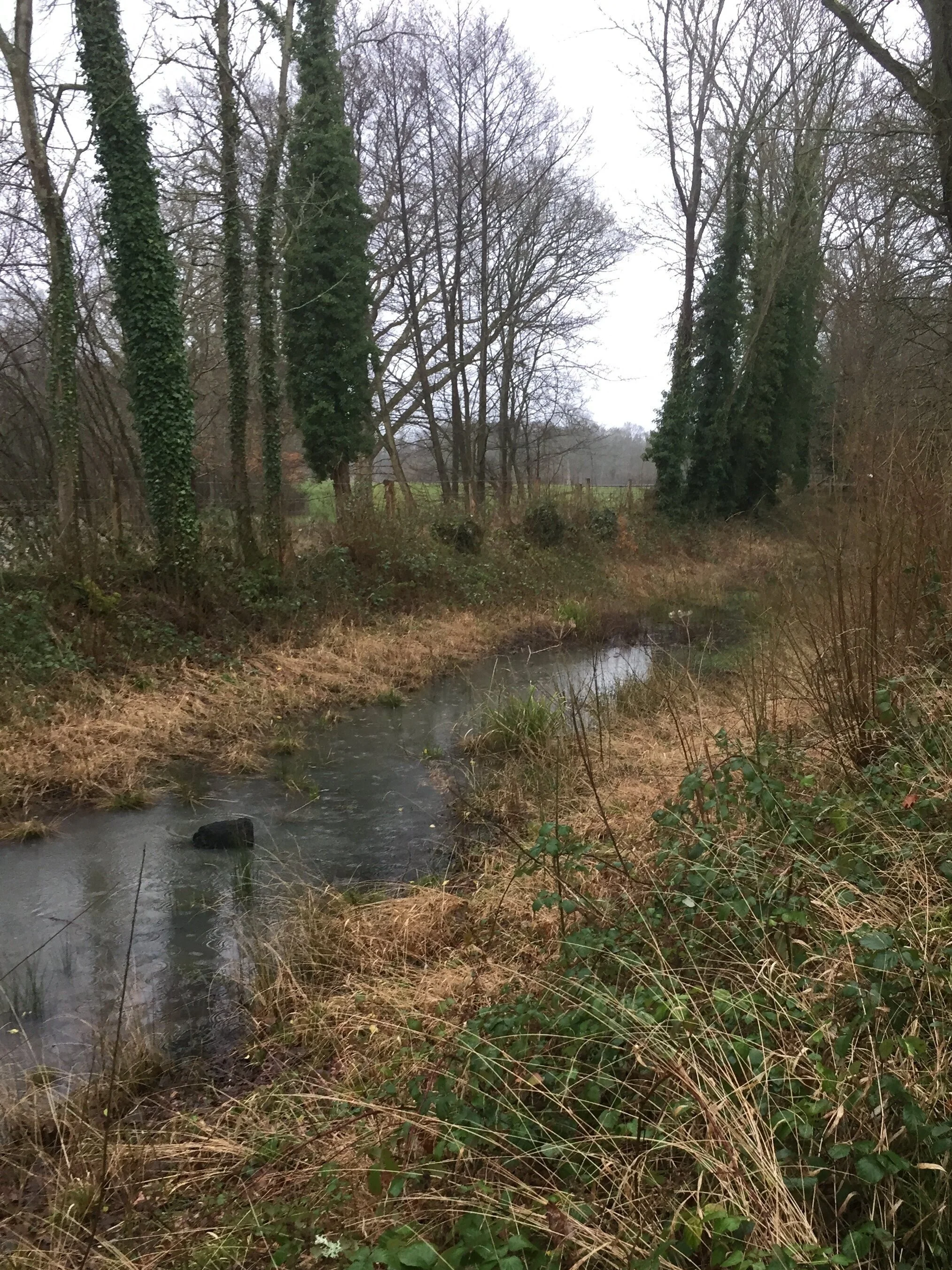
An unrestored part of the Wey and Arun canal
English Social and Economic History
Back in days remembered best in sepia, the school children of this land used to study British social and economic history 1700 to 1945. This would give the successful students an O Level in History.
This wasn’t the study of war or conquest or empire, this was the study of how a small island nation became great - innovation, reform, experimentation and science. Throw in liberty, religious tolerance, property rights and you have an alternative history of Britain to combat the modern narrative of “It was all slavery, innit?”
Isambard Kingdom Brunel, Abraham Darby, Josiah Wedgwood, The Enclosure Acts, The Duke of Bridgewater, Robert Stephenson, William Wilberforce, The Great Reform Act all roll off the tongue of English of a certain vintage. The landmark acts of Parliament, the social reformers, the dark satanic mills, the sheep fanciers and anti Malthusians, all flash by in a parade of not quite forgotten factoids.
One of the accelerators of the industrial revolution was ‘canal mania’ - the twenty or thirty years before the advent and mass adoption of railways. Canals could move bulk commodities long distances safely and efficiently. Britain became criss-crossed by a network of canals, linking cities to the sea, factories to their markets. The longboat, pulled by horses along countless towpaths, complicated series of locks, was one of the unsung heroes of our island story.
But it wasn’t to last.
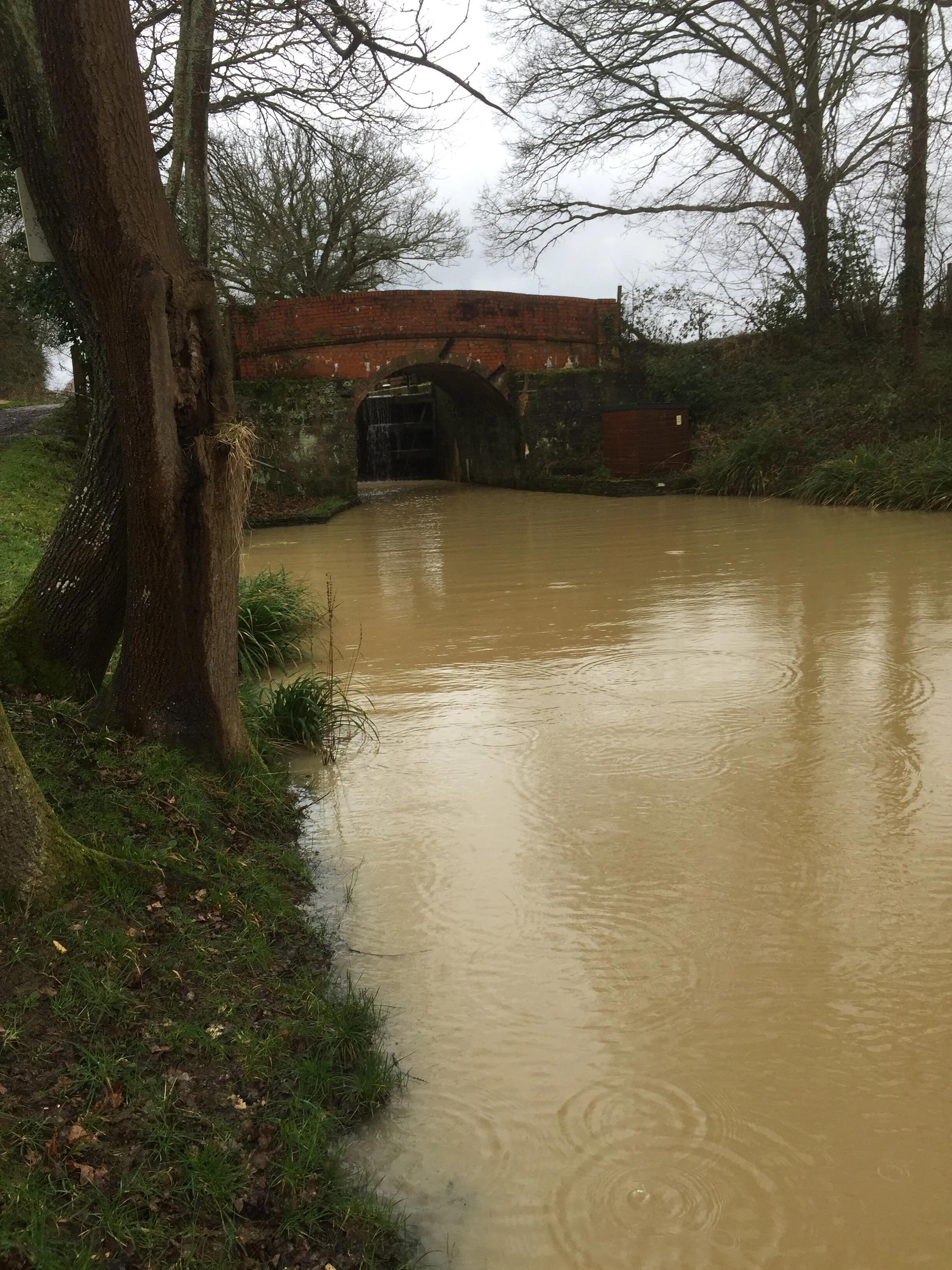
A restored part of the canal with bridge
The railways were faster and could carry more and for further distances. Gradually the canals were abandoned as goods transferred to rail. Slowly the canals disappeared, bit by bit, one by one. They were neglected, infilled, allowed to rot as nature took its course.
Which brings me to The Wey and Arun Canal.
The canal was built between 1813 and 1816 to link the river Wey in Surrey with the River Arun in Sussex. This vital link would thus connect London with the South Coast. But it was soon eclipsed by the railways and never brought in enough traffic to make it viable. It closed in 1871 and gradually was left to rot and re-wild.
I was there a couple of weekends ago. Storm Dennis was coming in hard, the wind was howling, the rain was falling and so - in Tim World - this meant “go for a hike”. Resolving to see somewhere different, a few clicks on Google got me to Loxwood and the Wey and Arun Canal. Hiking boots, walking trousers, bobble hat and Mars bar packed, off I went!
The story of this abandoned canal is one with an evolving happy ending. Since 1970, a preservation society has been gradually reclaiming this old waterway; getting planning permissions, digging it out, repairing bridges and locks, organising professional workers and armies of volunteers. They’ve restored several miles to make it navigable again. They have plans to get the whole canal operational. Big dreams.
A Solitary Walk on The Wey and Arun Canal
I chose a walk incorporating both the restored and unrestored portions, starting and finishing in Loxwood. Technically this was a four mile hike but given the weather, the mud, my unfamiliarity with the route and a failing iPhone battery, it seemed a somewhat longer endeavour. But I live for wind and rain, soft challenges and middle-class war stories.
The restored part of the canal was like any other canal in a beautiful part of the country. The dreadful weather meant I had it all to myself. I walked along the tow path, dodged the falling branches and contemplated the rain on the water. What interested me more though was the unrestored the sections of the canal - untouched since the nineteenth century and left to their own devices. In places there was no flow of water, in others just a trickle. Obstructions abounded - trees grew right in the middle of where a canal was still clearly defined. Farmers had created the own bridges and accesses that cut the canal into pieces. Seeing this made me appreciate the restored part even more. What labours and fortitude must the merry volunteers of the Wey and Arun Canal Trust have suffered to turn basically a dip in the landscape into a functioning canal?
I turned away from the canal up the marvellously named Rosemary Lane (When I was in service in Rosemary Lane*) and then headed cross country back towards Loxwood. Across field and dale, woodland and track I wandered, head down.
There’s a point on a walk where - after stepping in one too many muddy puddles - you no longer beat yourself up about opting for hiking boots and not knee high wellies. You see, walking along woodland trails in mid Feb with a full on storm blowing was, shall we say, difficult. My hiking boots sank into the mud and got soaked (checking today, they still are). I got soaked. My phone ran out of battery. But I ate my Mars bar and found my own way back to Loxwood.
The solitude allowed me to ponder those long ago, semi forgotten lessons in British social and economic history. In truth it was a dry subject matter - no villainous Tudors lopping heads off, or epic Crown against Commons clashes or even little England alone against the united forces of fascism 1940. But walking along this partially restored piece of our industrial revolution got me thinking; it’s the inventors, the doers, the makers and builders that really make the lasting changes, isn’t it? What lasts is not the generals but the engineers. Canal mania was a brief but intense time in our development but they helped get us to where we are. Even in the wind, rain and mud
The Good Life - Part 1

La Plage, Deauville - 2019 (Photo Tim Robson)
“society regulates the general production and thus makes it possible for me to do one thing today and another tomorrow, to hunt in the morning, fish in the afternoon, rear cattle in the evening, criticise after dinner, just as I have a mind, without ever becoming hunter, fisherman, herdsman or critic.”
The other day I gazed at my Twitter feed and saw the same news item retweeted and commented upon by several of the people I follow. Making the same points with various degrees of humour or waspishness. I was literally gazing down at my own personalised echo chamber. Comforting, affirming and totally corrupting.
We all know - or at least I hope we do - that to live the good life, you should be understanding, humble, a seeker or truth and knowledge. What is a good life? Well, read my dissection of Marcus Aurelius here. We should all try to widen our sources of information, and gain new perspectives and thoughts.
This feeling grew after the election in December. I should have been happy - and I was - but a feeling in me grew that perhaps I was missing something. On a whim I trimmed my right wing and libertarian sources and upped my left wing and radical sources. I always had a few (George Galloway, Jimmy Dore, Tulsi Gabbard) but now I wanted left wing voices to be more represented on the panels of my thoughts. My politics is complicated and I wanted my sources to reflect this, to challenge myself.
But last week I went further. As any reader of this blog knows, I have interests in Roman history, history generally, architecture, London and art. But my Twitter feed did not reflect this. So I actively sought out Twitter feeds that nourished what I actually like beyond the narrow prism of politics - archaeological finds and digs, art exhibitions, great architecture from around the world.
And so my twitter feed - my guilty pleasure - is now (for now) more representative of me as a whole, including the better half of my soul. When I look at my feed I want to stray from Trump’s tweets, to a campaign to save a Roman villa in Gloucestershire, to what’s happening next door at the Tate, to the painful internal process of good solid Labour MPs as they try to work out why they got the recent kicking from the UK electorate.
The same with books. The same with podcasts. The same with YouTubing. Music. 2020 has to be the year of diversity of thought, that most important but under-rated of qualities. It is a central pillar that buttresses ‘a good life’.
Next week, I discuss that how reducing your alcohol intake, eating moderately across all the food groups, quitting smoking and exercising regularly might actually make you more healthy. It’s part of my new series; Stating the Bleeding Obvious.
* Footnote - the Marx quote… This always struck me as ridiculous when I read this back at University. We all had to study Marx a lot, and this quote seemed to summarise the unrealistic nature of communism as envisaged in The German Ideology. But if one substitutes work and replaces it with thought, then, not so crazy…
The Greatest Album One / Two Punches

Albums that come out swinging!
There are albums that come out of the blocks with two killer tracks that are like a pissed off Mike Tyson swinging wildly at some trash talking, old timer patsy in the late 80's. Albums that decide that the best way to follow a kicking first track, is with another.

Lock up your aunties! The Crowes in 1992
The Southern Harmony and Musical Companion (1992)
The second album from the Crowes throws 'Sting Me' to the left and "Remedy' to the right. 1992 might have been Grunge Year Zero but, together with Teenage Fanclub, the Crowes held rock's banner aloft. These are kick-ass rock tunes. Basically, The Faces reimagined if their Marshalls were turned to 11 and Rod really went for it instead of pretending to be Sam Cooke. Love these two songs. Highlight - the 'fuck you' start of the guitar solo in Sting Me. A moment in rock I've ever and a day tried to replicate. Two seconds of true power!

The CD reissue doesn't 'feel' right!
Eden - Everything but the Girl (1984)
The impulse purchase one doesn't regret! Stood in WHSmith Rochdale's record department in 1984, I hear the wondrous album play over the store speakers. One track, two tracks, I was sold. Marched up to desk and asked, "Pray tell me good madam, who is making this bewitching sound?". Everything but the Girl apparently. Crazy name, crazy sound. So, I bought the album with its distinctive cardboard, non veneered album with the abstract painting on the front. The songs, I now know, were Each and Everyone and Bittersweet. They detail the commonplace jealousies and realities of relationships. All bedsits, screaming babies and jealousy. No holding hands and a rush towards lust with these songs. It was the clever lyrics as much as the bossa nova rhythms that had me captivated. The rest of the album's pretty good (apart from the execrable Soft Touch). I’ve framed this album.

George is a pinapple head
Beatles for Sale (1964)
Not a One / Two, but a 1-2-3. The Fab Four of course do what other groups do - only better. Whilst other groups would put their singles on their albums, The Beatles didn't. So Beatles for Sale kicks off with No Reply, I'm a Loser, Baby's in Black. With these stunning ditties The Fab Four literally piss on their competition. The bar is set so high, their album tracks sound like a career best single for any other group. Bizarrely, although released at the height of Beatlemania, Beatles for Sale is pretty obscure these days and these three - being non singles - are not as well known as they should be. But I love this album. Almost as much as I love...

Fisheye
...Rubber Soul (1965)
Pound for pound, this non single containing album, packs pretty much the hardest punch of any album. It roars out of the blocks with McCartney's funky - come on Motown have a go if you think you're hard enough! - Drive My Car. Most groups' best single ever. Just an album track. We then shift gear to the acoustic and sitar masterpiece that is Norwegian Wood. As a guitarist, this latter song - with its major to minor shift - is a dream to play. Like You've Got To Hide Your Love Away this shows why Lennon is so revered. This is effortlessly brilliant. We all fuck around on D but don't achieve anything like this. Let alone chucking in a middle 8 in G minor. Class. In a glass.

Hard. Soft. Kicks ass.
Led Zep 4 (1971)
Anything The Beatles can do, Zep does one better and louder! The whole of Side 1 of Led Zep 4. Just review these four tracks:- Black Dog, Rock n Roll, The Battle of Evermore, Stairway to Heaven. And this is just an normal album, not a greatest hits compilation. Not a filler in sight! From the sonic destruction of the first two, to my teenage fav with Sandy Denny (obligatory hobbit references!) to the ubiquitous - but deservedly so - Stairway, this is how to start a 37 million selling album. Are these guys knights of the realm yet FFS?
Want to read more?
What about the five songs from the early sixties that led to heavy rock?
From Bulgakov to Hardy via Romans

It’s crowded. It’s dusty. It is my overstocked bedside table. What lurks there?
Master and Margarita - Mikhail Bulgakov
A Russian novel recommended by a Russian lady. Though she’s departed the scene, the novel remains; a 439 page aide memoire to one of life’s tiny footnotes.
SPQR - Mary Beard
It’s like the law - or something - that there shall be a Roman History book on my bedside table. Mary Beard traverses familiar ground as she meanders around from Romulus to Septimius Severus. Not my favourite author or person but I’ll try and look past that and let the subject speak for itself.
Life’s Little Ironies - Thomas Hardy
Hardy was an all rounder - novels, poems and short stories. Study the art from a master.
The Folio Book of the English Christmas
It’s an annual tradition, I get this book out 1st December, it gathers dust and I put back on the shelf in February as the crocuses emerge and the thought of Christmases past appal.
Caligula - The Corruption of Power, Anthony A Barrett
Not one, but two Roman histories. As a keen student of Suetonius and Robert Graves, this feels a bit obvious to my tastes. I crave the third and fourth century, the fury of Aurelian, the prescience of Constantine, the oddness of Julian. But one still returns to the Julio-Claudians like a Hollywood film-maker.
The Bible - King James Version
The only constant presence on my bedside table. I like to look in occasionally. Ah, wisdom and Western Culture. Mmm. As you were. And today’s reading is: Bread of deceit is sweet to a man; But afterwards his mouth shall be filled with gravel. (Proverbs 20: 17)
And my mobile phone and a coaster with my name on it. Possibly my Boss watch.
The Dead Pubs of Clapham

Snow hits the Artesian Well, Wandsworth Road. A dead pub of Clapham
Adieu Clapham
After three and a half years, I’m leaving my office on Wandsworth Road for Westminster. Three years of working in a repurposed brewery surrounded by dead pubs. In Clapham… Or was it Battersea?
WelI; I worked on the cusp of both districts. Basically Clapham is south of the Lavender Hill / Wandsworth Road axis whereas Battersea is north, next to the Thames.
It’s wise to be precise. For example, Clapham Junction train station has the motto, The Heart of Battersea above its main door.
Geography aside, what do I remember about this area?

A map showing Battersea / Clapham
Lavender Hill
Lavender Hill of course; I walked this bugger twice a day for three and a half years! As I’ve written elsewhere on this blog, I can probably trace in my head every damn step from Debenhams in the West to Sainsbury’s in the East. This trek is aptly described by one of my favourite writers:-
“It’s approximately 2400 steps from one end of Lavender Hill to another. I walk one way in the morning, and the other in the evening. From Clapham Junction to Wandsworth Road, from Wandsworth Road to Clapham Junction twice a day, five days a week. This is my Lavender Hill. ”

The beginning of Lavender Hill - Photo TR
Though there is bustle and many small shops, Lavender Hill was a place to walk along, to get from A to B without stopping. An exception to this would be that fine piece of Victorianara - Battersea Arts Centre (BAC) housed in the old Town Hall. Here, in the Scratch Bar, over a beer or a wine, I composed some of this very site’s best blogs. Always happy when composing in public, BAC provided a home for my ever-elusive muse for a couple of years.
Many was the night I sat and jockeyed a Mac typing spiteful little blogs, dashing off mean spirited diatribes about the posh twats with their elaborate beards and facial jewellery sat around me talking bollocks about politics. Highlight was probably Second Thoughts a story written about BAC and the online dating scene. A modern classic. What wasn’t a classic is ‘The Dead Pubs of Clapham’ a pig of a short story that I never finished. In fact, it was the title I liked, much, much more so than the actual story itself. Hence me reusing it for this blog celebrating the area. But let me give you a flavour of this deservedly obscure tract:
“A dead pub always makes me sad. There are plenty in Clapham. The dead pubs of Clapham. My journey to the station passes many. VE day. The Coronation. 1966 World Cup. The Falklands. And there they stand, not even with the fig leaf of being converted into a Cheap Fried Chicken outlet or a chichi furniture shop for hipsters to waste a grand on a fucking chair.”
The Artesian Well, The Mist on the Water, The Prince of Wales, The Victoria, The Cedar. All dead. Dead in 2016 and dead in 2019. The Dead Pubs of Clapham.
Massages?
One amusing side note to Lavender Hill. In my published ode to this urban highway, I mentioned en passent the many oriental massage parlours dotted on the road where you can - allegedly - get a happy ending massage. A small but reliable number of hits to this blog to this day come from Google searches seeking rub and tug merchants on Lavender Hill. And then they click on this blog where I prattle on about fourth century Roman emperors and obscure Stones tracks. Sorry guys, go back to self-service.
But let’s leave Lavender Hill and massages aside. From where I was based, atop Silverthorn Road, my walks could either take me down the hill to Battersea Park or up the hill to Clapham Common. Down was literally down, a bit shit, loads of Harry Brown type estates, a mishmash of railway tracks, car dealers under the arches, grimy off licences, obscure train stations and finally the wondrous urban space that is Battersea Park. I’ll miss it.
From my office window I used to look down on this city scape, an outlook dominated by the ever changing face of Battersea Power Station. It’s now surrounded by tall towers and modern glass investment flats for international money. Soulless, nondescript, anywhereville. The power station itself got buried in these modern intrusions. However, from my new vista in Westminster on the other side of the river, it looks great; the shitty towers and modern embellishments are merely supporting actors not co-leads. I suppose it’s all about angle and perspective which is about as deep as I get, children.

Battersea Power Station - recent past. Doesn’t look like this now.
Clapham Common
Up the hill and into Clapham where million pound houses give way to eight million pound houses (gorp at Macauley Road if you want to check them out). What do I remember about this side of the tracks? I didn’t walk on the Common much. Obviously the Trinity Church stands proud on the east side near the tube station. In these days of ignorance and lack of knowledge about British history, the significance of this 18th Century church is lost on most of the present day passers-by. But it was here, of course, where the so-called Clapham Sect used to meet and plot the abolition of slavery. We should celebrate this stuff more.

The Common. The High Street. A wet day.
Talking of churches…
No ramble through Clapham is complete without mentioning Graham Greene and his wartime novel The End of the Affair set in and around Clapham Common. One of the scenes is, of course, set in the church of St Mary’s which dominates the eastern end of the Common. From my window at work for a couple of years I used to gaze at the spire half a mile away. My photo (left) rather inadequately represents this local landmark which survived the Luftwaffe bombing the area but who’s spire got somewhat wrecked by an errant friendly barrage balloon.
Another memory, ever present and ever changing is the schtick of the local Romanian beggars outside the tube and Sainsburys Local down The Pavement. For a while accordions were the fashionable must-have accessory for the enterprising beggar. Tuneless whirly-gigs were played evoking, well what exactly? Smokey Roma camps back home? Belle epoch Champs Elysee? Fuck knows. However, accordions now seems so very 2018. The begging community have reverted to the classic shake and a shimmer with hand outstretched and a single word ‘please’ dragged out pitifully. And who could forget the daily ‘conferences’ on the waste land beside the tube station, where the area’s street workers gathered to compare takings, discuss tactics, and split test new methods of appeals.
Then there are the pubs.
The Bobbin Pub
“The Bobbin pub lies hidden on a side street near Old Town in Clapham. The area, suggesting unflashy old money, is flush with inner city mansions, tree lined roads festooned with Land Rovers and X5s, gardens tended by minimum wage labourers, constant daytime building works as the inhabitants add subterranean swimming pools and climate-controlled wine cellars, but quiet at the weekends as the residents retire to their country piles in Wiltshire. There’s an abundance of leonine men of a certain age wearing red trousers sporting trophy wives.
Twats.
”
And there was one barmaid. I’ll miss her. If I asked what her feelings were on my departure I’m sure she’d just smile shyly, push a strand of hair away from her face and say, as she had many times before, “What would you like to drink?”
Literally cannot turn it off. In Clapham. Or Battersea.
Read More?
What about my thoughts on Lavender Hill? Or more London Walks?
Check out my novel Franco’s Fiesta on Amazon. Pretty sure it’s free now!
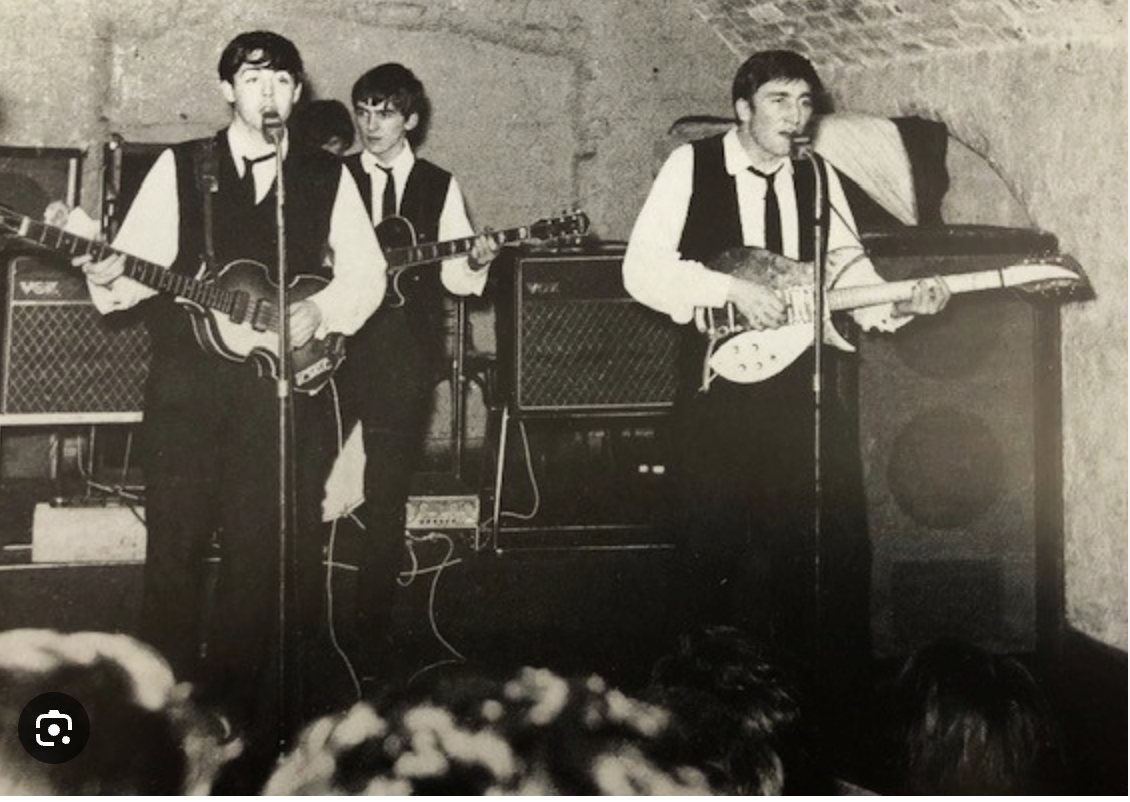

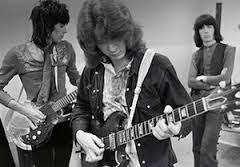


The Battle of East Croydon

Happy commuters gather to celebrate paying thousands for a shit service
Chaos at East Croydon. Again.
The following is an excerpt from the diaries of The Unknown Commuter, who fought in the legendary Battle of East Croydon. He's currently believed to be somewhere between Clapham Junction and Brighton waiting for a train. The reader is advised that the recollection includes strong opinions expressed robustly.
"Rail chaos. Where am I? My 17:52 from Clapham Junction has just been cancelled. Cancelled because too many drivers and conductors pulled a sickie. Because they can’t be bothered calling a real strike and therefore lose pay. So they do this low-down not turn up trick.
The petulant bosses cancel trains at the last minute. Twelve car coaches are reduced to four. When they turn up. Standing next to some git's armpit listening to techno leaking noisily from his headphones. Wanker.
A Swift Pint at The Junction Pub
So I stop off at the pub outside the station. And have a pint. Hope the chaos has died down. My train app says the train is now on time. Run to the station. Go on the platform. My train has been delayed. Doesn’t even merit a revised time. Just delayed. That is ominous. Okay, so no direct train. Recalibrate, so; if the 17:52 has been cancelled I’ll take whatever goes to East Croydon – they all go to East Croydon – and take my chances there. I jump on the first train arriving at my platform. Travellers swirl around the opened doors. No one tries for a seat – just to get on and then find somewhere to lean that’s not on a fellow passenger. Somewhere to hold on.
The train, almost deliberately, crawls to East Croydon. I mean, I could walk faster than this fucker. It must know there are whispered reports of mythical connecting train that will take me home. Leaving in ten minutes from East Croydon. So my train goes slow. Very slow. Stops at Purley and just chills for ten minutes. The conductor says something about there being congestion which means we’ve missed our slot to get into East Croydon. Fucking comedian. They’ve cancelled half the bloody trains! What congestion can there possibly be? Congestion at the bar in the striking drivers local, perhaps?
A feeling of bleak despair grows in me as I keep checking the time. I know, yes, I know, I’ve missed my connection. Gone like the wind. Unlike every other train tonight, my connecting train will be promptitude itself. Arrive on time. Leave on time. Of course.
So I join the chaos at East Croydon looking for another way home. Need a piss. Hey – I’m at a railway station. Need a piss. I know there is nowhere to go. When did that happen? When I was younger, I can still remember - though it’s pictured in sepia - you could take a piss at railway stations. Where did they all go those public conveniences? Maybe it was too many junkies shooting up or too strangers giving each other hand jobs but toilets in stations disappeared. So now what we gonna do? Hold it in while we wait for some fantasy train that will take me home which has fantasy functioning toilets.
The platform signs are in on the great swindle. Part of the con. Constantly changing, they show an ever changing landscape of fuck ups. Seasoned travellers, world weary and pissed off, stand up the stairs ready to run wherever directed. Just cause a train to the South coast is always on platform 2 or 3 doesn’t mean they won’t pull a surprise on you last minute. Platform 5! Leaving now. Run plebs! Too late.
So I stand on the concourse. Bladder full to fuck, ready to run, run wherever the electronic scoreboard predicts a train going my direction might be. Flashed up – it will arrive in ten minutes on platform 3. We all run down there jostling for space, for a place. Then the platform scoreboard flashes up that this train has been cancelled. Lots of shouts and swearing. Some of us go back up again. The scoreboard upstairs still says the cancelled train will arrive, er, well, about three minutes ago.
The station announcer employs a world-weary voice. Fed a diet of bullshit and nonsense by the train companies he reads out the ever changing deployment of fantasy trains he knows won’t make it. His bosses just want us off their platform, out of their station. Pass the problem further down the line. Get East Croydon passenger free, demob the mob on someone else’s patch. So they get the announcer to try and parse our journeys – push us to smaller stations with promises of legendary connecting trains. Some fall for it. We see them hours later, mournfully sat at Balcombe or Three Bridges helplessly watching the non-stopping Brighton trains pass them by. Idiots. Novices!
A Train on Platform 3? Or 2?
As to my own train, it’s now got a time, eight minutes hence on Platform 3. Hang on. No, it’s now twelve minutes away. No it’s cancelled. No it’s just late the announcer says. Might be at Clapham Junction. Might be further ahead. Who knows. Information is power.
Silently, below us on platform 2, a train pulls in unannounced. Suspicious, some passengers edge towards that platform. I hear a shout – it’s our train – just as the announcer tells us that it is indeed the train we want but it is now getting ready to depart. Shouts and swearing as three hundred people rush towards platform 2. Exactly ten seconds later an announcement says that we should move away from the doors as the train is preparing to leave.
Fuck off.
We rush the train, rush the doors, the rail people on the platform tells us to move away but we’re an unstoppable, feral force of nature. They’re concentration camp guards, and collaborators. Fuck off. To the sword with them!
We storm the train. Push the guy with the folded bike out the way, edge past the confused old couple who had a day’s shopping in London and now rather wish they didn’t. The seats are all taken. Naturally. So we’re packed in, standing, holding onto whatever we can. The LCD sign in the carriage boldly displays that we will be going back up to London Victoria – the wrong way FFS. Can’t these monkeys get anything right? The conductor comes over the tannoy and announces that we should stay away from the doors. Cheers mate, but where are we actually going? This way or that? Not until the doors have shut and we start to crawl away – packed, overweight, angry – and it’s too late to change – does the conductor announce that this train is indeed going south.
And we crawl there. Two toilets out of three are out of action. The one I go in looks blocked. I don’t care. Shut eyes and leave quickly. Ah the relief. My station is announced. As I get off, tired, sweaty, battered, the station tannoy says that the 19:54 train to Brighton is ten minutes late. It’s taken me two hours of stress to get here. Should be fifty minutes.
Wankers. Truly wankers.
The battle begins anew tomorrow."
This repost from 2016 is dedicated to the morons who are striking all through December on South Western Trains. Tossers.