
Walking on Lavender Hill

Old fashioned street sign. Classic Design. Not used anymore. Of course.
“I commute into Clapham Junction everyday. My office is a twenty minute walk up Lavender Hill and Wandsworth Road.”
Lavender...
The word lavender conjures up those sun drenched, hazy fields of Provence. Or perhaps some choppy, warm-toned, Impressionist masterpiece. Or is it a section of a busy thoroughfare in South Central London? Yes, it’s probably the latter. For years this road, this feeling, was my beat.
One thing you won’t find much of on Lavender Hill is, well, lavender. Maybe some discarded pizza boxes, plenty of rubbish strewn waste bags, an upturned supermarket trolley or a decaying Christmas tree thrown onto the street. But not much lavender. The shrub that gave this area its name has gone. Long gone.

The green fields of Lavender Hill. Picture TR
My entrance and exit point to this urban dreamscape is Clapham Junction railway station. Not sure what a junction is, but as to the Clapham part, well, that’s a little bit of historical postcode snobbery. A fib. It’s in Battersea. And Battersea is working class. Full of engineering and manufacturing works back in the day. Less so now. Maybe we could rename it Lavender Junction? Help shift those new million pound apartments, no?
There’s a pub. There’s always a pub, isn’t there? The Falcon is pretty special though. One of those big pubs you only get in London. The ones dripping with large baskets of flowers, partitioned rooms and back lit smoky glass. This one sports a famous horseshoe bar (the UK’s longest apparently). I don’t drink there though – nor the Slug and Lettuce next door. However, the facilities are unguarded and handy so I was pretty much a regular.

The Falcon. Piss stop.
So up we go, up Lavender Hill, ambling wistfully through these London fields. Past the retail splendour of Arding and Hobbs, sprinting past Fitness First, KFC and numerous Lebara money transfer shops where bored staff sell cheap booze and fags, whilst conducting mobile phone conversations that sound important, but probably aren't.
There was a girl once. There's always a girl, behind the memories, driving the words. We were students at South Bank University further up the A3036 on Wandsworth Road. The campus is now closed and converted into a Tesco Express and Pure Gym. I used to catch the Number 87 bus down Lavender Hill to Clapham Junction. If I was more observant, as I sat on the bus all those years ago, I would have noticed a local oddity – a genuine London eatery – the Pie and Mash shop. The historian and the Englander within me likes the fact that this relic of old London, of its working class eating habits, is still there. I like that. I’m a fan; pie and mash and gravy for £4. Treacle Pudding and ice cream or spotted dick for £3. I don’t go near the eels or the liquor (eel and parsley sauce). It's cheering though to know nestling amidst the numerous Thai, Indian, Italian, Japanese, Chinese and assorted other restaurants there is an authentic London eatery. But for how long?

Eels. Jellied. Yum.
Continuing on we get Battersea Library, the police station but, most wonderfully (and where most of the drivel on this website was written) the Grade 2 listed building that used to be Battersea town hall but now doubles as Battersea Arts Centre. They used to build beauty, those Victorians, you know, put the effort in, and make buildings things of wonder and aspiration.

“Kate and I are meeting in Battersea Arts Centre. I’m late. I scan the bar. At a corner table is a woman who bears a passing resemblance to Kate’s online dating profile.”
However, money was always an issue, even in the 1880’s. None more so than The Church of the Ascension, a big, bold - God is terrible, God is almighty, repent ye sinners - church at the top of the hill. It’s a massive stone structure with Byzantine influences by way of Carcassonne. It should have been adorned with an equally gigantic phallic tower but the original architect pissed the money away, was eventually sacked and so he church was completed sans spire. Nerdishly, I own a copy of the original architectural plans from 1875 and framed, they adorn my living room.

French / Byzantine architecture meets Victorian brick shit-house, muscular Anglicanism.
“There’s a tramp whose regular perch is the low surrounding wall of the Ascension of the Lord Church on Lavender Hill. Kicking back with his can of strong lager, he likes to shout abuse at the passing world. His favourite trick is surprise; hunched harmlessly over his carrier bag one minute, and then, as though roused from sleep, pouncing like a lion the next.”
And then we're walking downhill. Go past - hurry! - The Crown pub. One time, as I was leaving, I witnessed some ritualised urban ballet as two drug dealers squared off to each other out on the street. Held back by their various women folk screaming, "Leave it out Jon, he's not worth it!" I waited for my Uber to take me to the station as the performance played out. Don't know who won. It's probably on YouTube somewhere.
This eastern part of Lavender Hill is all shit council flats and massed ranks of mopeds parked on the pavement outside nondescript takeaways. Let me explain lest you live in a town where cuisine laziness hasn't yet set in. Every eatery on Lavender Hill - and there are many, so many - has a fleet of mopeds waiting to transport to the indolent, the obese, and the time poor banker-wankers, their genuine, wood fired Neapolitan pizzas. This, children, is what decadence looks like. Fight, fight, against the dying of the light and cook from scratch you lazy bastards!
“We continue walking down Lavender Hill keeping our own counsel. Once again, our pace is well matched and we walk together, three feet apart. As we near the old Cedar pub, she slows.”

Lift up your eyes. There is beauty in the most unusual places.
There are many places on Lavender Hill that offer a 'massage'. Strangely they always want to massage - for extra, for cash only - those parts that don't often get massaged in - say - more mainstream establishments. Happy endings are promised. Not always delivered. I avert my eyes, clutch my pearls, lift up my skirts, and run from these places.
(And that paragraph - about happy endings on Lavender Hill - still sends me significant traffic to this website. I’m guessing here, but there’s probably money to be made from adult activities.)
And so, after a mile or so, Lavender Hill finishes at Cedars Road and hands the A3036 baton over to Wandsworth Road in a fistful of Tesco Expresses, coffee shops and Premier Inns in old temperance halls. We are now entering Lambeth and our story must end here.

What happened to Battersea? Abolished in 1965, apparently.
And so where does all this take us? An old London Street. Full of Victorian buildings. What signifies?
“And with clear, cold eyes
And newly acquired candour,
I sift these departing delusions;”
Well, everything. And nothing. From the confident Victorian public buildings, to the sturdy 19th Century housing for the workers, to the bold and confident Anglicanism. To the many, many cultures that have taken root here, left their mark on the shops, restaurants, through even the pizza delivery boys that criss-cross unknowing across this urban thoroughfare. To the pubs, open and closed, converted or renovated, silently bearing witness to wars and coronations, disasters and triumphs. History shines through, hiding amongst these stones, these relics, peeping shyly from under the brim of modernity. The breath of London, old London, still blows gently in this cityscape. And if you look hard enough, you will find some lavender. Yes, even on Lavender Hill.

Lavender. On Lavender Hill
All pictures of Lavender Hill, Tim Robson February 2017. Article revised April 2020
Tony Blair, Re-appearing Chimneys and Knee Breeches.
I look out my window and see Battersea Power Station sporting four chimneys. I can remember last year when there was just one. In between I remember there being two and then, some time afterwards, three. Chimneys; they come, they go.
It's an exciting observation and I wanted to share it with you - fellow students of urban architecture.
Back when I had hair and the world was younger and kinder, I did a Masters Degree in some real estate related subject. Some right-on professor who put the tosser in the phrase 'complete tosser' was jerking off about the evils of worshipping buildings. Apparently, everything in the urban environment should be new, anything 'old' knocked down when a new fad comes into view. No idols. No memories. No sentimentalism. He was Corbusier's idiot son.
Architectural and cultural vandalism was very a-la-mode in the 90's. Remember that dickhead Blair ludicrously waffling about Britain being 'a Young Country'? Scrapping the Lord Chancellor's office because it was symbolised by wigs and knee breeches? He should have been impeached just for that particular stupid action. Let alone the illegal wars.
Professor Tosser would look out from his ivory tower on Wandsworth Rd and pontificate on the built environment he could see. BTW, I use the term 'ivory tower' loosely. It's more like a concrete tower. And the University building is now a Tesco Express which seems appropriate and very modish somehow. The Prof would riff on the poverty of Battersea around him and the ridiculousness of preserving that great white elephant - Battersea Power Station. A cesspit of chemicals, pollution and redundant bricks.
But, it remained. And remains. Though redeveloped it still maintains its facia. The bricks. It's dominance and, yes - count them! - it's four chimneys. As Bruce says:-
“I had a brother at Khe San
Fighting off the Viet Cong.
They’re still there, he’s all gone.”

Four chimneys August 2017

Three Chimneys Feb 2017

One Chimney Spring 2016
Lavender Hill (up against the wall edition)

Piles of perfectly good bricks outside Battersea Arts Centre May 2017
“All politics is local.”
Wandsworth Council quite clearly have so much money they can just piss it up against the wall.
There's an interesting example of digging holes and then filling them in again happening on Lavender Hill. An act of such pointlessness it would be funny if it wasn't for the fact the taxpayers are taking a beating again.
Lavender Hill had pavements in red brick. Bricks tend not to break and fracture like concrete slabs. The pavement is therefore in pretty good condition (excepting the non brick, stone slabs outside Battersea Arts Centre).

The brickwork pavement in Feb 17. Pretty good condition, no? Gone. A memory.
So what are the Council doing? Digging up and skipping a perfectly good pavement and then putting down another.
As an act of pointless waste of tax payers' money this is quite high. I literally cannot understand what the hell they are doing. Maybe, they signed some bullshit deal with a contractor that means they have to rip up the pavements every X number of years. Irregardless of condition.
Wandsworth is a Tory Majority run council. You can't trust the Tories when it comes to money. I suppose they had to justify their 3.99% council tax increase in 2017/18 somehow.
Of course, Labour / Lib Dem / Green would just hose the money into the Thames so it's a choice between a kick in the goolies or being shot.
--- --- --- -- --- ---- ---
So here I am. Worrying about the state of the pavements in Wandsworth. I think - girls - I should start re-engaging with you. But, once you turn on that switch, there's no turning it off. You have been warned...

Concrete slabs. Waiting to be broken.
Lavender Hill
Old fashioned street sign. Classic Design. Not used anymore. Of course.
“I commute into Clapham Junction everyday. My office is a twenty minute walk up Lavender Hill and Wandsworth Road.”
Lavender...
The word lavender conjures up the sun drenched, hazy fields of Provence. Or perhaps some choppy, warm-toned Impressionist masterpiece. Or it's a section of a busy thoroughfare in South Central London. Yes, it’s probably the latter.
One thing you won’t find much of on Lavender Hill is, well, lavender. Maybe some discarded pizza boxes, plenty of rubbish strewn waste bags, an upturned supermarket trolley or a decaying Christmas tree thrown onto the street. But not much lavender. The shrub that gave this area its name has gone. Long gone.
The green fields of Lavender Hill. Picture TR
My entrance and exit point to this urban dreamscape is Clapham Junction railway station. Not sure what a junction is, but as to the Clapham part, well, that’s a little bit of historical postcode snobbery. A fib. This is Battersea. Not Clapham, which is posh and a mile away. Battersea is working class. Engineering and manufacturing back in the day. Less so now. Maybe we could rename it Lavender Junction? Help shift those new million pound apartments, no?
There’s a pub. There’s always a pub, isn’t there? The Falcon is pretty special though. One of those big pubs you only get in London. The ones dripping with large baskets of flowers, partitioned rooms, and back lit smoky glass. This one sports a famous horseshoe bar (the UK’s longest apparently). I don’t drink there though – nor the Slug and Lettuce next door. However, the facilities are handy so I’m pretty much a regular.
The Falcon. Piss stop.
So up we go, up Lavender Hill, ambling wistfully through these London fields. Past the retail splendour of Arding and Hobbs, sprinting past Fitness First, KFC and numerous Lebara money transfer shops where bored staff sell cheap booze and fags, whilst conducting mobile phone conversations that sound important, but probably aren't.
There was a girl once. There's always a girl, behind the memories, driving the words. We were students at South Bank University on Wandsworth Road. I used to catch the Number 87 bus up and down Lavender Hill to Clapham Junction. If I was more observant, as I sat on the bus all those years ago, I would have noticed a local oddity – a genuine London eatery – the Pie and Mash shop. The historian in me likes the fact that this relic of old London, of its working class eating habits, is still there. I like that. But I don’t go in. Not a fan of eels unfortunately. But it's cheering to know it’s still there nestling amidst the numerous Thai, Indian, Italian, Japanese, Chinese and assorted restaurants.
Eels. Jellied. Yum.
Battersea Library, police station but, most wonderfully (and where this drivel is mostly written) the Grade 2 listed building that used to be Battersea town hall but now doubles as Battersea Arts Centre. They used to build beauty, those Victorians, put the effort in, make buildings things of wonder and aspiration.
“Kate and I are meeting in Battersea Arts Centre. I’m late. I scan the bar. At a corner table is a woman who bears a passing resemblance to Kate’s online dating profile.”
However, money was always an issue, even in the 1880’s. None more so than The Church of the Ascension, a big, bold - God is terrible, God is almighty, repent ye sinners - church at the top of the hill. It’s a massive stone structure with Byzantine influences by way of Carcassonne. It should have been adorned with an equally gigantic phallic tower but the original architect pissed the money away, was sacked and the church was completed sans spire. Nerdishly, I own a copy of the original architectural plans from 1875.
French / Byzantine architecture meets Victorian brick shit-house, muscular Anglicanism.
“There’s a tramp whose regular perch is the low surrounding wall of the Ascension of the Lord Church on Lavender Hill. Kicking back with his can of strong lager, he likes to shout abuse at the passing world. His favourite trick is surprise; hunched harmlessly over his carrier bag one minute, and then, as though roused from sleep, pouncing like a lion the next.”
And then we're walking downhill. Go past - hurry! - The Crown pub. Last week, as I was leaving, I witnessed some ritualised urban ballet as two drug dealers squared off to each other out on the street. Held back by their various women folk screaming, "Leave it out Jon, he's not worth it!" I waited for my Uber to take me to the station as the performance played out. Don't know who won. It's probably on YouTube somewhere.
This part of Lavender Hill is all shit council flats and massed ranks of mopeds parked on the pavement outside nondescript takeaways. Let me explain lest you live in a town where cuisine laziness hasn't yet set in. Every eatery on Lavender Hill - and there are many, so many - has a fleet of mopeds waiting to take the indolent, the obese, the time poor banker-wankers, their genuine, wood fired Neapolitan pizzas. This, children, is what decadence looks like. Fight, fight, against the dying of the light and cook from scratch you lazy bastards!
“We continue walking down Lavender Hill keeping our own counsel. Once again, our pace is well matched and we walk together, three feet apart. As we near the old Cedar pub, she slows.”
Lift up your eyes. There is beauty in the most unusual places.
There are many places that offer a 'massage'. Strangely they always want to massage - for extra, for cash only - those parts that don't often get massaged in - say - more mainstream establishments. Happy endings are promised. Not always delivered. I avert my eyes, clutch my pearls, lift up my skirts, and run from these places.
And so, after a mile or so, Lavender Hill finishes at Cedars Road and hands the A3036 baton over to Wandsworth Road in a fistful of Tesco Expresses, coffee shops and Premier Inns. We are now entering Lambeth and our story must end here.
What happened to Battersea? Abolished in 1965, apparently.
And so where does all this take us? An old London Street. Full of Victorian buildings. What signifies?
“And with clear, cold eyes
And newly acquired candour,
I sift these departing delusions;”
Well, everything. And nothing. From the confident Victorian public buildings, to the sturdy 19th Century housing for the workers, to the bold and confident Anglicanism. To the many, many cultures that have taken root here, left their mark on the shops, restaurants, even the pizza delivery boys that criss-cross unknowing through this urban thoroughfare. To the pubs, open and closed, converted or renovated, silently bearing witness to wars and coronations, disasters and triumphs. History shines through, hiding amongst these stones, these relics, peeping shyly from under the brim of modernity. The breath of London, old London, still blows gently in this cityscape. And if you look hard enough, you will find some lavender. Yes, even on Lavender Hill.
Lavender. On Lavender Hill
All pictures of Lavender Hill, Tim Robson February 2017
Beneath the Veneer, The Past Appears

Hiding for years behind an advertising board, this older pre-war painted advert for a long dead company appears like a tidal island on a house on Wandsworth Road. The board that obscured it for so long also protected it and kept its colours fresh.
(Underneath the current modern advertisement board there's another old style ad peaking out for the same company.)
An amazing find. Am I alone in finding these things fascinating?
The Lavender Hill Mob

To supplement my earnings as a writer (cue laughter).... What? I don't make millions from my scribblings? Sadly no. Anyway, to supplement my earnings as a writer, I started working for a great, small company a couple of months ago. It's based on Wandsworth Road, London, just beyond Lavender Hill and close to Clapham Old Town / Common. Which means, I'm commuting again.
(Should I write a blog post about the frustrations of being a commuter, the appalling manners and habits of my fellow passengers? Maybe - right after I finish this novel I'm writing about a boy wizard in a school for magic, who has a dark past...)
My walk to and from work takes me past the Grade 2 listed Battersea Arts Centre. Formerly Battersea's town hall before absorption into Wandsworth, it's a beautiful late Victorian building. It's currently undergoing a renovation. I know this because the outside steps and pavement are being revamped as I write - beautiful slabs of stone awaiting to be laid. They're not doing it on the cheap. It's good this piece of heritage is in such good hands.

The restoration work going on April 2016
Anyway, it is my custom to stop here as I await my evening train and write the odd blog post (hello world!), pen hackneyed poetry - my new thing - or tweak a short story. The bar is a great space - the vibe of an old school refectory hall with parquet floor, mismatched furniture and flickering candles. I can people-watch the pre-theatre crowd as they tweak their beards or polish their nose rings.
Actually it's a bit more broad based than that (well, not much to be fair) but the clientele are a merry bunch, like the bar staff. A simple menu of rustic burgers (beef/jerk chicken/ pan fried humus or some shit like that) and sharing plates tempt the hungry writer... The plays my hipster friends are here to see however, all seem to be absolute leftie bollox - unchallenged, lazy victimhood-claiming rants spewed out to an unthinking Guardian reading audience. Perhaps I should go along! Or put my nob in a blender. Choices. Choices.
Amusingly, the beard who's sharing my table with his - not unattractive - date, is seriously over-reaching. He's wanking on about some Time-Out review of tonight's opus about whales (called Wails). Aside - I wonder if I could get a whale steak here? Probably not. Anyway - he's earnest in his denunciation of those global capitalistic, UKIP supporting whalers who are triggering the safe spaces of tuna or bearded twats or something. Blah Blah Blah. Probably Donald Trump's fault. Anyway, this seems to be working with his date who's nodding her head at his sage bon mots. Maybe I should update my routine, no?
Anyway - the wail of the curtain going up has moved my good friends from the table and I'm now alone penning sundry character assassinations. But - and this is the bit I want to leave you with - you can never close off a place, or shut out people just because you don't agree with them. I laugh at them and poke fun at them in a public forum because I live in land where to do so is part of our culture and I'm free to do so. And hideous lefties that they undoubtably are, what I share with them is SO much more than what I disagree with them about.
Everything is permitted in the UK unless banned. Other cultures and countries give you licence to do certain things. Think about it. There's a world of difference.
But I'm happy to be here in the lovely confines of Battersea Arts Centre and I'm glad even the lefties will have a good night with their righteousness to keep them warm. I think my earnest friend may well have something else to keep him warm!
God-like power
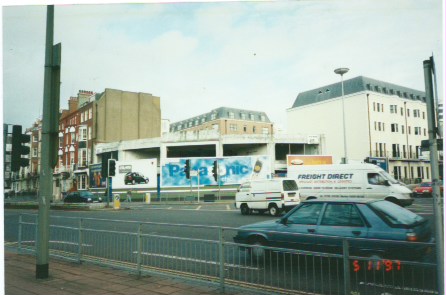
A familiar sight in the mid to late 90's opposite The Royal Pavillion, Brighton
One of my passions is urban architecture and how cities change over time.
I’ll explain.
Take a large corporate plc with many employees. Staff come and staff go. There is no such thing as ‘the staff’ over any period of time. There can only ever be a snapshot of employees at any given moment.
As Pocahontas said – I paraphrase – you never can put your hand in the same river as, it is always flowing, always different. Yes, the wisdom of Disney.
It is the same with urban architecture. It is always changing and the only thing that tricks us into thinking it is not is the fact that bricks and mortar typically change more slowly than humans (or rivers) and so we don’t see it.
I first became interested in this subject when I was eleven. I used to walk through a housing estate on my way to school and every day for months I passed a house - a house where a rather large extension was being built. Day after day, I would trudge past with my briefcase and French horn and for a few months, this state of incompleteness was my experience of this house and this journey. Now, of course, the extension has been built for thirty odd years and has taken on a look of permanence. But I remember a time when it wasn’t there and a time when it was incomplete. My ‘snapshot’ is different to most.
This little experience gave me a love and interest in the urban built environment. Hey - it’s better than watching football or soaps! Old pictures of Rochdale, Brighton or London, for example, excite my interest. I found a picture once of the Houses of Parliament being built in the 1850’s with Big Ben only partially constructed. How the Londoners must have marvelled and how that incomplete tower must have been their reality for months, if not years. History literally in the making.
So urban architecture in transition is always of interest to me and if I see something being built or changed I try to snap a picture and record that moment of transition between one solid state and another. Capture the ephemeral nature of the built environment.
Unsurprisingly given the above, I did a master’s degree in portfolio management in the 90’s and, as part of it, authored many theoretical projects to develop the South London and Brighton built environment. This was an interesting period – right after the property crash of the early 90’s – and there were many underused or derelict sites lying undeveloped, in places we would now see as property hotspots.
I especially remember the site at the bottom of Edward Street opposite The Royal Pavilion in Brighton. It had been a derelict shell for years with a short term use as a temporary car park. My limited proposal was to build a hall of residence for the polytechnic as you couldn’t give away flats in those days. But what’s most interesting now to remember, is the fact that this site – right in the heart of historic Brighton – lay abandoned for years. Hard to imagine now, but cities ebb and flow with the years; we, who live in them, just don’t recognise this.
An interesting aside to this period in my life was that I was in charge of real estate for American Express Corporate Travel - the division with the largest portfolio of space in the UK. When the lease of the HQ building in the Haymarket ran out, I was tasked with acquiring the replacement. And I found it by walking around the then unfashionable district of Southwark - south of Blackfriars Bridge. This was the real old London experience where you could still imagine the Ripper wielding his knife on unsuspecting late night revellers unwisely walking through the narrow streets of tall warehouses.
I acquired a building on Blackfriars Road that was – in Amex terms – incredibly cheap. At that point the Jubilee Line extension hadn’t been completed and Southwark tube station – just yards from my building – wasn’t yet complete, let alone open. Today the area, with great tube links, is a thriving commercial part of London but when I was in the market, it was a backwater, and - as some eminent real estate professor at my university told me like the perennial late night black cab driver - no-one wants to go South of the River!
So when I walk past ‘my’ building these days, I experience several emotions. Firstly, pride in my accomplishment, of course. Reflections about how my decision influenced hundreds, if not thousands, of lives. About how I changed their lives permanently. Oh the power! Yes, the beginnings of my nascent God complex… But what I really remember - as I walk around - is my first impressions of a central London area, next to the Thames, with no tube, no intrusive glass towers, that was covered in post war Corbusier inspired hideous concrete offices but also rather marvellous back street pubs filled with growling cockneys and cigarette smoke.
It’s not just buildings that change the character of cities!
Do know what? In that period, I couldn’t even give away offices in Argyll Street and New Bond Street. Can you imagine that? I’d go up and meet the agents who’d tell me how they couldn’t get rid of my space – opposite the Argyll Theatre, amongst all the high end fashion shops. That I’d have to lower the price and give rent free periods. Different days. Different times.
Different times.
More tales from the life urban and architectural soon.
Tim