
Kirkby Lonsdale to Whittington: A Circular Walk
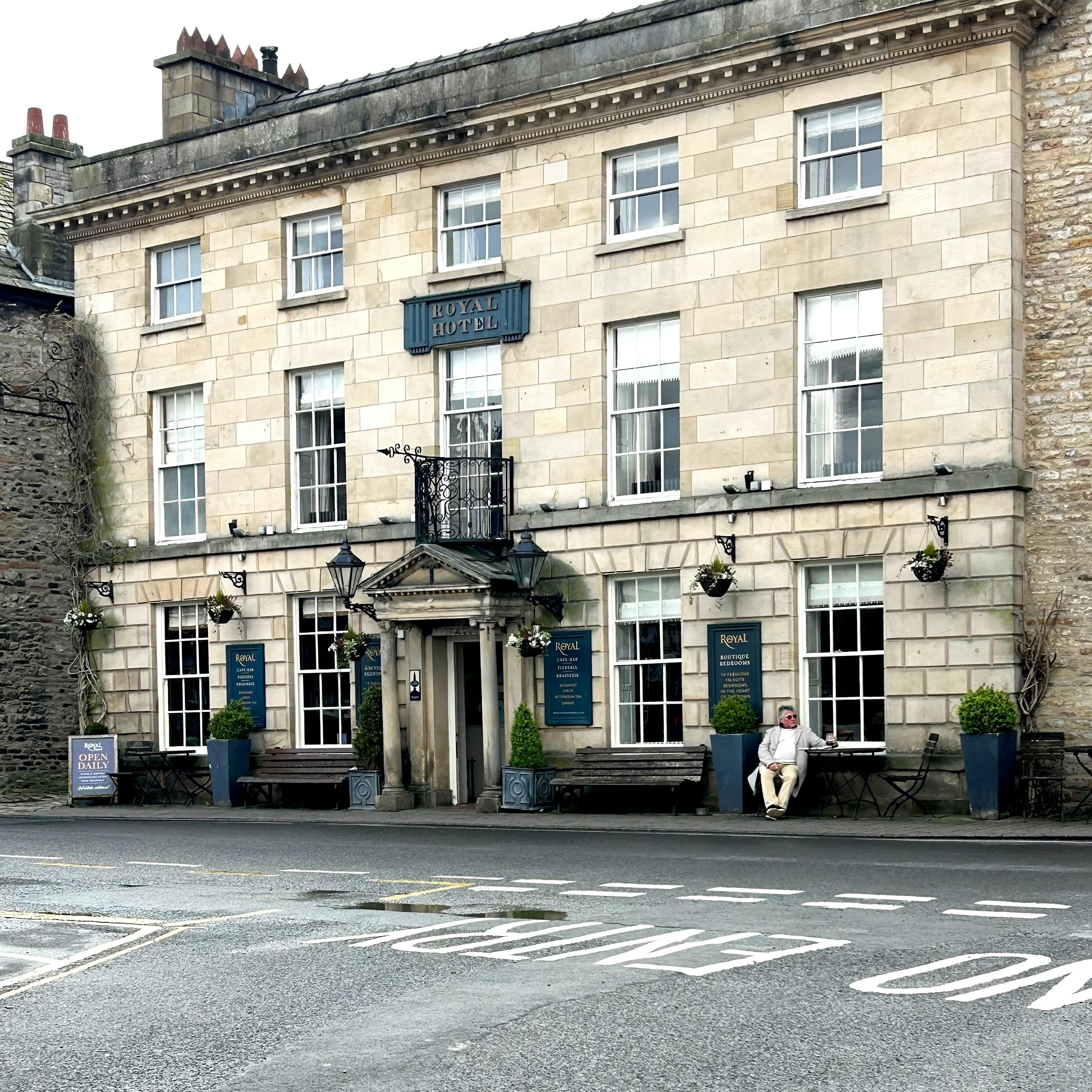
The Royal Hotel: The start and the end of this walk
(In which Tim babbles about a 5 mile circular walk in Kirkby Lonsdale. Strays from this literary path, takes wrong turns, reverses himself, tries to elevate the experience, fails, makes poor jokes and maybe, maybe, perhaps, provides the casual viewer with some advice. But, probably not.)
Hiking repeats itself, first as disappointment and embarrassment and then as elation and smugness. Marx nearly got it right. So close but I think I’ve adapted his words well. It’s what the old boils-on-the-arse freeloader would have wanted. Or, whatever. Yeah.
I have a rule when discovering a new hike for the first time; like sex, it’s better alone. Er, what Tim? Is that right? Okay… Maybe what I meant to say is that, in order to get knowledgable about a hiking route (and sex), then it’s best to explore alone first. Because, well, so you know what you’re doing, right?
No Tim. The analogy is still crap and pretty embarrassing. Take the shame and move on.
Kirkby Walk Anyone?
Anyway. I ‘discovered’ Kirkby Lonsdale last year. Put it on the map, in fact. Or at least my sat nav. Stayed at the Royal Hotel in the centre of town with my father and my eldest daughter. Looked up a walk. But ignored the first rule of new hikes as set out above (you know, do it yourself first). So I went on it with family members striding confidently into the countryside. Of course I fucked it up royally. Ended up playing dodge- -the-mad-country-traffic on a busy road game. Fun times.
But the world likes a trier so, sans famille, I went back a couple of weeks ago. Autumn had become spring and right replaced wrong. Did the walk again. But I got it right this time. It is a lovely walk and I’d recommend it if you can follow my crap map and instructions below.
I then had myself a night out in Kirkby. Some pints drunk, some interactions with locals. Got into adventures. When Tim rolls, he rocks hard (and talks about himself in the third person).
The Route Map

The Route (approx.)
From the Royal Hotel, up and out of Kirkby, into the countryside, down a country lane to Whittington, down to the Lune River and follow it back to Kirkby & the old Devil’s Bridge. Have a pint.
Tell Us About Kirkby Lonsdale, Tim
Where is Kirkby Lonsdale? Is it Lancashire? Yorkshire? The Lake District? Westmoreland? Somewhere Up North? All of these probably. The locals didn’t seem too sure themselves. Let’s go with a picturesque cross-road between many beautiful parts of the country. The market town itself is a venerable gem; stone built 18/19th century buildings, more pubs than you can shake a shepherd’s crook at, artisan shops. There’s even a brewery with a pub which brews it’s own decent beer. The Royal Hotel - my abode of choice - sits right in the centre on the market square. The sort of solid establishment where you know a good breakfast with decent sausages awaits in the morning. The hotel boasts a bar / restaurant but there’s also a library / reading room with leather armchairs, open fire, newspapers. More. About. That. Room. Later. (1)
Kirkby has been rumoured to have the most perfect view in all of England - Ruskin’s View. It’s behind St Mary’s church in case you wish to gaze upon the vista yourself. Hills, river bends, farms, woods. Not much changed much since Turner painted it. Me? It’s beautiful but not the best. (2)
As a frequent visitor to the Lake District, the topography around KL (as I shall now call it) has much more of the green, rolling hills vibe than it’s northern neighbour. Very ‘The Shire’ without Bilbo. Maybe hobbits. Pretty without being spectacular. Look at the pictures below to get a flavour.


The Walk - crap instructions. Sorry
Facing the Royal Hotel, go up the road to the right. Keep following it up the hill (New Rd / Biggins Rd). Take the left hand fork and pass a school on your left. Leads to the A65 out of the town. Cross and follow the smaller road upwards with houses on either side. When you get to the end of the houses there’s a pathway to the left which leads narrowly down the hill alongside - or in - a pebbly stream which comes out eventually after 10 mins or so at some farm buildings. Cross fields to the right skirting a hill and using a couple of styles. The path is clearly embedded in the grass heading right and up. You come out by a house. There’s a lane leading left (Hosticle Lane). Follow this down to Whittington. Turn left down Church Street and pass the church (pictured above) then when the road meets Main Street turn right. Walk out of the village. On the left - at the last buildings - there is a small road / pathway that leads to the River Lune after 15 mins or so. Turn left at the river and follow it back to Kirkby over some styles but never going far from the water. A Kirkby, cross the road, then a park and follow the pathway along the river again. (Devil’s Bridge side trip.) Steep but short walk up from the Lune to Kirkby. Have a pint. Maybe some chips. Bath / shower. Change of clothes. Out for the night.
Should I collect these into a book?
The Evening
And so to the evening. I thought I’d pop into a couple of Kirkby pubs. Taste the local bitter. I was carrying my laptop around like some Southern nobhead; someone who wants to write about life rather than experience it. An observer, not a full participant. Well, that plan got derailed! Usual story. Unusual story. Tales to tell. But not here. Sorry. What happens in Kirkby, stays in Kirkby! (3)
But perhaps, make your own journey? (See my other walks)
Footnotes:
0) Who does Footnotes on a blog? Me. That’s who.
1) Or possibly not. A gentleman never tells. Me on the other hand! No; the fog of discretion and too many well poured Cumbrian ales allows me to draw a tatty veil over the end to this particular evening.
2) The real best view in England? Easy; the panorama one is faced when descending from the moors on Edenfield Road and, suddenly, the whole of Rochdale comes into view below you. Especially at night. Ruskin missed this, Turner never painted it, but Rochdale and England never looked so magnificent.
3) Me being me, my life is more salacious and vibrant in retrospect (see Madonna / Princess Di story for proof)
A circular Brighton walk - Station, Kemptown, Seafront
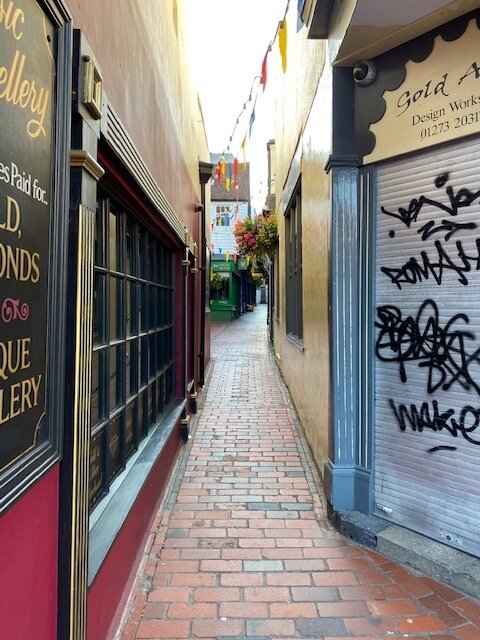
“Disenchantment achieved, I buy a packet of cigarettes and go to the next pub up the hill. I used to drink here ... It wasn’t that long ago in the grand scheme of things, but I picture my youth in sepia, with horse drawn carts straining to get up the road as men in strange bowler hats, standing stiffly on corners, scowl back at me.”
“What’s with all the reservations on the the tables?” I ask the young barmaid in an empty Kemptown pub.
“Pub quiz tonight. Really popular.”
“So you’re still doing them, then?”
“Yeah, for over a year now.”
“Well, actually thirty,” I say cryptically proving myself both wise and stupid.
Never go back. Never turn around. Lot’s wife forgot that and see what happened to her (pillar of salt, you ignoramuses). Sequels are inferior to the originals, we all know that. Weekend at Bernies 2 maybe. And returning back to a place? Forget it!
And yet I found myself walking around the backstreets of Brighton the other day. I wrote a short story some years ago about a disillusioned man in the midst of a divorce returning to Brighton, revisiting old haunts. And so, I set out to recreate a recreation. A copy of a copy.
Yeah, makes no sense to me either. Still, I get to write about a walk around some of my favourite parts of Brighton with some added pithy ‘then v now’ comments and ‘it’s all gone downhill’ editorialising. As it happens, it’s taken me so long to write this article, I feel like I should write another where I follow in my summer 21 footsteps and compare the brightness of mask-free August with the gloom of COVID hysteria December. Those brief July to November days were different times.
Starting Point: Brighton Station (and ending point. It’s all a circle, man)

Let it never be said TR doesn’t do arty photos. See how these two trains converge into the distance? That’s composition, my friends.
Aug 2021: Have you noticed it’s mainly the Millennials that mask up these days? I suppose virtue signalling is ingrained in their souls and so ostentatiously wearing a mask is another opportunity to show how good they are. Question: have charities cottoned onto this fact yet? Started producing their own branded face nappies for the beard and tats generation? Just a thought.
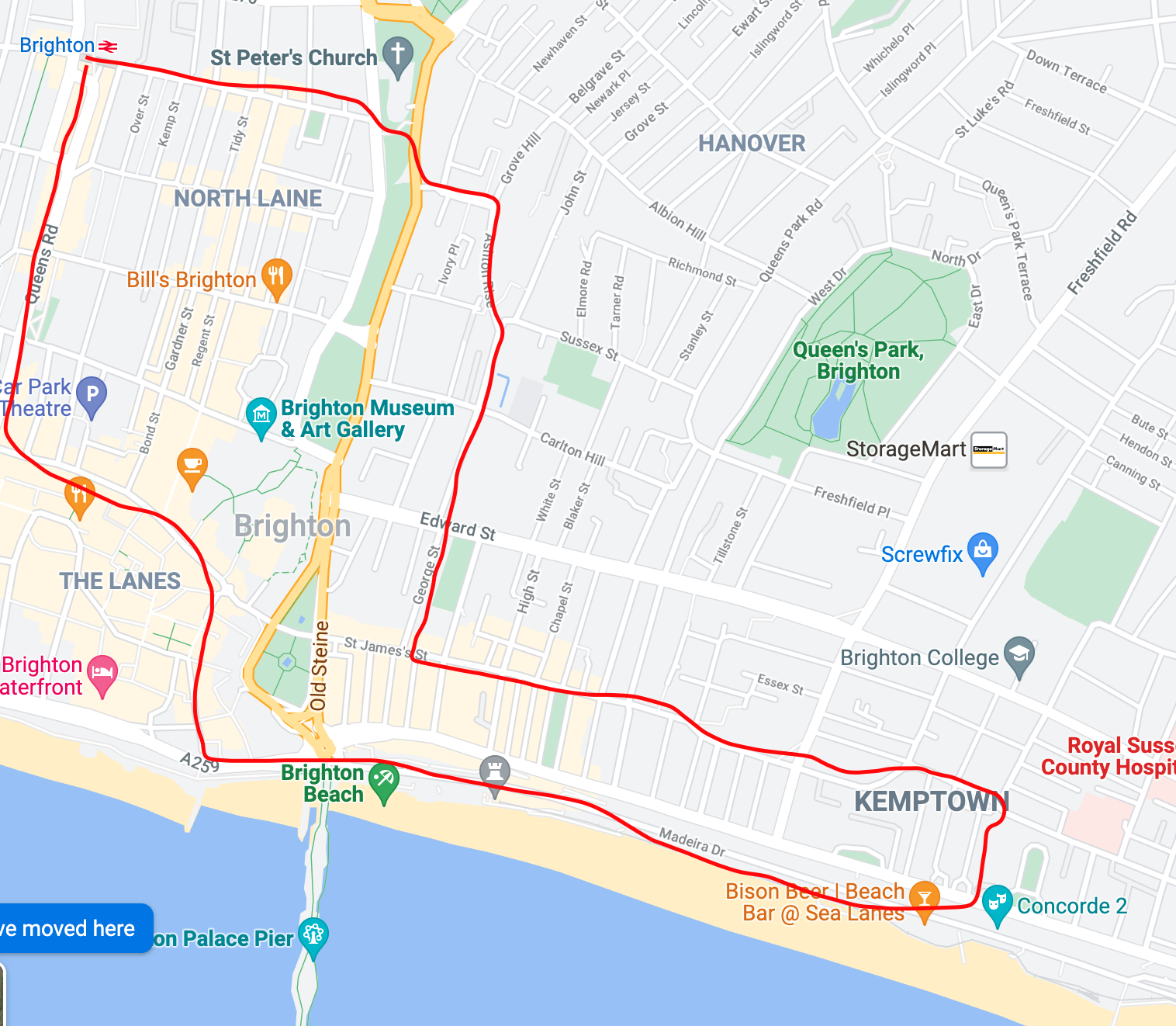
Anyway, out of the station, you need to loop straight down, underneath, and go down one of Brighton’s infamous hills (there are many): Trafalgar Street. Like much of the walk, this street has that curious changed / unchanged vibe from thirty years ago. Back then, it was full of small musty shops selling records and 2nd hand clothes. Now, it bristles with a few new office blocks at the top end and more vegan / plant based cafes and restaurants than even the most enlightened beardy could shake a stick at. Soya milk lattes are most definitely on the menu. Probably obligatory.
Down we go. The Great Eastern pub near the bottom is worth a stop. Like much of Brighton it’s a bit poncified these days but - outside at least - it looks the same as it did when my solo singer/guitarist career crashed to a halt in the early 90’s. And thence to the Steine, central Brighton’s main thoroughfare. Cross over this multi lane highway, St Peter’s church - currently enrobed and refurbishing - is to your left and aim for the Norfolk pub on the other side (scene of one of my 90’s band Shambolic frequent public embarrassments) and climb the hill straight in front of you. Turn right before the tower blocks and we’re walking past 1930’s slum clearing flats. In the distance, and getting closer, are American Express’ new(ish) offices.
Into Kemptown
Ah, Kemptown… My stomping ground for, well, although a definite period of my life - remembered in detail years later - it was, in fact, only a short period of time. Two years? Three addresses? These days whole decades pass without a mark or memory. Back then, each day seemed monumental. Maybe they were.
Cross Edward Street (RIP Amex House), and go down George Street where a brace of royal named pubs flank the entrance onto Kemptown’s main thoroughfare, St James’ Street. We’re going to be following this road leftwards into deepest, darkest Kemptown. Kemptown, named after Thomas Kemp, has historically always been the centre of Brighton’s gay community. Although there are gay pubs the area is very mixed and vibrant and just very ‘Brighton’ - that liberal, carefree vibe you imagine this town to have.
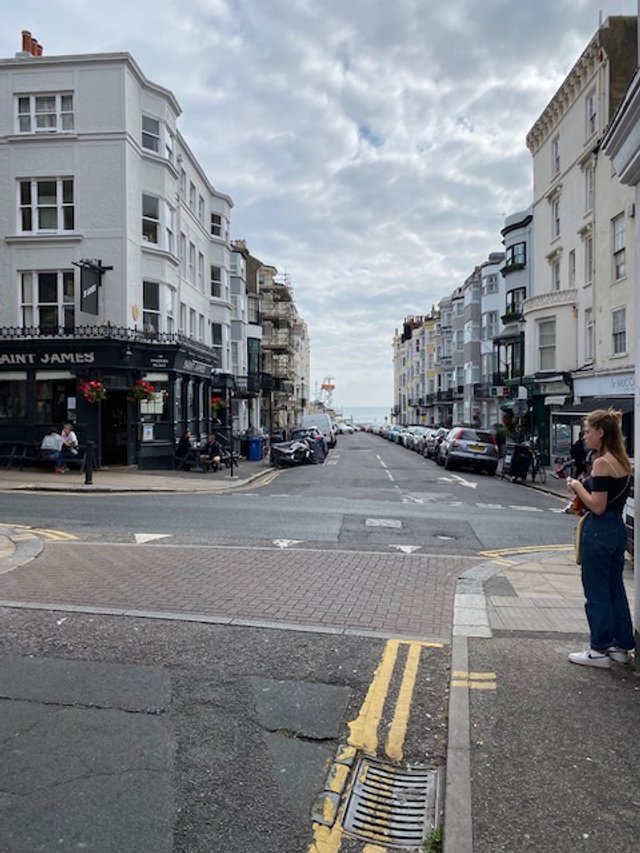
The Saint James (where’s the ‘Tavern’ gone from its name?). Turn left when you see this vista.
Pubs? The St James’ Tavern was always good. I used to hold court here every Friday lunch with my team of reprobates over a couple of pints and a £5 Penang curry back in the early 2000’s. I see it does Lebanese cuisine now.
So we continue, past old haunts, catching glimpses of yesteryear ghosts, and into The Hand in Hand. It was once the home of the Kemptown Brewery and served their various real ale type concoctions, for example, SID - Staggering in the Dark. Might still be a brew pub. They used to sell boiled eggs on the bar which you could scoff with the aid of handily placed salt and pepper pots. The eggs have gone. The decor is still the same - eclectic, old pictures, postcards, random objects. Ties. In my mind this pub always plays Out of Time by REM and I have hair and pretty girlfriends… Drink up Tim, move on, move on.
On a pub theme: There was a pub around here called the Stag. It’s knocked down now. I made the mistake of going in there once with my then girlfriend. Like some B western movie, the music stopped as we entered and all the regulars stared at us. The barman may have made a comment about my drink selection (possibly lager and lime). “Do you want a cherry with that?” Never went back.
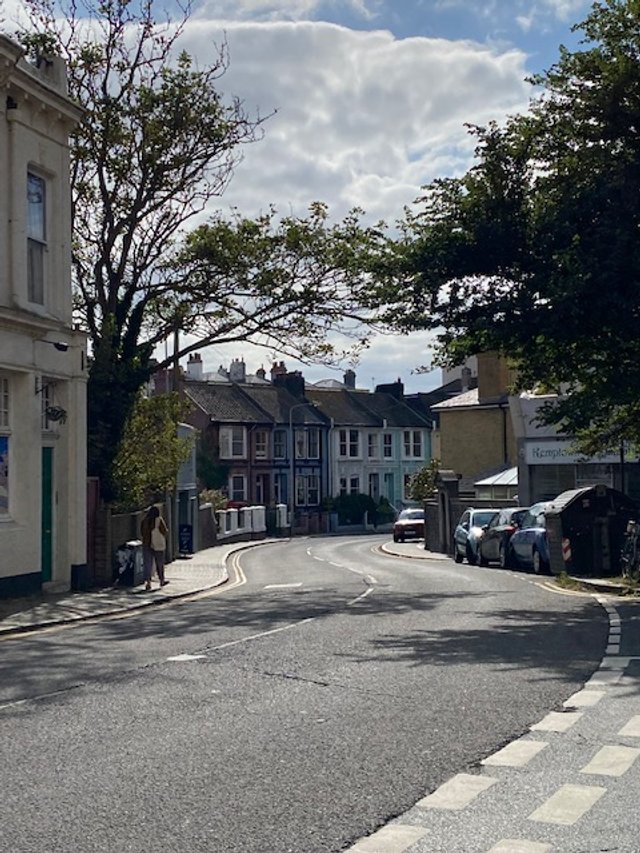
Bristol Rd. Curves.
Continuing along, the pace is quieter, the vibe more village-y. There’s a twist in the road (now called Bristol Road) and then we’re into Kemptown proper. You know, small shops and the launderette where I used to pin up adverts for my band’s gigs. Interesting pubs. It feels a community all of itself. I remember an Irish girl with red hair who’s beauty was matched by her capriciousness. She and I lived together in a shared house for a while a little further down the road… I aspired to be a writer and she a better boyfriend. One of us probably achieved our goals.
And then into the Thomas Kemp pub and conversations with the young barmaid about thirty years ago. “Yes, granddad”. The pub is swankier now with more restaurant tables than previously, less sofas. Pubs just can’t be pubs anymore, can they? I suppose people - not me - drink less these days. Lots of preloading going on. Wandering around today, I feel I’ve preloaded but not on cheap booze.
So, your author crosses and sneaks down a little alleyway and into Bloomsbury Place - a past address. Here also was a small basement studio where one of my bands - Tempting Alice - cut four tracks. Although one was played on BBC Radio Sussex, strangely this didn’t lead to a life of rock ‘n’ roll excess. We walk on and down this quiet road until it opens up onto the seafront.
We’re now pivoting back towards our start point. Cross Marine Parade and walk right along the promenade for about half a mile towards the pier. What can you see as you walk? Well, the sea, obvs! To the left, you’ll notice the high rise ghetto that Brighton Marina has latterly become and, in front of you, the pier and all those tourists who neglected to read this blog and so just headed down to the sea front. You’re so wise. You’re so clever. You are me. Literally.
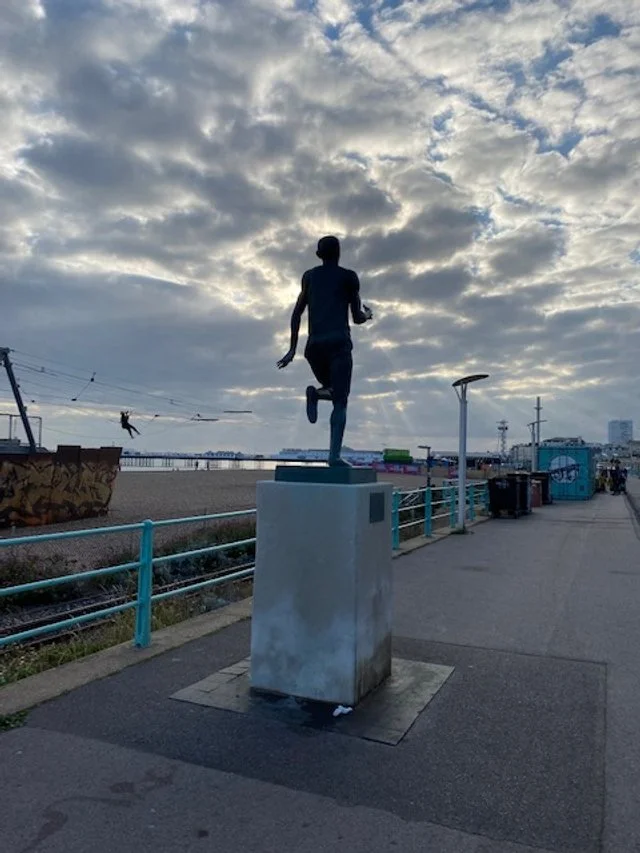
Steve Ovett - Brighton hero
You keep walking along the promenade until you get to the Sea-life Centre and cross at the ridiculously small but congested mini- roundabout that mediates all the traffic on Brighton seafront. We’re going to traverse through Brighton’s famous Lanes so walk on the side of the Albion Hotel and turn left on East Street. Little shops, a gunsmith (?), that alley in Quadraphenia, guide us along to The Sussex Pub. Used to go there. Don’t now. Through a small alleyway past English’s Fish restaurant (apparently quite good but as not a poisson fan, wouldn’t know, mate). Thence into Brighton Square, start of The Lanes, those collection of alleyways with ex fishermen’s cottages that now sell, what? Crap for tourists. Coffee for tourists. Cornish pasties (for the gulls - don’t feed them). You can probably get your stick of Brighton rock here, though, probably not these days.
Navigate your way through the Lanes by always going up and left and you’ll end up on East Street. A shimmy and a shake and you’re on North Street which feels like it should be the main shopping Street but isn’t. Lots of buildings that look like banks - they once were - are now ersatz Italian restaurants and small batch coffee shops. It’s not my Brighton. At the top of North Street is The Clocktower. Back in the day this used to have a loo underneath. Too many public handjobs, too much to maintain means it, along with all Brighton public toilets, is just a full-bladdered memory.
We turn right at the clocktower and walk down the parade of kebab shops and - yes - coffee shops that is Queen’s Rd and we’re back at the station. Now put on your mask like a good boy and bugger off back to London. Don’t forget your soya milk latte.
As your train is delayed through lack of drivers isolating at home, consider what you’ve seen and what you’ve experienced. You - I - have walked a mile or two in the shoes of the younger me. Never turn back, I said. But, as Disney’s Pochahontus said, you can’t dip your hand in the same river twice. And I think, I’ll leave it to a kids’ cartoon to provide my epitaph to this circle (of life? We doing Disney references now, Tim? I remember when you used to quote the Stoics).
Yeah. Enjoy.
A Circular Walk around the Downs near Burgess Hill

A View up the hill towards the Saxon church of Wivelsfield: St Peter & John the Baptist
“They still spread their grassy surface to the sun as on that beautiful morning not, historically speaking, so very long ago; but the King and his fifteen thousand men, the horses, the bands of music, the princesses... how entirely they have they all passed and gone! - lying scattered about the world as military and other dust, some at Talvera, Albuera, Salamanca...and Waterloo, some in home churchyards; and a few small handfuls in royal vaults.”
Thomas Hardy is one of favourite novelists. His bucolic stories, bittersweet, often tragic, tend to be set in the rural parishes of olde Wessex - further to the west than my Sussex home. I’ve been rereading Hardy recently and by necessity, by design, I’ve also been walking the down-lands, woodlands and common lands around Burgess Hill.
Burgess Hill is a pretty nondescript town to be honest. I chose to live here years ago because of two reasons only - one, the houses prices were cheaper than Brighton or Worthing and, secondly, it has two mainline stations with a commute of less than an hour to London. But whilst it doesn’t ring any bells architecturally or culturally, it does sit in a sweet spot sheltering behind the ridges of the South Downs to the south - for example Wolstonbury Hill - and lying in the middle of the Sussex Weald.
So there’s a bucolic charm to found in the surrounding area; mighty oaks, coppiced beech, bluebells, ancient trails. It’s pretty. One of the nicest parts of the country. There’s a superficial certainty about the countryside - the seasons follow in a regular pattern, snowdrops are followed by crocuses, edged out by daffodils, carpet bombed by bluebells, superseded by roses. The common lands here detail brambles, ferns, grazing cows, dieback, desolation, and rebirth all in the correct order.
But to be alive is to be aware of change; sometimes good, often not.
The countryside around me in Sussex is sadly diminishing, year by year, acre by acre, at an increasing pace. New housing estates greedily gobble up those spaces between villages, tearing into the fabric of remembered country walks, disturbing those quiet places where once the busy calls of birds were all you could hear.
And so I frantically carve out new experiences; fashioning walks from footpaths researched or found, splicing together routes known or imagined to meld together that perfect creation, the circular walk. I now have plenty of these to occupy my enforced home captivity. They all tend to be variations on a theme, using and re-using certain pathways only to branch to the left, or through a woodland to the right, a hill in front, a bridge to the side. Constant reputation and adaption means I have options, sometimes taken randomly, often not.
Here is one such walk. It last about an hour or so at a brisk pace, two if you want to do it leisurely. There is no real hardship or rough terrain though the paths do tend to get muddy during the winter and so wellies (not walking boots) are advised at those times… But enough throat clearing, here is a brisk canter through an easy circular walk around the countryside of North Burgess Hill.

START: World’s End Car Park
Park in the recreation ground car park by the playground and head up Valebridge Road, ie away from the park and up the slight incline. After about 5 minutes you meet a small road leading right - Theobalds Road. We’ll be on that private lane for a little while so best to look around a bit. It’s quiet, populated by just the wealthy residents going back and forth and - in the early parts anyway - the ever present dog walkers. (An aside - there’s a lot of dogs around here. It seems fashionable to have more than one; two is a minimum. And are dogs getting smaller?)

Theobalds Road
As you walk up this quiet road, you’ll begin to notice notices pinned to fences and trees. They’re numbered 1 to 8 and detail a history trail. They’re quite informative - apparently Theobald’s Road is an ancient track - perhaps 2000 years old. It’s part of a trail that used to lead between Burgess Hill and Haywards Heath. The notices have a slightly autodidactic tone that hints at something unspoken. And then we have it… One of the notices attacks the ‘new’ houses to the right and the fact that the house-builders destroyed an ancient hedge. Yep, can’t agree more. Stop the bulldozers! Sign me up to a protest.
Of course, wandering further up the lane, where it’s quieter and the homes are older, one can’t help notice that farmers and residents in the older houses have also ‘changed’ the ancient hedges and installed modern fences and barbed wire. Mmm, nothing more bitter than a local dispute about hedges!
Anyway, follow the road for around a mile until, over on the right, you see a stile leading onto a narrow path that skirts a house and leftwards, some fields with horses. The trail leads downhill to another stile and into the woods. You’ll cross a bridge and climb back up to another stile that leads to what us country folk call, ‘a big field’. You’ll see what I mean. A vast area of greenness broken by two incomplete lines of oak trees. Walk around the field or head straight up the hill. There’s a gate at the top directly in front of the stile you’ve just climbed over and follow the track to the left.
You’ll find yourself on a driveway leading to a large house. But stop for a moment. Looking down you have great views over the downs and the distant hills. Worth the odd photo. And then, go through the kissing gate opposite and follow the trail downwards (houses on your left). This leads to a field which you’ll cross diagonally to the left and cross a stile. Follow the farm track at the bottom veering right. This leads - sometimes - to a field of cows. Walk along the right-edge of this field until it leads to the driveway of Ote Hall. This is a big Tudor Manor House that now does weddings. Worth a quick peep!
Head left down the road, passing the farm on your left until you get to Jane’s Road. Cross over and climb the stile directly opposite and head through this field keeping to the left until you reach the stile at the bottom. Turn left and follow the track along the edge of this field until it reaches a makeshift bridge over the stream. Cross this and turn right and, following this path, you’ll end up out of the countryside and on Manor Road. Turn right along Manor Road which very shortly brings you back to World’s End Recreation Ground.
You’ve made it! I hope you enjoyed those 10,00 steps!
As Burgess Hill residents, dog walkers and Nimbies might tell you, there are a thousand variants of this walk. Longer, shorter, less road, more woods, more common land. All true. But this is a logical - and easy - circle and that’s what I tend to look for when I come to a new area with no prior knowledge. For example, my walks centred around the Wey & Arun canal at Loxwood started small after reading about it on the internet. They have grown over the last year so I now incorporate together several bits and pieces of many walks to form an ever changing, ever expanding whole.
I started this piece with a quote from Hardy as he reflected on George III and his army parading on the Wessex Downs as they awaited to repel Napoleon and his vast invasion force. From then to now, Hardy was saying, they are all dead and gone. Use it or lose it people! We’re all in a parade where the flags won’t wave forever.
Come to Burgess Hill (said no one ever). Good walks, two stations. Waitrose.

A Walk Up Wolstonbury Hill in Winter

A Hike Up Wolstonbury Hill
A bracing December walk on the Downs, up an ancient hill, trudging above the rainclouds, looking down on the misty haze of the Sussex weald, listening to my Desert Island playlist, remembering the times I met Margaret Thatcher.
What’s that last thing, Tim?
Margaret Thatcher? Random thoughts you get as you hike on your own. I looked into those cold blue eyes once - doltishly described by Mitterand as akin to Caligula’s. Piercing, soul searching, intimidating perhaps; you could see she took no shit from anyone. If only she - a trained scientist - were in charge now instead of the blundering third raters we have today.
Such thoughts I have, ascending, and descending Wolstonbury Hill, Clayton, West Sussex.
Getting out, hiking, exploring, invigorates the mind, stimulates the memory and shakes the box of possibilities. If there has been one good thing to take from this awful 2020, it’s that I’m deliberately walking more around my beautiful county. I say deliberately; before this en-cagement, I used to do 10,000 - 12,000 steps a day naturally, just getting to and from work. (You think my lithe and toned frame occurs naturally?). Once the lockdown began in March, I realised that if I didn’t consciously go on walks, I’d quickly morph into a supersized Tim.
So, I began walking, firstly around Burgess Hill. I think I know the streets and pathways and countryside around my town pretty well now nine months on. How have I lived here so long and not known anything about where I lived? Embarrassing really. But, seek and you shall find, and I have been seeking a lot recently. I’ll share some of these discoveries here over the coming days.
Wolstonbury Hill is part of the defensive screen of rises that separates the Sussex weald from the coast. It lies above the parish of Clayton, famous for the Jack and Jill Windmills but also the castle folly bestriding the railway tunnel that takes the London trains under the hills to Brighton beyond.

The Clayton Tunnel takes the London to Brighton trains under this remarkable 19th Century castle folly.
A View Over Danny Hall
I followed the National Trust map for my walk. The instructions were clear until I hit the environs of Danny Hall - a large country house used by Churchill and his war cabinet. Instead of walking around the hill and climbing obliquely, I went too early and ended up clambering up the steep slope directly. I puffed and panted up the hill aware that an attractive, and much younger lady, was coming up fast behind me.
So I increased my pace and hit the top red faced and wheezing, all ready to smile benignly at my pursuer. I mean, how does anyone meet anyone these days? Perhaps a real-life ‘hello’ is better than being ghosted on a dating app? Probably, maybe, dunno; the lady - quite rightly - ghosted me in real-life and whizzed past and onwards into the flock of bell wearing sheep. Yes, like Switzerland.
It’s a racy blog I write.
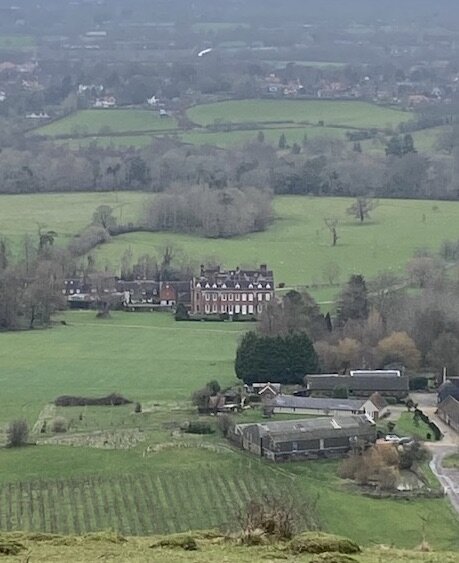
The view from the hill : Danny House in the foreground
The views down to the coast or across to the Jack and Jill windmills were obscured by the mist. Still, what I could see - Hassocks, Burgess Hill, Hurstpierpoint - was well worth the climb. This being December, the pathways through the various woods were clogged with mud. I suppose, that’s what you expect in winter, out on the Downs. I think next time, I’ll don the wellies and sacrifice looking good for remaining dry. Spring and summer will bring their own delights.
My route down was milder, more winding, more reflective. The rain came down slightly and that, combined with my playlist and the bells of the sheep, made this more Christmas-y than I expected. I don’t need snow or twinkling lights. Just bleakness and the dark trunks of lifeless trees. Yes, I’m more Corelli than Carey.
Christmas is a time of memory - lost family Christmases, departed relatives, forgotten friends, little children now grown up. Memories of Margaret Thatcher... In the mist, in the rain, walking the chalk scarred hilltops of Sussex, you can think of these things.
I’ll be back.

The return from Wolstonbury Hill.
Playlist
Sixpence None The Wiser - Kiss Me
Everything but the Girl - On My Mind
Van Morrison - Beside You
Eurythmics - Here Comes the Rain Again
Frank Sinatra - You’re Sensational
The Rolling Stones - Time Waits for No-One
Abba - The Winner Takes it All
More Walking Stories? Click Below.
A Walk Up Wolstonbury Hill in Winter
A bracing December walk on the Downs, up an ancient hill, trudging above the rainclouds, looking down on the misty haze of the Sussex weald, listening to my Desert Island playlist, remembering the times I met Margaret Thatcher.
What’s that last thing, Tim?
Margaret Thatcher? Random thoughts you get as you hike on your own. I looked into those cold blue eyes once - doltishly described by Mitterand as akin to Caligula’s. Piercing, soul searching, intimidating perhaps; you could see she took no shit from anyone. If only she - a trained scientist - were in charge now instead of the blundering third raters we have today.
Such thoughts I have, ascending, and descending Wolstonbury Hill, Clayton, West Sussex.
Getting out, hiking, exploring, invigorates the mind, stimulates the memory and shakes the box of possibilities. If there has been one good thing to take from this awful 2020, it’s that I’m deliberately walking more around my beautiful county. I say deliberately; before this en-cagement, I used to do 10,000 - 12,000 steps a day naturally, just getting to and from work. (You think my lithe and toned frame occurs naturally?). Once the lockdown began in March, I realised that if I didn’t consciously go on walks, I’d quickly morph into a supersized Tim.
So, I began walking, firstly around Burgess Hill. I think I know the streets and pathways and countryside around my town pretty well now nine months on. How have I lived here so long and not known anything about where I lived? Embarrassing really. But, seek and you shall find, and I have been seeking a lot recently. I’ll share some of these discoveries here over the coming days.
Wolstonbury Hill is part of the defensive screen of rises that separates the Sussex weald from the coast. It lies above the parish of Clayton, famous for the Jack and Jill windmills but also the castle folly bestriding the railway tunnel that takes the London trains under the hills to Brighton beyond.
The Clayton Tunnel takes the London to Brighton trains under this remarkable 19th Century castle folly.
I followed the National Trust map for my walk. The instructions were clear until I hit the environs of Danny Hall - a large country house used by Churchill and his war cabinet. Instead of walking around the hill and climbing obliquely, I went too early and ended up clambering up the steep slope directly. I puffed and panted up the hill aware that an attractive, and much younger lady, was coming up fast behind me.
So I increased my pace and hit the top red faced and wheezing, all ready to smile benignly at my pursuer. I mean, how does anyone meet anyone these days? Perhaps a real-life ‘hello’ is better than being ghosted on a dating app? Probably, maybe, dunno; the lady - quite rightly - ghosted me in real-life and whizzed past and onwards into the flock of bell wearing sheep. Yes, like Switzerland.
It’s a racy blog I write.
The view from the hill : Danny House in the foreground
The views down to the coast or across to the Jack and Jill windmills were obscured by the mist. Still, what I could see - Hassocks, Burgess Hill, Hurstpierpoint - was well worth the climb. This being December, the pathways through the various woods were clogged with mud. I suppose, that’s what you expect in winter, out on the Downs. I think next time, I’ll don the wellies and sacrifice looking good for remaining dry. Spring and summer will bring their own delights.
My route down was milder, more winding, more reflective. The rain came down slightly and that, combined with my playlist and the bells of the sheep, made this more Christmas-y than I expected. I don’t need snow or twinkling lights. Just bleakness and the dark trunks of lifeless trees. Yes, I’m more Corelli than Carey.
Christmas is a time of memory - lost family Christmases, departed relatives, forgotten friends, little children now grown up. Memories of Margaret Thatcher... In the mist, in the rain, walking the chalk scarred hilltops of Sussex, you can think of these things.
I’ll be back.
The return from Wolstonbury Hill.
Playlist
Sixpence None The Wiser - Kiss Me
Everything but the Girl - On My Mind
Van Morrison - Beside You
Eurythmics - Here Comes the Rain Again
Frank Sinatra - You’re Sensational
The Rolling Stones - Time Waits for No-One
Abba - The Winner Takes it All
A Walk on the Wey and Arun Canal
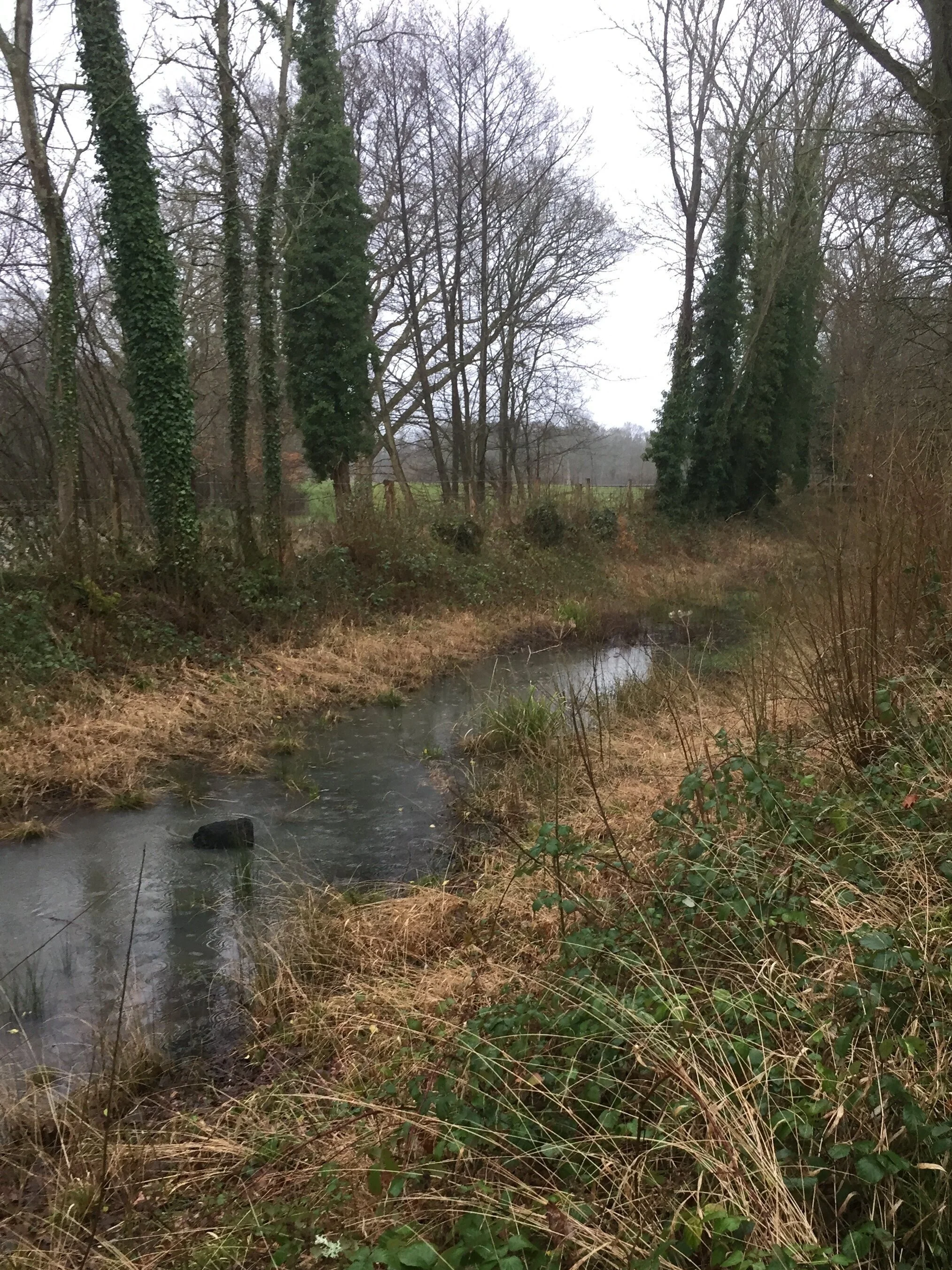
An unrestored part of the Wey and Arun canal
English Social and Economic History
Back in days remembered best in sepia, the school children of this land used to study British social and economic history 1700 to 1945. This would give the successful students an O Level in History.
This wasn’t the study of war or conquest or empire, this was the study of how a small island nation became great - innovation, reform, experimentation and science. Throw in liberty, religious tolerance, property rights and you have an alternative history of Britain to combat the modern narrative of “It was all slavery, innit?”
Isambard Kingdom Brunel, Abraham Darby, Josiah Wedgwood, The Enclosure Acts, The Duke of Bridgewater, Robert Stephenson, William Wilberforce, The Great Reform Act all roll off the tongue of English of a certain vintage. The landmark acts of Parliament, the social reformers, the dark satanic mills, the sheep fanciers and anti Malthusians, all flash by in a parade of not quite forgotten factoids.
One of the accelerators of the industrial revolution was ‘canal mania’ - the twenty or thirty years before the advent and mass adoption of railways. Canals could move bulk commodities long distances safely and efficiently. Britain became criss-crossed by a network of canals, linking cities to the sea, factories to their markets. The longboat, pulled by horses along countless towpaths, complicated series of locks, was one of the unsung heroes of our island story.
But it wasn’t to last.
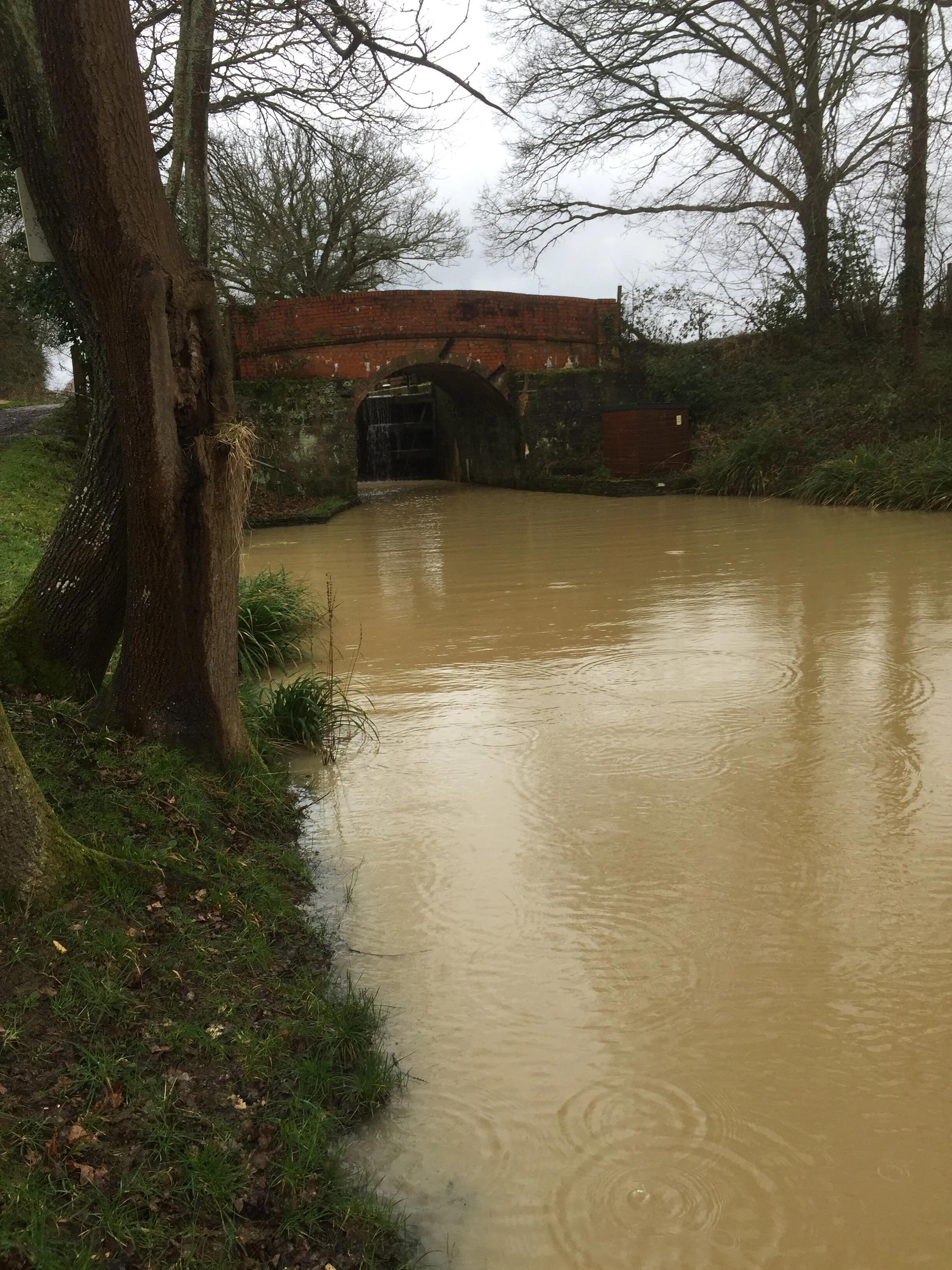
A restored part of the canal with bridge
The railways were faster and could carry more and for further distances. Gradually the canals were abandoned as goods transferred to rail. Slowly the canals disappeared, bit by bit, one by one. They were neglected, infilled, allowed to rot as nature took its course.
Which brings me to The Wey and Arun Canal.
The canal was built between 1813 and 1816 to link the river Wey in Surrey with the River Arun in Sussex. This vital link would thus connect London with the South Coast. But it was soon eclipsed by the railways and never brought in enough traffic to make it viable. It closed in 1871 and gradually was left to rot and re-wild.
I was there a couple of weekends ago. Storm Dennis was coming in hard, the wind was howling, the rain was falling and so - in Tim World - this meant “go for a hike”. Resolving to see somewhere different, a few clicks on Google got me to Loxwood and the Wey and Arun Canal. Hiking boots, walking trousers, bobble hat and Mars bar packed, off I went!
The story of this abandoned canal is one with an evolving happy ending. Since 1970, a preservation society has been gradually reclaiming this old waterway; getting planning permissions, digging it out, repairing bridges and locks, organising professional workers and armies of volunteers. They’ve restored several miles to make it navigable again. They have plans to get the whole canal operational. Big dreams.
A Solitary Walk on The Wey and Arun Canal
I chose a walk incorporating both the restored and unrestored portions, starting and finishing in Loxwood. Technically this was a four mile hike but given the weather, the mud, my unfamiliarity with the route and a failing iPhone battery, it seemed a somewhat longer endeavour. But I live for wind and rain, soft challenges and middle-class war stories.
The restored part of the canal was like any other canal in a beautiful part of the country. The dreadful weather meant I had it all to myself. I walked along the tow path, dodged the falling branches and contemplated the rain on the water. What interested me more though was the unrestored the sections of the canal - untouched since the nineteenth century and left to their own devices. In places there was no flow of water, in others just a trickle. Obstructions abounded - trees grew right in the middle of where a canal was still clearly defined. Farmers had created the own bridges and accesses that cut the canal into pieces. Seeing this made me appreciate the restored part even more. What labours and fortitude must the merry volunteers of the Wey and Arun Canal Trust have suffered to turn basically a dip in the landscape into a functioning canal?
I turned away from the canal up the marvellously named Rosemary Lane (When I was in service in Rosemary Lane*) and then headed cross country back towards Loxwood. Across field and dale, woodland and track I wandered, head down.
There’s a point on a walk where - after stepping in one too many muddy puddles - you no longer beat yourself up about opting for hiking boots and not knee high wellies. You see, walking along woodland trails in mid Feb with a full on storm blowing was, shall we say, difficult. My hiking boots sank into the mud and got soaked (checking today, they still are). I got soaked. My phone ran out of battery. But I ate my Mars bar and found my own way back to Loxwood.
The solitude allowed me to ponder those long ago, semi forgotten lessons in British social and economic history. In truth it was a dry subject matter - no villainous Tudors lopping heads off, or epic Crown against Commons clashes or even little England alone against the united forces of fascism 1940. But walking along this partially restored piece of our industrial revolution got me thinking; it’s the inventors, the doers, the makers and builders that really make the lasting changes, isn’t it? What lasts is not the generals but the engineers. Canal mania was a brief but intense time in our development but they helped get us to where we are. Even in the wind, rain and mud