
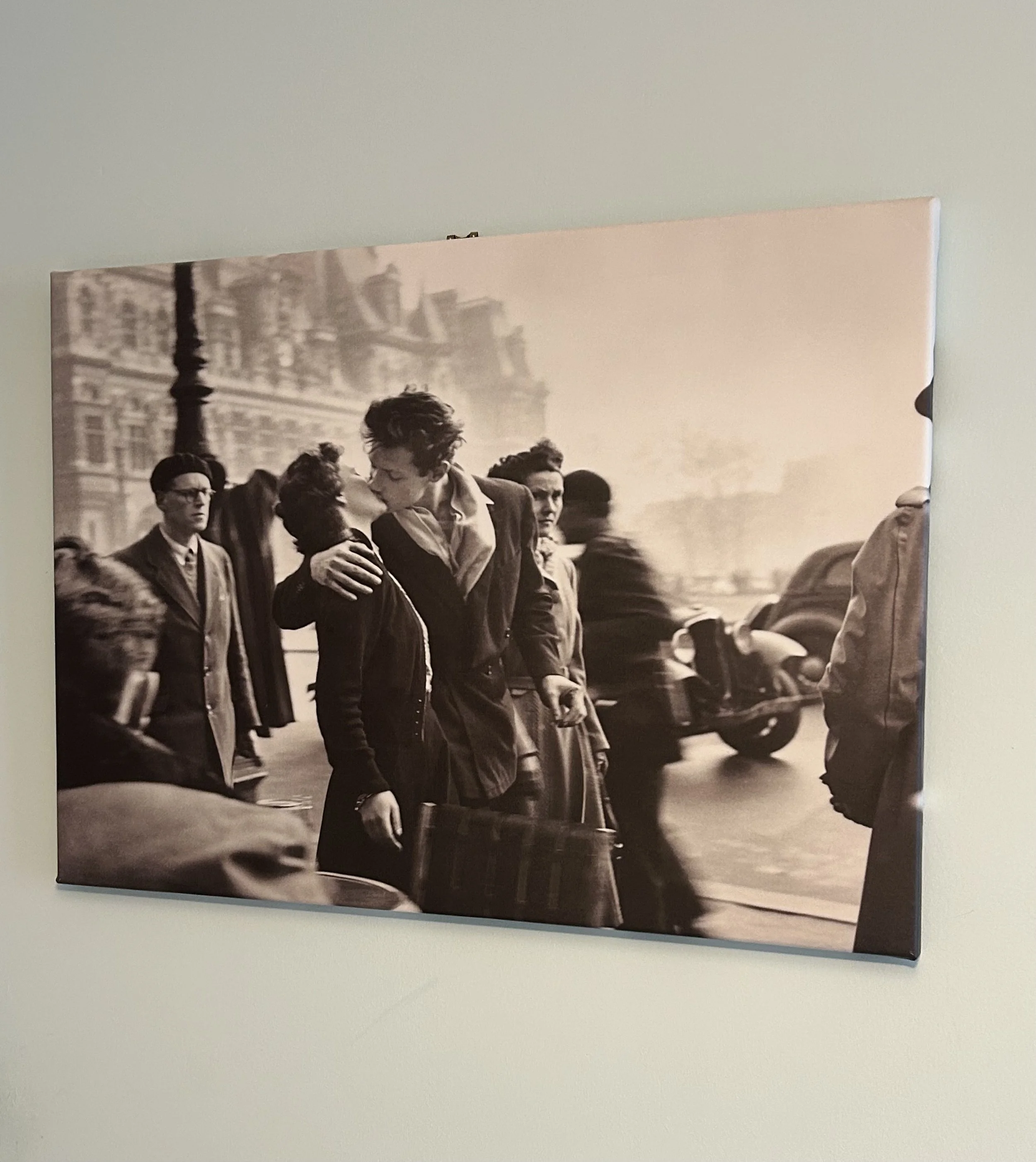
Le Baiser de l'Hotel de Ville

Iconic Doisneau photograph
Is art preference an indication of character? What do the paintings or photos that we place on our walls say about how we perceive ourselves? About how we wish to be perceived by others?
For almost as long as I can remember, I have placed pictures on my walls. Blue tac, pins; nothing seemed to be framed back in the day. What I liked, I stuck up, starting with posters of football teams, Elvis, The Beatles, leading - from 16 onwards - to real 6*4 pictures from my own life - mug shots freeze framed into vanishing history. Hilariously - it now seems - I also pinned up letters from cabinet ministers and MPs (I collected MP’s signatures like others might popstars or film icons).
Doisneau and the University Bedroom
What posters did I have on my university dorm room walls? Debbie Harry. Raquel Welsh. The Beatles. But I was most proud of a large (and expensive) black and white print of Robert Doisneau’s “Le Baiser de l’hotel de Ville”. Although the photo was taken in March 1950 for Life magazine, it lay forgotten for decades. At the prompting of his publishers though, Doisneau had - in the mid 80’s - sanctioned the image to be rereleased in poster form. Not long after, I saw it in a Brighton shop (Virgin Megastore? HMV? Athena?) and immediately liked it. So I bought it and up it went up onto my Sussex University dorm room wall.
How cool was I?
I probably thought I was just as cool as the guy kissing the girl in the photo. But in reality I was definitely more like the the guy in the beret unwittingly walking past the lovers just as the photo was being taken! Actually, entre nous, I read some story that this stereotypical French mec was an Irishman called Bert on a motorcycling tour of Europe who randomly happened to be in Paris that day. Who knows? Even the identity of the couple kissing was firstly, shrouded in mystery and then secondly, disputed in the courts. Turns out they were both actors / models and were paid for this semi staged tableau.
But why does this photo call to me even now?
Voyeurism?
Well, it’s not the voyeurism, the thrilling sense that we are encroaching on the lovers’ private moment. The angle of the shot from the cafe table looking outwards suggests a photo illicitly taken, grabbed furtively. Perhaps the photographer had his camera on the table and clicked the button at the perfect moment or maybe he was pretending to reset his lens and snuck a shot. Some may like this aspect of stolen moments but I always thought the mise en scene a little too perfect to be a lucky shot; it is - and was - artfully staged.
Time and Place?
Is it the sense of time and place? A fleeting glimpse of world now gone reflecting back at us through the camera? That’s closer. Like children running after a balloon floating above Montmartre , or policemen in caps and capes directing jaunty deux chevaux around the Arc de Triomphe, the picture documents a Paris remembered but lost. This type of reportage of daily life is what Doisneau is best known for. I have a marvellous and chunky photo book of his Paris shots - during and just after the war - which detail life on the streets and in the bars. Smiling faces gaze back at me, so sure, so real but so impermanent.
Carefree Young Love?
Or is it the picture of young love, so carefree, so intense, before life intrudes and ennui gradually chokes off the heady dopamine? This feeling never lasts and is as fleeting as a freeze frame from a video; a frozen moment captured out of time and pulled roughly to the fore. This picture captures the apex of young love, in Paris no less, and as such it represents an ideal of something for which we all search. I know people who are ever tumbling into the vortex of new love, always looking for that elusive high, ever disappointed when it never lasts. I also know people who continually think past the sale and so, to avoid the fall, avoid the climb and never experience the heights.
It’s all our pasts and all our dreams, a once and future representation of humanity. And I think it represents optimism and that, following all the words, is why this picture is on my wall.
April 2026 - TR House
Post Script
I don’t know what happened to the original poster. I don’t believe it survived the 1980’s. Why it was discarded, is lost in time, just like the Paris of 1950. However, I have re-bought the print and it is once again featured prominently chez-Robson amongst the numerous Hoppers and James Hardaker originals. That feels right somehow.
Read More
For more Paris related stories what about my travels to Palais Garnier? Or the traction beam of walking to Bastille?
Perhaps you’re into Impressionism? The read my Honfleur-Rouen Art Tour.
Dessine-moi un mouton

Le vieux port - Honfleur. Picture TR. Notice the light?
Honfleur - It’s About the Light
I read once - sometime ago - that Impressionist artists loved the quality of the light in Honfleur, Normandy. The way it arrives sharply from the estuary, dapples on the water, shards through the slate tiled buildings. I think my photograph (above) of the old harbour might actually demonstrate this beautifully. You’re welcome (@Tim Robson - reasonable rates for reproduction rights if you’re a cheap arse and can’t be bothered going yourself).
Yes dear readers, we’re into one of Tim’s infrequent forays into art criticism. But, like some overfed, underbred Yorkshireman holding forth after several pints of frothy ale and a chicken madras, “I know what I like.”* The rest of this article may be a bit rough and ill-focused. Bit like Impressionism, in fact.
Tim’s Impressionism
Normandy plays an important role in the development of impression art. Impressionists, when they weren’t trying to get unemployed actresses to take their clothes off for ‘life studies’, liked to paint out of doors - en plein air - and so light, and the quality of it, was really important. When I was younger I used to claim I liked impressionist artists. It was fashionable. However, as my tastes have matured and become designedly my own, I’m less enamoured these days. I prefer a more literal approach to a painting which can then be interpreted.
My notes from Honfleur are a little more damning - as befitting being written in a bar: “Impressionism seems to be an artist forgetting how to paint and covering this with obfuscation and swirls.”
Yes, I’ve just had a short break in Normandy. Honfleur is where one of the godfathers of impressionism, Eugène Boudin, was born. There’s a pretty good museum in the town dedicated to his work and other Impressionists. Extolling the light thereabouts, Boudin dragged a coterie of young men in the latter part of the nineteenth century to this part of France. Men like Claude Monet. And together they painted - and repainted - seascapes, beaches, harbours and buildings, of Honfleur and other towns along the Côte Fleurie. Outside and capturing the light, you see.
So, wearing my black polo neck sweater, pea coat and artistic flat cap, I visited the Eugène Boudin musée in Honfleur and the somewhat grander Musée des Beaux-Arts de Rouen. Both have large Impressionist collections. Frankly, I’m all Pissarro’d and Sisley’d out. I had the freedom to be slow, to be quick, to linger over paintings I liked and to pass by those that didn’t interest me (basically anything with fruit or tedious biblical allegories). However, both galleries are worth a visit. Each contain copious non-Impressionistic paintings amongst their roster. French art galleries just do it right don’t they?
(Rouen town however is a bit of a clown show. Beggars and drunks acting out their dizzy versions of Les Misérables. Check out my searing Third Battle of Mons for some more of this urban theatre vibe.)
The Bell Tower Honfleur: Tim v Monet
One thing I noticed though about all these Impressionists: Everyone who held a painting stick seems to have had a go at rendering The Bell Tower in Honfleur. Hell, me too… So let’s start by comparing Monet and Tim Robson shall we? First up our old mec Claude:-

Clock tower Honfleur - Monet
Not bad Monet - bit squiggly for my tastes though. More bell-end than bell tower.
Now me… I literally did the drawing opposite in 30 seconds. I bet Monet took days to do his misjudged dab-fest. Piece of piss this art game.
But the gods of talent long ago asked me to choose between art and literary fame. I chose both and so got neither. However, some vestiges of skill still remain. More in the written word than the art world to be honest but - I’m available for commissions. I don’t charge much.
Same goes for my gigalo skills frankly.

Awkward Pivot: Which Paintings to See?
So, what pictures would I actually recommend from (the many) that I saw?

Le Martyre de Sainte Agnes - Joseph Court
The monumental Le Martyre de Sainte Agnes - Joseph Court 1864 (shown above in Rouen, picture TR). Clearly the Roman theme attracted me. Diocletian was one of the better emperors but became a bit of a bastard towards the Christians in his final years. Plug: Read my Roman articles, scholarly and yet still accessible.
Place de la Haut-Vielle Tour a Rouen - Giuseppe Canella 1824.
Rouen Cathedral. Grey - Claude Monet. This one grew on me. As I walked away from it, the indistinct shapes became whole and I - for once - ‘got’ impressionism.
Hetraie a La Côte de Grâce - Eugène Boudin (can’t find this online). One of his better ones. Can’t remember it though. This is a great article, isn’t it? Seek and ye shall find and comment on it below. Why was I right?
François Louise Français - Les Hêtres de La Côte de Grâce (can’t find this online either.) I’ve decided I like pictures of trees. In particular, I like pictures of trees in Autumn. I wrote a poem about this once. Crap but shows I’m sensitive. ‘Want another glass of wine, my dear while I talk about art and, er, what are you doing later?’
Light, shade, impressionism, abstraction and poetry. I’m the worthy shoemaker in the Renaissance looking up from his workbench and shouting “It’s all bollocks, isn’t it?”
But yet I go back every year. Honfleur may be touristy but, go out of season, and the old magic that drew these painters here still works. Works on me anyway. It’s a unique and mysterious place.
And I got through all this without mentioning Satie. He’s got a museum in town too. Never been.
Read On Mes Amis
If you want to pursue the French aspect of my corpus of writing then my Parisienne walkways series - Paris Profond - is the ideal place to start. Try the walk to Opéra or the more magestic walk to Bastille.
Or, sticking to the arty theme, my thoughts on Doisneau’s Le Baiser de l’hôtel de ville. Paris then. Paris now. The Paris of my youth. How art captures a moment.
And a song to finish (you off)
Finally, to round out the Gallic theme, watch one of my favourite French songs below as a well chosen companion piece to accompany this article - the monumental rock masterpiece that is Draw me a Sheep (Dessine-Moi Un Mouton).
Quotidian Notes
1) *Actually, digression alert, I was born in Yorkshire so I can laugh at myself (well, them really, but, whatever). Can’t do the accent though. When I try it sounds like some generic ‘trouble at t’mill’ version of a Northern accent soft southerners do to entertain themselves with at posh dinner parties when the subject of Brexit voters come up.
2) Revised, scabrous’d up in August 2026 along with numerous algorithm-pleasing internal links. Hey Google Bots! I’m a bloody authority on this stuff although I wear my knowledge but lightly. Reader, click on my thoughts on Marcus Aurelius’ Meditations. Stoic does not even come close to describing this head-to-head intellectual cage-match.
Into the Hopper

Gas (1940)
“Great art is the outward expression of an inner life in the artist, and this inner life will result in his personal vision of the world.”
Although my writing often uses allusion and metaphor my most common technique is reference. The deliberate triggering of emotion or intellect by forms of words and experiences with which the reader may be familiar, perhaps unknowingly. Sometimes my references pass people by, but they are there, hidden beneath the surface, like buried treasures. Music, films, history, ancient texts, The Bible nestle side-by-side. My prose is deceptively simple but is buttressed by those that went before.
Visually, I'm quite literal. I could be dismissed - and often am - as hating all art that doesn't have a semblance of reality. But this literalism can hide artifice and subtext (pre-Raphaelites, anyone?). The framing, the subject, the angle, the deliberate manipulation of scene, emotion and place that an artist consciously puts into a painting is as important as the form.*
So, in this spirit, let me introduce my favourite artist, Edward Hopper. In my lounge, along with framed LP covers, two Hoppers hang, facing each other. On one wall is:-

New York Movie Theatre (1939)
This is faced by:-

Nighthawks (1942)
Within these two you get pretty much quintessential Hopper. The very strong sense of place, mood, of images being presented full on but still hiding much. I mean, what is the usherette thinking in the Movie Theatre picture? But also, it reveals the human element behind life which I like. It's the deliberate panning back in order to highlight the trivial. All life is affected by mood, emotion, secrets. There is surface and there is stuff going on underneath. Hopper is about these things. It's not happy.
So Hopper is a realist but his paintings always convey a mood, hint at a story, scratch the surface of deep emotions. These are the sorts of paintings where you can sit in front of them in an art gallery, scratch your chin and speculate on what the artist meant. 'Gas' pictured above is very much like this. A solitary garage on a little used road, closes for the night as the shadows from the evening and the forest close in. It's lonely, suggestive, oppressive even,
Let me give you a couple more favourites:

Automat (1927)
I suppose an early fore-runner of Nighthawks. Who is she? Why is she on her own? Questions. Questions.

Cape Cod Evening (1939)
The grass, the sinister trees again. The man and woman pensive (argument, loss, waiting something), the dog!
But I've entertained you enough, I feel. Hopper's my man with the brushes. But it's a personal thing. Shared by millions.
So long, farewell, auf weidersehn.
Tim
* I could bore for Britain on my views of the duty of the artist. Or the freewill of the artist. How selection and viewpoint is as much a part of the artistic palette as skill, technique, form. But also serendipity.
RIP Charmain Carr who died this week. Remember her this way. I think somewhere we're all 16 going on 17.