
Unkept Good Fridays

Unkept Good Fridays - Thomas Hardy
〰️
Unkept Good Fridays - Thomas Hardy 〰️
A review of this late Thomas Hardy poem and how it explores - and makes universal - the themes of Easter.
There are many more Good Fridays
Than this, if we but knew
The names, and could relate them,
Of men whom rulers slew
For their goodwill, and date them
As runs the twelvemonth through.
These nameless Christs' Good Fridays,
Whose virtues wrought their end,
Bore days of bonds and burning,
With no man to their friend,
Of mockeries, and spurning;
Yet they are all unpenned.
Hardy’s Unremembered
I hadn’t read this poem by Thomas Hardy until today. Written the year before he died in 1928, it discusses the unsung fates of ‘nameless Christs’ who likewise suffered throughout history but are unremembered, whose stories remain unpenned.
In one way, its rationalism is entirely correct; we are all God’s children and each of us are worthy of celebration and equality before history. We all navigate the same path, face the same doubts and share the same ultimate fate.
But the poem is not especially concerned with universal equality; in my reading it is a poem of courage. Like Christ, certain people have displayed this foundational quality; the courage to stand up and speak your truth. The consequences for doing so - like Christ - can be appalling. There is no end, or change, to human nature and it can be, as well as kind and compassionate, also cruel and uncaring. To stand against received opinion, in any age, is a dangerous pastime.
Christ died for our sins. He was an individual but, like many biblical stories, I think the truth is more instructive than literal. He was abandoned, put on trial, humiliated, tortured and killed but rose again from the dead to point the way of redemption. It is both personal but universal.
Christs of Unwrit Names
The correct path (one hesitates to write righteous) isn’t easy. We all know that and struggle daily to be better versions of ourselves. This takes courage. Courage takes many forms but the courage to seek out the better parts of human nature and avoid the easy, destructive path, is a strength all us ‘Christs of unwrit names’ must battle each day. There is no redemption without struggle and that struggle is personal, unremitting and, often as not, forgotten by history but, perhaps, perhaps, remembered in eternity.
And that is my Easter message through poetry and scripture.
The full Hardy poem can be read here.
More poetry / philsophy can be accessed on my website. Read on.
Julian: The Great or The Apostate?

Julian - notice ‘Greek’ facial hair
Julian and his wicked cousin Constantius
(Here Tim discusses fourth century Roman history. Note, at this time, the Empire was well used to having more than one Emperor with often a senior (Augustus) and junior (Caesar).)
The Emperor Constantius II was a right bastard. For example, the massacre of the princes - where he killed off his male relatives in Constantinople during a family gathering following the death of his father Constantine The Great in 337 - was just the sort of ‘real’ history that gives Game of Thrones legitimacy.
One nephew that survived the cull was Julian. A bookish and pious prince, he was spared because he was so young and, well, a bit of a nerd. But ten years later - following the overthrow of Western emperor Constans – cousin Constantius needed a partner to share in the burden of the imperial purple. Turning first to Gallus, Julian's older brother – who he later killed - Constantius eventually elevated Julian into the family business as Caesar of the West in 355.
Caesar in Gaul
Here, in Gaul, the boy became a man. After kicking some serious German butt at The Battle of Strasbourg and other conflicts, Julian became popular with his legions. Cousin Constantius became jealous and there followed lots of 'come and have a go if you think you're hard enough' correspondence between the two emperors until Julian marched East at the head of an army in 361. And then – miraculously - Cousin Constantius died suddenly leaving young Julian the sole master of the Roman world. What to do?
Sole Emperor
Well, what Julian did - in his brief two year reign – was attempt to turn the clock back on Christianity and try to re-establish the old gods. You know, get rid of all this Christian rubbish legitimised by his uncle Constantine. He also thought Persia was up for a bit of Roman steel and so marched off deep into the Sassanian Empire, never to return. Killed by a random spear, Julian left his troops miles from safety on the Euphrates and in the feeble hands of his short-lived successor Jovian. Ultimately, on religion and war, he must be judged a failure.
So why do I tell the story of Julian the Apostate?
Can one man change history?
Well, unlike his uncle Constantine (the Great), he only had 2 years to make his mark. Constantine had 31 – with the 13 years in sole charge of the Empire. Constantine changed the course of history. Julian however flamed out quickly and his successors Valentinian, Valens and Theodosius reaffirmed the Christian hegemony (give or take the odd Arian, or semi Arian, heresy). Julian was an anomaly in Western history where Constantine looms large but Julian does not.
Can one person change the course of history? Or – as in this case – a solitary spear? What if Julian had lived and reigned twenty years? Would he have quashed Christianity and reduced it into a cult, one of many, like Isis, Mithra or Sol Invictus, that bubbled around in the later Roman Empire? It’s possible that Christianity could have gone underground only to re-emerge stronger, much as it did during the persecution of Diocletian sixty years earlier. It’s impossible to say. It’s a little like powerful newspapers; do they lead opinion or merely reflect it?
What’s of interest though for those who seek parallels in history, who look for patterns to help with understanding the present day, is the theory that there are turning points – yes kings and emperors – but social, religious, military too, that alter the course of history. The trick is to spot whether events have produced a Constantine the Great or a Julian The Apostate.
Read more 4th century history as I discuss the five landmark battles that defined this climatic era in Roman history.
Or maybe read all my Roman articles - from Hannibal to Theodosius.
Whispers and Echoes
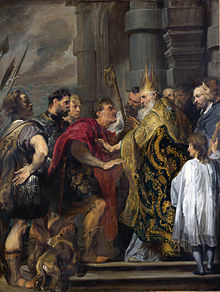
Ambrose barring Theodosius from Milan Cathedral.
As we all know, Theodosius I was the last unified emperor of both the Eastern and Western halves of the Roman Empire. Clearing up the mess left by Valans at Adrianople, he battled Goths, usurpers and heretics to Nicene orthodoxy in a time of tumult for the Empire.
It was also an interesting time in the history of the early church. During Theodosius' reign, Bishop Ambrose of Milan formulated the doctrine that whilst the Emperor ruled matters temporal, the Church was in charge of matters spiritual. This was an important development in the history of Western thought. One of the Emperors' many titles was Pontiff Maximus - the highest religious office in the Roman World. By the act of giving away this authority, the later emperors allowed the church to control both religious life on earth and - more importantly - the path to salvation in the afterlife. This segregation of church and state persisted until at least the Renaissance and, arguably, through to the Bishop of Rome even now.
Ambrose was a combative sort who liked to defend the church's rights. He excommunicated Theodosius following a massacre of civilians in Thessalonica in 390. More interesting to the modern world, perhaps, was his meddling in imperial matters. A christian mob burnt down a synagogue in Callinicum, Mesopotamia and Theodosius ordered the local bishop to rebuild the temple. Ambrose argued that Theodosius should retract this as he was ordering the local bishop to act against either truth or death.
Theodosius backed down and the synagogue in Callinicum was not rebuilt.
Today Callincum goes by its Syrian name of Raqqa.
History is somewhat wider than living memories.