Going Off Safari
I think I've solved my website problems. Yes, you can all breath again, the crown jewels of online blogging have been returned to the Tower and all is well once more within the online kingdom.
Which means, I've switched from Safari to Chrome. You see Chrome doesn't drop like Safari and lose my blogging pearls of wisdom. And I can watch my Amazon Prime easier.
Win: win.
Utilising my new freedom from the oppression of lost marvels, I'll be updating more frequently.
Plenty to talk about, loads to comment on, axes to grind and rock to roll.
Tim
Archimedes' Arse

It's a well-known story that whilst the Sicilian/Greek mathematician Archimedes was taking a bath, he noticed the water level rose. Now, today that's like, doh!, of course, mate, but at the time, this was one of great discoveries of the Ancient Greek world. Up there with the kebab even. It founded what we amateur, but enthusiastic, mathematicians still like to call, The Archimedes Principle.
Now, me and Archimedes may not have much in common, but we both reached a revelation whilst we were sat in a bath. Well, in my case, some other bloke sat in a bath. Bitching about how cold the water was. Yeah, I know, I know - time out - this blog takes in an eclectic range of subjects but I seem to be straying towards the banal tonight, and yes, I may have reached the limit of your 'WTF is he on about' - o'metre....
But bear with me Robsonites (@Tim Robson 2015), this shaggy dog tale gets both more profound, and less. The prime mover behind this paradox, some bitching pensioner, discovered that when he bought a costly newly built house last month, the bath water was 'tepid'. Yeah, not hot. He rang in to shout about this. At the time I was doing some charity work for a local business, answering their phone and helping people with housing needs (all right, temping in a building warranties call centre, whatever). So, after some digging, some questioning, some reflection, I found the cause of my caller's ire lay within the sturdy confines of the 2010 Building Regulations (section G).
This unlovely piece of legislation - actually, that modern equivalent of totalitarianism - a Statutory Instrument - sets the delivery temperature of bath water at between 44-46C (plus or minus 2C). This is to stop pensioners burning their arses in hot water and moron parents scalding their babies. Laudable aims, I think you'll agree. But, as JS Mill wrote in On Liberty "You're having a fuckin' laugh, mate." (Can't remember the exact page so I'm kind of summarising a more complex argument about the balance between a paternalistic state and individual liberty. John would agree with my précis though, don't worry about that).
But anyway, like my good mate Archimedes, I came to a revelation and 'Eureka' moment in a bath. Sort of. So I've developed my own principle. A principle future historians will no doubt call, the Robson Principle. Here goes:-
The weight of regulation curtailing individual liberty and the free market is equal to the total mass of legislators, lobbyists, and pressure groups (collectively known as 'wankers') available to justify their existence by annoying everyone else with vexatious and irksome rules using stealthy subclauses and statutory instruments. Or some shit like that.
Okay some of the words may need tuning. And the sentiments. And the conclusion, but damn it!, I think I'm onto something. I strike a blow for freedom, justice and the soul of man. Sips pint. Or something. Whatever. Passes the time between cat feeding times.
Anyway, I've just pulled the trousers down on my new article on Linkedin which explores the same themes, albeit in a more business friendly fashion. You see I can do both high, and low and every gradation in between.
It's a talent.
Maybe Archimedes' bath water was too hot. Hence him leaping out. Just a thought.
Cheers
Tim
The thing that hath been, it is that which shall be

Increasingly I find myself drawn to the Bible. The King James Bible. Of course.
I'm not remotely religious if you define religion as believing in supernatural stories, impossible events, miracles, ridiculously tight social codes. The sublimation of self, or humanity, to an abstract idea. Or if you believe that your belief is superior to any other person's belief. We are all grubs poking around on a dirt ball. None of us know the answers.
But some of us at least ask the questions.
Religion also discusses the great philosophical issues, the futilty of man's existence, how we should navigate living together as social beings. As a writer - though it might not seem so - I like to address big issues, confront existential questions. And more and more I find myself reaching for my battered copy of the King James Bible (or googling it online!).
Why?
1) It's a comfort, and a shock - to find that all the issues have been dealt with before, discussed before. As Ecclesiastes 1 has it, there is 'no new thing under the sun'. It also has some words to say about each generation forgetting the lessons learnt by the previous. It's humbling but reassuring to know that we all stand on the shoulders of our ancestors.
2) As a writer, I can see The King James Bible is a beautiful document. The phrasing and quality of writing is top notch. I find myself marvelling at its ability to be at once profound but also carefully constructed so it could be read aloud. It's in the cadences, its in the repetitions, its in the well chosen words where the artistry lies. And it was deliberately made so.
3) As we live in a multi cultural society - and we do - then I find myself drawn towards investigating my own culture. The invisible thread that runs through England, the Anglo-sphere, through our history, is laid bare in the King James Bible. My ancestors would have known its words, understood its allusions, recited its parables, sought comfort and strength in its words.
To find wisdom. To write better. To understand better my own culture.
And I gave my heart to know wisdom, and to know madness and folly: I perceived that this also is vexation of spirit.
For in much wisdom is much grief: and he that increaseth knowledge increaseth sorrow.
And who would disagree?
Laters, my flock
Tim
I Am the Resurrection.

"I was saying something. Oh yes. Maria and English literature. We argue about its relevance, English Lit. As an academic subject as opposed to a leisure activity. I write, she reads. I read, she deconstructs. What annoys me is the way they (as in ‘They’ – those buggers who populate an ill informed argument. Yes, ‘Them’.) er, yes, the way they take something that's for everyone and raise it above the heads of the people for whom it was originally meant. Alienation I believe it’s called. Yes, you can see I’m better read than I let on. However, it's all bollocks, your honour."
Tim Robson - Neil Diamond's Beard (early 90's)
I've been reading some of my stuff from the early 90's. The superbly titled unpublished novel - Neil Diamond's Beard. Was it any good? Was I a literary enfant terrible tearing up Brighton in my 20's? It's an attractive image but I'm perhaps not best placed to answer. However, what I would say is that lifting the lid on your younger self is sometimes a wondrous thing, sometimes a shocking thing. You forget so much, the passage of time smooths the edges off the anger, laughingly points out your conceits and can make a mockery of your juvenile attempts at a deeper truth, a coherent worldview.
But - and it is a big but - there's a vibrancy in the writing, no doubt about that. I know my brain had then been captured by Martin Amis, Jack Kerouac, by a cinéma vérité confessional style that confused reality for readability, and yet... It's a two fisted brawl of a novel, no punches left in the locker, no attitude unexplored. There's also a willingness to be honest and truthful which, however polished and skilled my writing has now become, and however much the self-edit red pen excises the wilder prose, I still endeavour to retain. Not for me plastic emotions and gossamer thin characterisations. It's all, or it is nothing.
So - what are the major differences I notice in my writings of the early 90's?
1) Smoking in pubs and restaurants (see picture above, Aug 1989). It seems like ancient history now. How we all accepted cigarettes in an indoor environment. How every table had an ashtray. How your clothes and hair would stink when you got home. Strangely I miss it - but only as a sensory shortcut to my youth, not as a going concern.
2) Lack of mobile phones. How the hell did we communicate back in the day? I seem to remember a lot of confusion and hanging around and detailed planning. Now we all just go out and kind of navigate to each other when we feel appropriate. Our 2015 ability to track each other would have been perceived as phenomenal, and perhaps sinister, in those pre mobile phone days. Conversations were more intense however without a constant distraction bleeping on the table, calling you to wonders elsewhere.
3) Political correctness. Strangely I found this worked both ways - both more and less at the same time. This was Brighton at the dawn of the 90's, not a Northern working men's club in the 70's. But some casual incorrectness creeps in. Words, phrases that I would be uncomfortable to use these days pepper the narrative. But perhaps that was youth. There's also a suspicion of the corrosive chilling effect of thought-crime in the writing. PC was both stronger but less prevalent. The war hadn't been won so the PC army wore combat fatigues.
4) How my world-view had more passion but less depth. An assertion is not an argument. Experience moderates the fires of youth. There's nothing like reality to piss on a dreamer's parade. Certainty is the preserve of youth.
5) I'm a better writer now. Fact. The work is littered with errors and stylistic howlers that poke the reader in the eye. I wouldn't publish what I wrote back then. There again, a decent and sympathetic editor (like me 25 years later) would have done wonders.
6) Despite that, I am very definitely - and distinctly - me. The themes, patterns, style, worldview are there, in infant form perhaps, but there nonetheless. It's reassuring isn't it, that stripping away temporary conventions and fashions, forgiving naivety, lack of experience, undeveloped skill, your voice and passions remain constant.
And rather frightening too.
Cheers,
Tim
German Companies

One day I write about The Beatles, the next about EU regulation. I muse about the coming autumn and discuss the influence of childhood on memory and the way we live our subsequent lives. I have what is sometimes called ' depth', a hinterland that takes me on a ceaseless, maniacal search for truth wherever it may lead. It's a painful journey, a search for the soul in these Godless times, but that's who I am. It is the scrap of ground I claim as being mine and 'on ne passe pas' as we say in this corner of the early twentieth century.
Whatever dude. What is today's ramble about?
Well, to show the integrated social media marketing drive for which I'm famous, I'd like to talk about German companies. About how families set up a company, have a row and then sporn two further ones. For example, Merck and Merck, Aldi Nord and Aldi Sud, ADIDAS and PUMA. It's a fascinating subject and one that I explore in depth over at LinkedIn.
The untold story behind my omnipotent business writing is the suppositions that fail. I'm happy to pull back the curtain here and reveal some of my false premises. Like Aldi and and Lidl being related (they're not). About Kelloggs and MW Kelloggs being related (they're laughable not). About Rolls Royce cars and engines being related (they are but - hey! - who cares).
So - if you get chance - read my article on German family companies. It's a rollercoaster of a ride, a read on the wild side, a clinking Wunderbar of an article that will one day be collected into an anthology and taught at business school - or normal school even - The Collected Wisdom of Tim Robson, Part 1 - The Wilderness Years.
And on that note (Bb) I'll sign off.
Tim
On Carrier Bags
Tim discusses the new carrier bag charge in England.
And so the carrier bag charge hits England. We now pay, with some (okay many and confusing) exceptions, 5p for a lightweight carrier bag.
As someone who always brings his own reusable bags to the supermarket I have mixed feelings on this. As a committed, old-school environmentalist (Reduce, Reuse, Recycle) if the charge leads to a reduction in the thoughtless use of plastic carrier bags and tilts the population to more sustainable solutions, then instinctively I approve. Wasteful consumption, especially of the harmful and avoidable type, like plastic carrier bags, needs to be reduced. I want dolphins to swim free. Who doesn't?
But as a libertarian, I note sadly the demise of 'nudge' and the rise of 'compulsion'. What do I mean by this? Well - and I hate to keep using my TESCO Clubcard points as an example, petty I know, but illustrative - formerly supermarkets used to give you 'green' points on their loyalty schemes. I used to get a Clubcard point every time I reused my own bag. With the charge, this has now gone.
The shift has been to sanction force from the state to change behaviour. This to me is always a regrettable and last ditch policy option. Doubly so when, as I have done, you research the genesis of the carrier bag charge. It was sanctioned by a statutory instrument in Parliament this year, enabled by The Climate Change Act 2008 and, depressingly, mandated by an EU Directive from 1994 which dictated that all states must have a plastic bag charge by 2018.
It's sad that the UK Parliament has become a branch office of a larger supranational body. Sad also that the good angels of our behaviour can't be trusted to do the right thing. Supermarkets have for a while offered plastic bag recycling, in fact, all stretchy plastic recycling. Who knew? Why don't local authorities do this? It's not just bags; packaging is often plastic intensive and just ends up in landfill.
So - two cheers for the inevitable outcome (all studies show that plastic bag usage goes down after charges are introduced). One cheer deducted for the method - more costs / regulation and lazy human nature for forcing this action.
Not all environmentalists are lefties!
Cheers
Tim
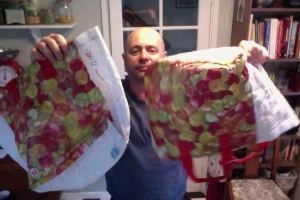
(BTW - the best reusable bags I have are the colourful ones I bought in France at Super U a few years ago. Strong, long-lasting and very stylish! See them modelled above by, well, me.)
The Falling Leaves...

And the leaves that are green turn to brown
And they wither with the wind
And they crumble in your hand
Autumn is the season of endings where summer tapers into nothing, leaves fall, nights draw in and the promise of Spring lays cold in the ground. It's the end of flowers and heat and late nights, no more smells of new mown grass, double edged roses and charcoal.
And yet, I always see Autumn as a beginning. The beginning of a new term, a new year, new friends. A countdown to Christmas and parties and frivolity. Bonfire night (never Halloween) and frosty morning walks around lakes flanked by bejewelled trees of yellow and orange.
Many of my new beginnings - and there have been many - have taken place in Autumn. Some of the most vivid memories come accompanied by a soundtrack of fallen leaves, with falling temperatures and dark nights. I remember a stormy day in Brighton, so many years ago where the wind blew and the rain fell... But no, I won't go there. Not now.
So, I'll leave you with a cheer for the coming Autumn and a wish that great things, memorable things, unusual things, happen to you. As I wish it for myself.
Autumn; life's new term.
Reflectively, and yet optimistically,
Tim
* The quote is 'Leaves That Are Green' by Paul Simon
What Julius Caesar Taught Me About Business

Catchy title, eh?
Winner of the 2015 'Big Hat, No Cattle' award for business writing, I published this sound piece of advice on Linkedin yesterday. The applicability of Caesar's strategies and personality to modern office practices struck me when I was rereading 'The Civil War' last week. Whilst obviously self-serving, Caesar's writings reveal a master at not only battle but in human interaction. Well, modern business is all about defeating the competition and working with colleagues.
Read the article following this link.
The lecture circuit sternly beckons.
Laters
Tim
A la recherché du temps perdu

Happenings ten years time ago // Situations we really know // But the knowing is in the mind // Sinking deep into the well of time
In historical terms, the day before yesterday is always the strangest and most remote.
What was it like to live in the 70’s? It wasn’t that long ago in the grand scheme of things and yet I picture the decade in sepia - populated by horse drawn carts climbing cobbled streets passing old men in bowler hats scowling back as though the image would capture their souls. The tricks of memory.
I grew up in the 1970’s. Despite the strikes, the oil crises and IRA terrorism, I remember it as a happy decade. Tim was ever to be found playing out on the street - no worries about cars or peodos in those days - endless games of football, cricket, making dens, short trousers, street parties, church parades; egg and chips.
One abiding memory is that every August my parents would take my sister and I out into the countryside around Rochdale to pick blackberries. We would go armed with huge empty margarine tubs and come back with pounds of fruit – just waiting to be boiled up and made into soon-to-be neglected pots of jam. The weather was always sunny (I’m probably picturing 1976), the blackberries always plentiful, the thorns always benign.
In honour of my upbringing, I take my kids blackberry picking. I’m lucky enough to live near the Sussex Downs and Ditchling Common. At this time of year, the bushes on the common are weighed down by juicy blackberries. My girls and I went on our bikes yesterday, Tupperware in my backpack, to grab some of nature’s high-summer bounty.
The blackberry picking has become part of the ebb and flow of seasons in my reduced family; it’s what we do and my kids look forward to it. Probably the idea more than the reality, but that is often the way. Even now though – whilst this is actually happening - I can see that my girls’ nostalgia gene is awakening – as we bike to the Common we pass new housing developments that have laid waste to what were, ever-so-recently, green fields. The world is ever churning and nothing but memory stays the same.
But creating those memories is at the core of our humanity. The remembrance and recreation of childhood memories – sights, tastes, rituals – is something that subconsciously draws us like an alcoholic to the bottle, the moth to the late night lamp, the sinner to the pew. With artists - and I include myself loosely in this group – it is one of the central drivers of creativity. The negation of childhood memories, to veer wildly away from familiar paths, works the same way.
The quotation that starts this post is Happenings Ten Years Time Ago, a rare Yardbirds single from 1966 when the group – so briefly - boasted the duel lead guitar attack of Jeff Beck and Jimmy Page. But you knew that already, didn’t you?
And the blackberries became a rather lovely homemade ice cream.
Cheers ears,
Tim
How to write Dystopian Fiction

I'm published in this book. Hero. Such a hero.
File under 'Random'.
In my quest for world domination of writing contests, I recently entered a competition whose theme was the end of the world. It was run by some online dystopian website.
I'll try my hand at anything - even a genre populated by adolescent boys and nerdy men (my people, my people!). All writing ultimately is good writing as the mere process improves your technique and destroys the blank page. So I entered. Having knocked out 4000 words, here is my guide on how to write Dystopian fiction:
1) Dystopian is basically a long word that tries to hide its sci-fi origins. Think Star Wars where the evil Empire wins. And it's cold and bleak and everyone dies a rat infested and lonely death.
2) Chuck in some cod philosophy. It may be gobbledegook and intellectually incoherent but don't worry about that. For example, here's one I've been working on:
"Like all misanthropes, Tim was exceedingly good company."
3) Forget morality. In some dystopian future, all people are essentially amoral. Clearly genre convention dictates that as mankind heads towards its doom, morality will go the way of my C90 home mix tapes from the 90's. Yes, into the bin.
4) Shove in a bit of sex. Hey! Your target readership is adolescent boys and nerdy men after all.
5) Like every self-authored teenage story, all endings should be a variant of "And then I went to bed and the universe blew up." (*see below)
6) For extra credibility, write a blog post slagging off the genre. Man, that's just like so subversive. Yep - that's me, a rule bending, guitar wielding, couplet writing, ex financial services professional with a specialism in payment systems technology. Hi ladies!
7) There is no seven. (Christ, that joke never gets old).
8) Lists are lame; the refuge of a bad writer using an artificial structure to cohere random thoughts in place of a good writing style.
Well, I hope that helps. I'll let you know if I win. I probably get a free black T-Shirt with some heavy rock band's logo emblazoned on the front as my prize. I wonder if it will go with pressed chinos and shiny purple shoes? Hope so.
Laters
Tim
* @Tim Robson circa 1983.
Word of the day : Bloviate
I came across this lovely word today in Peter Hitchens' blog in The Sunday Express. To quote:
“On the day that mass immigration reached levels not seen since the Blair era, the Prime Minister appeared amid a clearly staged ‘raid’ by immigration officials, bloviating about a ‘crackdown’ that will of course never take place.”
Now agree or not with Hitchens - I'm a fan as I like someone who will speak truth even if it is unpopular (so rare these days) - I love the use of the word which, to my shame, I'd never heard before. Bloviate. To bloviate. It's kind of a semi intellectual version of 'to bullshit'. Checking my Wikipedia, I notice that it comes from Ohio politics of the late 19th and early 20th century and means empty or vapid political speeches that essentially say nothing of substance.
How very apt in these shallow days! I shall endeavour to use this marvellous word from now on and if you think this is another example of Robson bloviation, then re-read my sentence!
Cheers
Tim