
The Best Unknown 60's Songs
The Best Unknown 60’s Songs - It’s All Subjective!
The best hidden 60’s songs - in musical terms - is a slippery concept. I say ‘best’, you say ‘deservedly obscure’. You say “but what about this one’ and I say something about your mother. Ah, dear readers, I remember pub conversations.
But unknown songs, some by famous groups like the Beatles or Stones, are always a joy to find. It appeals to the musical snob in me. We all like to feel that our shadowy light in the forest is the one true path to musical esteem.
It’s all subjective, of course.
(In the list below I mainly feature obscure tracks by well-known bands with a few unknowns in there to keep you on your toes. It would be easy to pack the list with Gene Clark demos but that wouldn’t be fair. Read my Part 2 of Best Unknown 60’s Songs for that!)
Lady Friend - The Byrds 1967
A joyous, rollicking single written by David Crosby, ignored at the time and now totally forgotten. Undeservedly so. The Byrds storm through a cracking tune with trademark Rickenbackers, floating harmonies, light and shade. Oh, and trumpets. There was a time, years ago, single and with tousled hair and Roger Mcguinn shades, this and Eight Miles High soundtracked my life. It was the beautiful dawning of a sadly short day… This is at the Byrds at their best and no-one knows this.
Reconsider Baby - Elvis 1960
Elvis would occasionally ‘do’ the blues. Exhibit A, his definitive take on Trouble in King Creole is perhaps his greatest ever vocal. Steamroller Blues is a highlight of his Aloha from Hawaii concert and album. Mess of Blues is one of my favourite ever tracks (but perhaps too famous for this list!) So, fresh out of the army, Elvis straps on his guitar and gets down and dirty with Lowell Fulsion’s driving lament. Yeah, that’s E on lead-rhythm. This version is famous for its two-in-the-morning feel epitomised by Boots Randolph’s extended strip club sax solo. Elvis is Back indeed!
The Who - Circles (1966)
An A side, a B side, and song of many names (Instant Party for example), Circles is a song with a complicated release history. What is not complicated though is that it is a great piece of mid 60’s psychedelia. Hypnotic, the tune apes the song title in that the guitar chug spirals round and round creating a musical embrace drawing you in. That’s John Entwhistle on French horn providing the persistent drone which pushes the track away from the Who’s previous RnB sound towards the more experimental I Can See For Miles. I used to mash up this track with Neil Diamond’s even more obscure ‘Shot Down’ to audiences between Brighton and London. Well, audiences in Brighton. And London.
Child of the Moon - The Rolling Stones (1968)
Hidden in plain sight, Child of the Moon is the B side of Jumping Jack Flash. I have the original single, lovingly bought at Rochdale’s Champness Hall monthly secondhand record fair back in the 80’s. “The wind blows rain into my face” begins Mick over an ominous drone kicked off with producer Jimmy Miller screaming out some inaudible words. It’s a bit hippyish, a bit psychedelic, slightly reminiscent of the Beatles (also obscure) B side Rain but it’s catchy and I like it. And the video. Weird. Slightly unsettling. See below.
My Girl the Month of May - Dion and the Belmonts (1966)
Yes, the guy who did The Wanderer and Runaround Sue, released this swinging-60’s record years after The Beatles had rendered him and Belmonts obsolete. It’s full of mid 60's hip strangeness, some spirited singing from Dion and a chuck in the everything including the kitchen sink approach to production. ‘Little girl of mine, youngest flowers of springtime, you're the month of May.” And what month is better than May? Got nowhere in the charts and so this is a delight to find. You’re welcome.
Born to be a Rolling Stone - Gene Vincent (1967)
Gene ‘Be-bop-a-lula’ Vincent relocated to the UK in the mid 60’s. Tax reasons. Women problems. A draw on the live circuit, he didn’t however record anymore hits. His moment had passed. But he recorded some obscure mid-60’s singles that are quite beautiful. Born to be a Rolling Stone (b side the almost equally sublime Hurtin’ for you Baby) is stop-start Byrds influenced, guitar led song with a riff that I’ve ripped off ever since. On one level, it’s a slight piece as the singer tells us in a couple of verses why he’s born to be a rolling stone. But music is often as not a feeling, a sense of time and place from where you first heard it. Gene’s mid 60’s output came along at the right time for me.
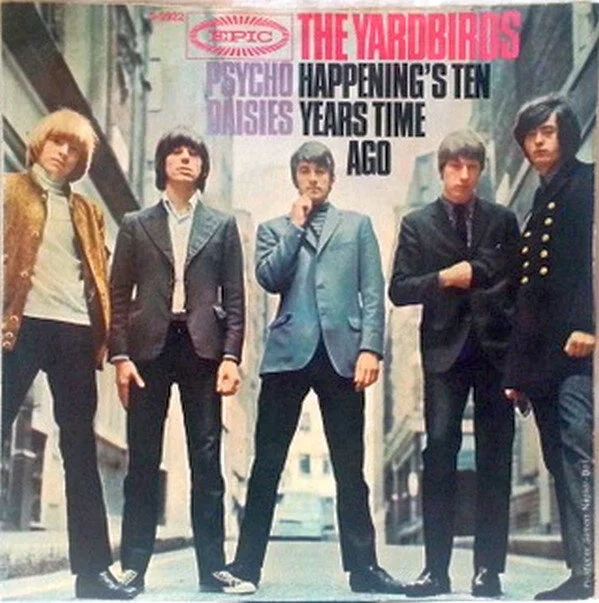
Happenings Ten Years Time Ago - The Yardbirds (1966)
“Why you all got long hair? Bet you’re pulling the crumpet, ain’t ya?”
It doesn’t get better than this. Jimmy Page and Jeff Beck on twin attack lead guitar smouldering through some hard rocking mid 60’s psychedelia. This is peak Yardbirds. They went up fast and fell almost as swiftly before re-emerging as the global phenomenon Led Zeppelin. So, much to write about this song. Jeff and Jimmy playing in unison, the catchy tune, the hard riff, the avant-gard spoken piece in the middle. Together with Stroll On, the dual lead guitar Yardbirds lasted for only a few months in 1966. Such months!
Juliet - Neil Diamond (1969)
I could write a whole article on fantastic Neil Diamond lost gems from the 60’s. Across both Bang and Capital labels he produced some wondrous songs from ‘66 onwards. Always good, he seemed to lose his way a bit from the mid 70’s until The Jazz Singer (1979). He’s now battling Parkinsons and I wish him well against that horrible disease. I’ve already written about Neil Diamond Song Number 1 Solitary Man, but there’s plenty of rivals from the 60’s. I chose Juliet because of the feel, the words, his range from baritione to falsetto, the cosy feeling of new love. “Lay your eyes on me, girl, wanderin’ inside a grown man, no more than a small boy, sweet Juliet.” The whole Sweet Caroline album is filled with some of my favourite music. I could have picked the sublime Glory Road, Hurtin’ You Don’t Come Easy, And The Grass Won’t Pay No Mind. The title track isn’t bad either.
Rain - The Beatles (1966)
An obscure Beatles track? Surely no such thing! Well, probably not, but a non-album B side is about as close as you can get. Rain was the B side of Paperback Writer. It’s the Beatles going full-on psychedelic. Snappy, stop-start drums and a persistent drone kick off this little beauty. It all works. Paul’s bass is fluid and a co-lead instrument. Check out the bass solo towards the end propelling the song into its backwards coda. “Raaaaaaiiiinnnnn” sing John and Paul never more in harmony than here. If you’ve not heard it, you’re in for a treat. In terms of Beatles B sides, it’s in the top three (along with Don’t Let Me Down and You Can’t Do That). A John song, of course.
Rudy’s in Love - The Locomotive (1968)
“No gun shootin’ for Rudi, no retributin’.”
A minor hit. British blue beat. Ska. The Birmingham sound. I first came across this song on a compilation 60’s cassette tape that came free with, I dunno, Vox magazine in the early 90’s. It’s a cheerful ditty about a rude boy who finds love and so doesn’t want to do gangster type stuff anymore. Basic boy meets girl stuff. Driven by a horn section and an organ, this is the ska sound that the Specials picked up ten years later. Syncopated. Danceable. Fun fact; until I checked this out I always assumed at least the singer was black. Apparently not, bunch of Brummie white boys. Who knew?
So there we go. It’s a list. Clearly I’ll argue with it tomorrow. Read Part II where I clearly disagree!
The Real Obscure Stuff of the 60’s?
Real obscure stuff - Gene Clark, The Toggery Five, The 13th Floor Elevators, Jackson Frank you can check out in Part 2 of Obscure 60’s tracks.
Or read me, living the music, introduced as Eric Clapton at Kingston Mines, Chicago.
Walking on Lavender Hill

Old fashioned street sign. Classic Design. Not used anymore. Of course.
“I commute into Clapham Junction everyday. My office is a twenty minute walk up Lavender Hill and Wandsworth Road.”
Lavender...
The word lavender conjures up those sun drenched, hazy fields of Provence. Or perhaps some choppy, warm-toned, Impressionist masterpiece. Or is it a section of a busy thoroughfare in South Central London? Yes, it’s probably the latter. For years this road, this feeling, was my beat.
One thing you won’t find much of on Lavender Hill is, well, lavender. Maybe some discarded pizza boxes, plenty of rubbish strewn waste bags, an upturned supermarket trolley or a decaying Christmas tree thrown onto the street. But not much lavender. The shrub that gave this area its name has gone. Long gone.

The green fields of Lavender Hill. Picture TR
Clapham Junction
My entrance and exit point to this urban dreamscape is Clapham Junction railway station. Not sure what a junction is, but as to the Clapham part, well, that’s a little bit of historical postcode snobbery. A fib. It’s in Battersea. And Battersea is working class. Full of engineering and manufacturing works back in the day. Less so now. Maybe we could rename it Lavender Junction? Help shift those new million pound apartments, no?
There’s a pub. There’s always a pub, isn’t there? The Falcon is pretty special though. One of those big pubs you only get in London. The ones dripping with large baskets of flowers, partitioned rooms and back lit smoky glass. This one sports a famous horseshoe bar (the UK’s longest apparently). I don’t drink there though – nor the Slug and Lettuce next door. However, the facilities are unguarded and handy so I was pretty much a regular.

The Falcon. Piss stop.
So up we go, up Lavender Hill, ambling wistfully through these London fields. Past the retail splendour of Arding and Hobbs, sprinting past Fitness First, KFC and numerous Lebara money transfer shops where bored staff sell cheap booze and fags, whilst conducting mobile phone conversations that sound important, but probably aren't.
There was a girl once. There's always a girl, behind the memories, driving the words. We were students at South Bank University further up the A3036 on Wandsworth Road. The campus is now closed and converted into a Tesco Express and Pure Gym. I used to catch the Number 87 bus down Lavender Hill to Clapham Junction. If I was more observant, as I sat on the bus all those years ago, I would have noticed a local oddity – a genuine London eatery – the Pie and Mash shop. The historian and the Englander within me likes the fact that this relic of old London, of its working class eating habits, is still there. I like that. I’m a fan; pie and mash and gravy for £4. Treacle Pudding and ice cream or spotted dick for £3. I don’t go near the eels or the liquor (eel and parsley sauce). It's cheering though to know nestling amidst the numerous Thai, Indian, Italian, Japanese, Chinese and assorted other restaurants there is an authentic London eatery. But for how long?

Eels. Jellied. Yum.
Continuing on we get Battersea Library, the police station but, most wonderfully (and where most of the drivel on this website was written) the Grade 2 listed building that used to be Battersea Town hall but now doubles as Battersea Arts Centre. They used to build beauty, those Victorians, you know, put the effort in, and make buildings things of wonder and aspiration. Now it’s a worthy shell for community theatre projects. Yeah, me neither.

Battersea Arts Centre, Lavender Hill
“Kate and I are meeting in Battersea Arts Centre. I’m late. I scan the bar. At a corner table is a woman who bears a passing resemblance to Kate’s online dating profile.”
However, money was always an issue, even in the 1880’s. None more so than The Church of the Ascension, a big, bold - God is terrible, God is almighty, repent ye sinners - church at the top of the hill. It’s a massive stone structure with Byzantine influences by way of Carcassonne. It should have been adorned with an equally gigantic phallic tower but the original architect pissed the money away, was eventually sacked and so he church was completed sans spire. Nerdishly, I own a copy of the original architectural plans from 1875 and framed, they adorn my living room.

French / Byzantine architecture meets Victorian brick shit-house, muscular Anglicanism.
“There’s a tramp whose regular perch is the low surrounding wall of the Ascension of the Lord Church on Lavender Hill. Kicking back with his can of strong lager, he likes to shout abuse at the passing world. His favourite trick is surprise; hunched harmlessly over his carrier bag one minute, and then, as though roused from sleep, pouncing like a lion the next.”
Towards Wandsworth Road
And then we're walking downhill. Go past - hurry! - The Crown pub. One time, as I was leaving, I witnessed some ritualised urban ballet as two drug dealers squared off to each other out on the street. Held back by their various women folk screaming, "Leave it out Jon, he's not worth it!" I waited for my Uber to take me to the station as the performance played out. Don't know who won. It's probably on YouTube somewhere. A straightner.
This eastern part of Lavender Hill is all shit council flats and massed ranks of mopeds parked on the pavement outside nondescript takeaways. Let me explain lest you live in a town where cuisine laziness hasn't yet set in. Every eatery on Lavender Hill - and there are many, so many - has a fleet of mopeds waiting to transport to the indolent, the obese, and the time poor banker-wankers, their genuine, wood fired Neapolitan pizzas. This, children, is what decadence looks like. Fight, fight, against the dying of the light and cook from scratch you lazy bastards!
“We continue walking down Lavender Hill keeping our own counsel. Once again, our pace is well matched and we walk together, three feet apart. As we near the old Cedar pub, she slows.”

Lift up your eyes. There is beauty in the most unusual places.
There are many places on Lavender Hill that offer a 'massage'. Strangely they always want to massage - for extra, for cash only - those parts that don't often get massaged in - say - more mainstream establishments. Happy endings are promised. Not always delivered. I avert my eyes, clutch my pearls, lift up my skirts, and run from these places.
(And that paragraph - about happy endings on Lavender Hill - still sends me significant traffic to this website. I’m guessing here, but there’s probably money to be made from adult activities.)
And so, after a mile or so, Lavender Hill finishes at Cedars Road and hands the A3036 baton over to Wandsworth Road in a fistful of Tesco Expresses, coffee shops and Premier Inns in old temperance halls. We are now entering Lambeth and our story must end here.

What happened to Battersea? Abolished in 1965, apparently.
And so where does all this take us? An old London Street. Full of Victorian buildings. What signifies?
“And with clear, cold eyes
And newly acquired candour,
I sift these departing delusions;”
Summing Up Lavender Hill
Well, everything. And nothing. From the confident Victorian public buildings, to the sturdy 19th Century housing for the workers, to the bold and confident Anglicanism. To the many, many cultures that have taken root here, left their mark on the shops, restaurants, through even the pizza delivery boys that criss-cross unknowing across this urban thoroughfare. To the pubs, open and closed, converted or renovated, silently bearing witness to wars and coronations, disasters and triumphs. History shines through, hiding amongst these stones, these relics, peeping shyly from under the brim of modernity. The breath of London, old London, still blows gently in this cityscape. And if you look hard enough, you will find some lavender. Yes, even on Lavender Hill.

Lavender. On Lavender Hill
1) All pictures of Lavender Hill, Tim Robson February 2017. Article revised April 2020 and June 2026. Better? Perhaps. More links and URLs and cheap ploys to drive internal traffic? Hell yeah!
2) Similar themed article is The Dead Pubs of Clapham which looks at the wider area within the context of pubs that once were that stand like ghosts in plain sight.
3) And I still pass through, every day, Clapham Junction. One time I will get off and retrace my steps and notice the changes; the chain pubs, the new takeaways, the vape shops… Urban life is always changing within the rails of hard geography. Nothing stays the same. For more thoughts on changing / not changing infrastructure, read about Brighton in the early 90’s.
4) The daily walk up and down Lavender Hill inspired me to write a novel some years ago. A novel I still tinker with occasionally. The start is anchored in this very walk. Read A Star on Lavender Hill intro. Demand I finish it!
Brighton to Manchester Train

A Class 47 Intercity : Attribution: Black Kite at the English language Wikipedia
No Car? Take the Train.
I didn't own a car until 1997. Before that time I either walked, rode my bike or, for longer journeys, hired a car but, most probably, took the train. It seemed a better, fitter existence, though maybe I was just younger and leaner and reaping the benefits of living in a city, Brighton. Or maybe I was just poorer.
In those days (roughly 1986 to 1997) in order to get between Brighton and Rochdale, I used to take a marvellous direct train that snaked slowly but surely across England between Brighton and Manchester Piccadilly. I checked National Rail Enquiries recently and this route doesn't exist any more and instead one is encouraged to take the commuter train to London, hop on the underground to Euston and then catch the Virgin to Manchester. It's a quicker journey end-to-end no doubt, but more bitty, and less stately.
Eight Hours
I remember the old Brighton to Manchester no-change journey (and its reverse) being around eight hours but perhaps my memory is playing tricks on me. It certainly felt a long time! There were plenty of stops; a selection, Gatwick, Kensington Olympia, Banbury, Birmingham New Street, Birmingham International, Stoke, Crewe, Wythenshaw etc etc. Back in those days there were smoking cars and non smoking cars. I sat in either depending on my ever flipping status. Buffet cars existed of course. I actually liked and looked forward to my British Rail cheese and tomato sandwich on white bread. I still miss it. Typically though I didn't drink alcohol on trains, then. I was corrupted eventually by a friend in 1989 who brought a four pack of Tetleys with him for the journey up to Stoke on our way to his 21st celebration. After that the drop to M&S pre mixed Gin and Tonic was a short one.
People. Newspapers. Books. No Phones
The interesting thing about the train from Brighton to Manchester was that - with so many stops - people were forever getting on and off along the way and so the landscape of interaction constantly changed. You might strike up a conversation with someone between say Coventry and Stoke, flirt with a girl between Gatwick and Milton Keynes. Sometimes it was busy, sometimes empty, and this changed depending on the day and the station.
In those pre mobile phone days, what did one do for all these hours? Well, one read, of course. Books and broadsheet newspapers. One could write letters. Yes, people actually used to write letters to each other and not that long ago in the scheme of things! I remember one time writing a letter to a friend on this very journey and stopping at Kensington Olympia, and briefly looking up to see Princess Diana strolling by my window. She was walking along the platform and passed right by me. She got on our train - I believe in a special ‘royal’ carriage though I may be wrong about this - and hitched a ride somewhere further down the line (not Brighton, I think). There was no phone to take a snap of her and so I only have my memory of her being so close, separated from me by just a pane of glass.
That and my Madonna story vie for a telling when I’m out to impress.
I do remember the eagerness one got, impatience even, as the last hour of the journey approached. If my parents weren't picking me up, the arrival at Manchester Piccadilly only meant the start of another journey: a cross town bus to Manchester Victoria, slow train to Rochdale, and parents or taxi for the last leg home.
Fickle Memory
I wish I'd have taken more pictures of these journeys. I look at the stock photos on the internet and they seem so old, so quaint, still lifes from another era. I begin to mix fading memories with fiction. I start to image white linen clad restaurant cars and Belgian detectives, efficient station masters looking at pocket watches and brass buttoned ticket collectors with stamps and strange hats. The Brighton to Manchester Intercity has morphed into Murder on the Orient Express or The Lady Vanishes.
Like all memories, one edits - either consciously or though age and declining brain cells - what is recalled. Probably there was lateness, smoky carriages, boredom, inconsiderate passengers but then there was also no inappropriate phone calls either and although many of us had Walkmans (if the batteries lasted!) not everyone was in their own sound buffered zone. So people did talk to each other and, given the era, there was more of a sense of homogeneity about the passengers - a shared story, culture, prejudices. Gone now. But so has British Rail, the route itself, my hair, the careless use of time, being out of contact for long periods of time. Yes, the past is a very different place, how strange it seems sometimes.

Train to London: Nov 1994. The jumper years.
Originally published 2018 - slightly revised May 2026.
The idea for this blogpost came from Peter Hitchens and his - far superior - memories of trains in Europe both now and then.from his Sunday Express column 21/01/18.
A Walk on the Wey and Arun Canal
An unrestored part of the Wey and Arun canal
English Social and Economic History
Back in days remembered best in sepia, the school children of this land used to study British social and economic history 1700 to 1945. This would give the successful students an O Level in History.
This wasn’t the study of war or conquest or empire, this was the study of how a small island nation became great - innovation, reform, experimentation and science. Throw in liberty, religious tolerance, property rights and you have an alternative history of Britain to combat the modern narrative of “It was all slavery, innit?”
Isambard Kingdom Brunel, Abraham Darby, Josiah Wedgwood, The Enclosure Acts, The Duke of Bridgewater, Robert Stephenson, William Wilberforce, The Great Reform Act all roll off the tongue of English of a certain vintage. The landmark acts of Parliament, the social reformers, the dark satanic mills, the sheep fanciers and anti Malthusians, all flash by in a parade of not quite forgotten factoids.
One of the accelerators of the industrial revolution was ‘canal mania’ - the twenty or thirty years before the advent and mass adoption of railways. Canals could move bulk commodities long distances safely and efficiently. Britain became criss-crossed by a network of canals, linking cities to the sea, factories to their markets. The longboat, pulled by horses along countless towpaths, complicated series of locks, was one of the unsung heroes of our island story.
But it wasn’t to last.
A restored part of the canal with bridge
The railways were faster and could carry more and for further distances. Gradually the canals were abandoned as goods transferred to rail. Slowly the canals disappeared, bit by bit, one by one. They were neglected, infilled, allowed to rot as nature took its course.
Which brings me to The Wey and Arun Canal.
The canal was built between 1813 and 1816 to link the river Wey in Surrey with the River Arun in Sussex. This vital link would thus connect London with the South Coast. But it was soon eclipsed by the railways and never brought in enough traffic to make it viable. It closed in 1871 and gradually was left to rot and re-wild.
I was there a couple of weekends ago. Storm Dennis was coming in hard, the wind was howling, the rain was falling and so - in Tim World - this meant “go for a hike”. Resolving to see somewhere different, a few clicks on Google got me to Loxwood and the Wey and Arun Canal. Hiking boots, walking trousers, bobble hat and Mars bar packed, off I went!
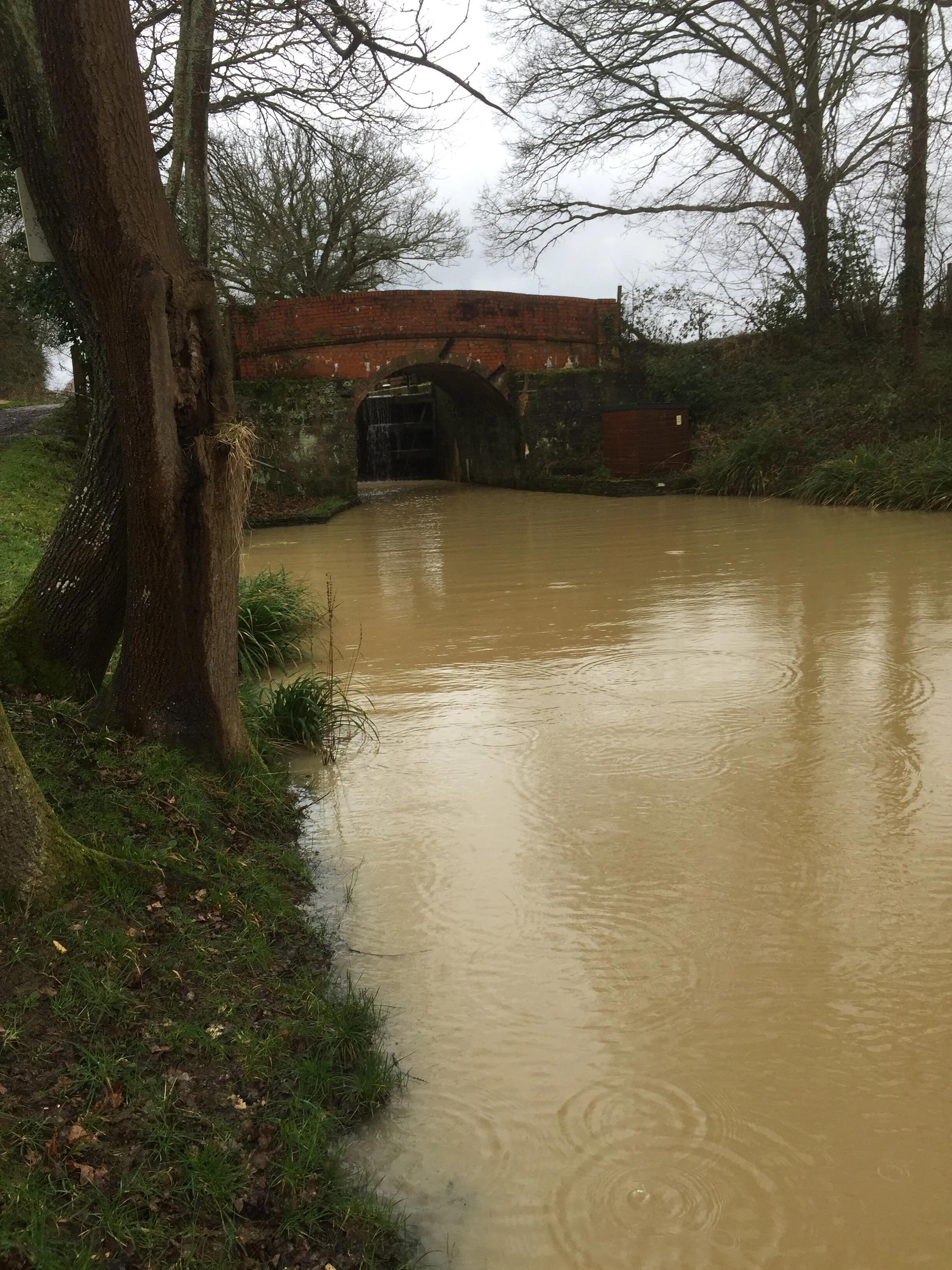
The story of this abandoned canal is one with an evolving happy ending. Since 1970, a preservation society has been gradually reclaiming this old waterway; getting planning permissions, digging it out, repairing bridges and locks, organising professional workers and armies of volunteers. They’ve restored several miles to make it navigable again. They have plans to get the whole canal operational. Big dreams.
A Solitary Walk on The Wey and Arun Canal
I chose a walk incorporating both the restored and unrestored portions, starting and finishing in Loxwood. Technically this was a four mile hike but given the weather, the mud, my unfamiliarity with the route and a failing iPhone battery, it seemed a somewhat longer endeavour. But I live for wind and rain, soft challenges and middle-class war stories.
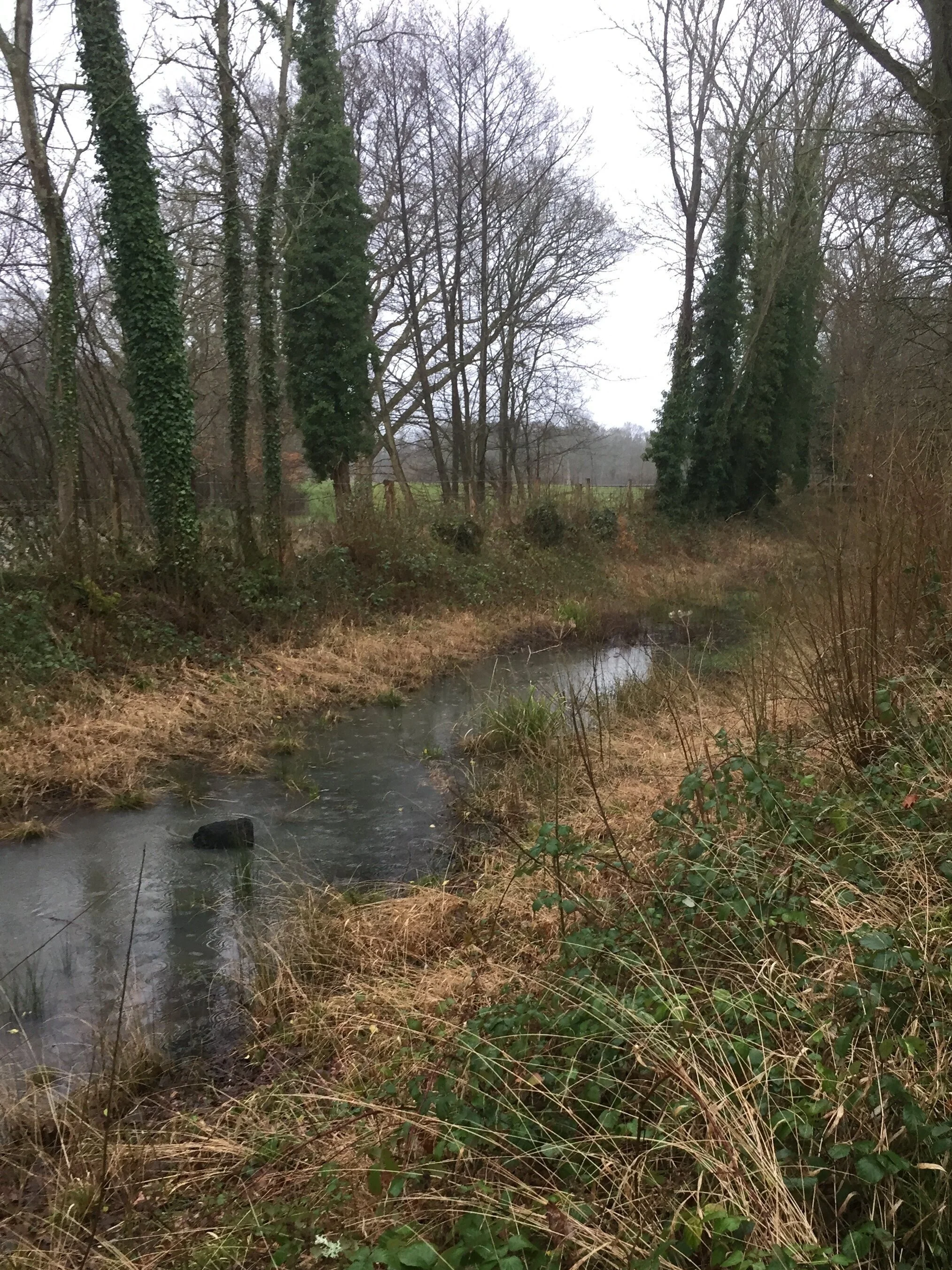
The restored part of the canal was like any other canal in a beautiful part of the country. The dreadful weather meant I had it all to myself. I walked along the tow path, dodged the falling branches and contemplated the rain on the water. What interested me more though was the unrestored the sections of the canal - untouched since the nineteenth century and left to their own devices. In places there was no flow of water, in others just a trickle. Obstructions abounded - trees grew right in the middle of where a canal was still clearly defined. Farmers had created the own bridges and accesses that cut the canal into pieces. Seeing this made me appreciate the restored part even more. What labours and fortitude must the merry volunteers of the Wey and Arun Canal Trust have suffered to turn basically a dip in the landscape into a functioning canal?
I turned away from the canal up the marvellously named Rosemary Lane (When I was in service in Rosemary Lane*) and then headed cross country back towards Loxwood. Across field and dale, woodland and track I wandered, head down.
There’s a point on a walk where - after stepping in one too many muddy puddles - you no longer beat yourself up about opting for hiking boots and not knee high wellies. You see, walking along woodland trails in mid Feb with a full on storm blowing was, shall we say, difficult. My hiking boots sank into the mud and got soaked (checking today, they still are). I got soaked. My phone ran out of battery. But I ate my Mars bar and found my own way back to Loxwood.
The solitude allowed me to ponder those long ago, semi forgotten lessons in British social and economic history. In truth it was a dry subject matter - no villainous Tudors lopping heads off, or epic Crown against Commons clashes or even little England alone against the united forces of fascism 1940. But walking along this partially restored piece of our industrial revolution got me thinking; it’s the inventors, the doers, the makers and builders that really make the lasting changes, isn’t it? What lasts is not the generals but the engineers. Canal mania was a brief but intense time in our development but they helped get us to where we are. Even in the wind, rain and mud
Read On - More Walks
Try some other walks in the area. What about Wolstonbury Hill? Or maybe, a circular walk around the Downs near Burgess Hill?
The Good Life - Part 1

La Plage, Deauville - 2019 (Photo Tim Robson)
“society regulates the general production and thus makes it possible for me to do one thing today and another tomorrow, to hunt in the morning, fish in the afternoon, rear cattle in the evening, criticise after dinner, just as I have a mind, without ever becoming hunter, fisherman, herdsman or critic.”
The other day I gazed at my Twitter feed and saw the same news item retweeted and commented upon by several of the people I follow. Making the same points with various degrees of humour or waspishness. I was literally gazing down at my own personalised echo chamber. Comforting, affirming and totally corrupting.
We all know - or at least I hope we do - that to live the good life, you should be understanding, humble, a seeker or truth and knowledge. What is a good life? Well, read my dissection of Marcus Aurelius here. We should all try to widen our sources of information, and gain new perspectives and thoughts.
This feeling grew after the election in December. I should have been happy - and I was - but a feeling in me grew that perhaps I was missing something. On a whim I trimmed my right wing and libertarian sources and upped my left wing and radical sources. I always had a few (George Galloway, Jimmy Dore, Tulsi Gabbard) but now I wanted left wing voices to be more represented on the panels of my thoughts. My politics is complicated and I wanted my sources to reflect this, to challenge myself.
But last week I went further. As any reader of this blog knows, I have interests in Roman history, history generally, architecture, London and art. But my Twitter feed did not reflect this. So I actively sought out Twitter feeds that nourished what I actually like beyond the narrow prism of politics - archaeological finds and digs, art exhibitions, great architecture from around the world.
And so my twitter feed - my guilty pleasure - is now (for now) more representative of me as a whole, including the better half of my soul. When I look at my feed I want to stray from Trump’s tweets, to a campaign to save a Roman villa in Gloucestershire, to what’s happening next door at the Tate, to the painful internal process of good solid Labour MPs as they try to work out why they got the recent kicking from the UK electorate.
The same with books. The same with podcasts. The same with YouTubing. Music. 2020 has to be the year of diversity of thought, that most important but under-rated of qualities. It is a central pillar that buttresses ‘a good life’.
Next week, I discuss that how reducing your alcohol intake, eating moderately across all the food groups, quitting smoking and exercising regularly might actually make you more healthy. It’s part of my new series; Stating the Bleeding Obvious.
* Footnote - the Marx quote… This always struck me as ridiculous when I read this back at University. We all had to study Marx a lot, and this quote seemed to summarise the unrealistic nature of communism as envisaged in The German Ideology. But if one substitutes work and replaces it with thought, then, not so crazy…
The Greatest Album One / Two Punches

Albums that come out swinging!
There are albums that come out of the blocks with two killer tracks that are like a pissed off Mike Tyson swinging wildly at some trash talking, old timer patsy in the late 80's. Albums that decide that the best way to follow a kicking first track, is with another.

Lock up your aunties! The Crowes in 1992
The Southern Harmony and Musical Companion (1992)
The second album from the Crowes throws 'Sting Me' to the left and "Remedy' to the right. 1992 might have been Grunge Year Zero but, together with Teenage Fanclub, the Crowes held rock's banner aloft. These are kick-ass rock tunes. Basically, The Faces reimagined if their Marshalls were turned to 11 and Rod really went for it instead of pretending to be Sam Cooke. Love these two songs. Highlight - the 'fuck you' start of the guitar solo in Sting Me. A moment in rock I've ever and a day tried to replicate. Two seconds of true power!

The CD reissue doesn't 'feel' right!
Eden - Everything but the Girl (1984)
The impulse purchase one doesn't regret! Stood in WHSmith Rochdale's record department in 1984, I hear the wondrous album play over the store speakers. One track, two tracks, I was sold. Marched up to desk and asked, "Pray tell me good madam, who is making this bewitching sound?". Everything but the Girl apparently. Crazy name, crazy sound. So, I bought the album with its distinctive cardboard, non veneered album with the abstract painting on the front. The songs, I now know, were Each and Everyone and Bittersweet. They detail the commonplace jealousies and realities of relationships. All bedsits, screaming babies and jealousy. No holding hands and a rush towards lust with these songs. It was the clever lyrics as much as the bossa nova rhythms that had me captivated. The rest of the album's pretty good (apart from the execrable Soft Touch). I’ve framed this album.

George is a pinapple head
Beatles for Sale (1964)
Not a One / Two, but a 1-2-3. The Fab Four of course do what other groups do - only better. Whilst other groups would put their singles on their albums, The Beatles didn't. So Beatles for Sale kicks off with No Reply, I'm a Loser, Baby's in Black. With these stunning ditties The Fab Four literally piss on their competition. The bar is set so high, their album tracks sound like a career best single for any other group. Bizarrely, although released at the height of Beatlemania, Beatles for Sale is pretty obscure these days and these three - being non singles - are not as well known as they should be. But I love this album. Almost as much as I love...

Fisheye
...Rubber Soul (1965)
Pound for pound, this non single containing album, packs pretty much the hardest punch of any album. It roars out of the blocks with McCartney's funky - come on Motown have a go if you think you're hard enough! - Drive My Car. Most groups' best single ever. Just an album track. We then shift gear to the acoustic and sitar masterpiece that is Norwegian Wood. As a guitarist, this latter song - with its major to minor shift - is a dream to play. Like You've Got To Hide Your Love Away this shows why Lennon is so revered. This is effortlessly brilliant. We all fuck around on D but don't achieve anything like this. Let alone chucking in a middle 8 in G minor. Class. In a glass.

Hard. Soft. Kicks ass.
Led Zep 4 (1971)
Anything The Beatles can do, Zep does one better and louder! The whole of Side 1 of Led Zep 4. Just review these four tracks:- Black Dog, Rock n Roll, The Battle of Evermore, Stairway to Heaven. And this is just an normal album, not a greatest hits compilation. Not a filler in sight! From the sonic destruction of the first two, to my teenage fav with Sandy Denny (obligatory hobbit references!) to the ubiquitous - but deservedly so - Stairway, this is how to start a 37 million selling album. Are these guys knights of the realm yet FFS?
Want to read more?
What about the five songs from the early sixties that led to heavy rock?
From Bulgakov to Hardy via Romans

It’s crowded. It’s dusty. It is my overstocked bedside table. What lurks there?
Master and Margarita - Mikhail Bulgakov
A Russian novel recommended by a Russian lady. Though she’s departed the scene, the novel remains; a 439 page aide memoire to one of life’s tiny footnotes.
SPQR - Mary Beard
It’s like the law - or something - that there shall be a Roman History book on my bedside table. Mary Beard traverses familiar ground as she meanders around from Romulus to Septimius Severus. Not my favourite author or person but I’ll try and look past that and let the subject speak for itself.
Life’s Little Ironies - Thomas Hardy
Hardy was an all rounder - novels, poems and short stories. Study the art from a master.
The Folio Book of the English Christmas
It’s an annual tradition, I get this book out 1st December, it gathers dust and I put back on the shelf in February as the crocuses emerge and the thought of Christmases past appal.
Caligula - The Corruption of Power, Anthony A Barrett
Not one, but two Roman histories. As a keen student of Suetonius and Robert Graves, this feels a bit obvious to my tastes. I crave the third and fourth century, the fury of Aurelian, the prescience of Constantine, the oddness of Julian. But one still returns to the Julio-Claudians like a Hollywood film-maker.
The Bible - King James Version
The only constant presence on my bedside table. I like to look in occasionally. Ah, wisdom and Western Culture. Mmm. As you were. And today’s reading is: Bread of deceit is sweet to a man; But afterwards his mouth shall be filled with gravel. (Proverbs 20: 17)
And my mobile phone and a coaster with my name on it. Possibly my Boss watch.
The Dead Pubs of Clapham

Snow hits the Artesian Well, Wandsworth Road. A dead pub of Clapham
Adieu Clapham
After three and a half years, I’m leaving my office on Wandsworth Road for Westminster. Three years of working in a repurposed brewery surrounded by dead pubs. In Clapham… Or was it Battersea?
WelI; I worked on the cusp of both districts. Basically Clapham is south of the Lavender Hill / Wandsworth Road axis whereas Battersea is north, next to the Thames.
It’s wise to be precise. For example, Clapham Junction train station has the motto, The Heart of Battersea above its main door.
Geography aside, what do I remember about this area?

A map showing Battersea / Clapham
Lavender Hill
Lavender Hill of course; I walked this bugger twice a day for three and a half years! As I’ve written elsewhere on this blog, Walking on Lavender Hill I can probably trace in my head every damn step from Debenhams in the West to Sainsbury’s in the East. This trek is aptly described by one of my favourite writers:-
“It’s approximately 2400 steps from one end of Lavender Hill to another. I walk one way in the morning, and the other in the evening. From Clapham Junction to Wandsworth Road, from Wandsworth Road to Clapham Junction twice a day, five days a week. This is my Lavender Hill. ”

The beginning of Lavender Hill - Photo TR
Though there is bustle and many small shops, Lavender Hill was a place to walk along, to get from A to B without stopping. An exception to this would be that fine piece of Victorianara - Battersea Arts Centre (BAC) housed in the old Town Hall. Here, in the Scratch Bar, over a beer or a wine, I composed some of this very site’s best blogs. Always happy when composing in public, BAC provided a home for my ever-elusive muse for a couple of years.
Many was the night I sat and jockeyed a Mac typing spiteful little blogs, dashing off mean spirited diatribes about the posh twats with their elaborate beards and facial jewellery sat around me talking bollocks about politics. Highlight was probably Second Thoughts a story written about BAC and the online dating scene. A modern classic. What wasn’t a classic is ‘The Dead Pubs of Clapham’ a pig of a short story that I never finished. In fact, it was the title I liked, much, much more so than the actual story itself. Hence me reusing it for this blog celebrating the area. But let me give you a flavour of this deservedly obscure tract:
“A dead pub always makes me sad. There are plenty in Clapham. The dead pubs of Clapham. My journey to the station passes many. VE day. The Coronation. 1966 World Cup. The Falklands. And there they stand, not even with the fig leaf of being converted into a Cheap Fried Chicken outlet or a chichi furniture shop for hipsters to waste a grand on a fucking chair.”
The Artesian Well, The Mist on the Water, The Prince of Wales, The Victoria, The Cedar. All dead. Dead in 2016 and dead now. The Dead Pubs of Clapham.
Massages?
One amusing side note to Lavender Hill. In my published ode to this urban highway, I mentioned en passent the many oriental massage parlours dotted on the road where you can - allegedly - get a happy ending massage. A small but reliable number of hits to this blog to this day come from Google searches seeking rub and tug merchants on Lavender Hill. And then they click on this blog where I prattle on about fourth century Roman emperors and obscure Stones tracks. Sorry guys, go back to self-service.
But let’s leave Lavender Hill and massages aside. From where I was based, atop Silverthorn Road, my walks could either take me down the hill to Battersea Park or up the hill to Clapham Common. Down was literally down, a bit shit, loads of Harry Brown type estates, a mishmash of railway tracks, car dealers under the arches, grimy off licences, obscure train stations and finally the wondrous urban space that is Battersea Park. I’ll miss it.
From my office window I used to look down on this city scape, an outlook dominated by the ever changing face of Battersea Power Station. It’s now surrounded by tall towers and modern glass investment flats for international money. Soulless, nondescript, anywhereville. The power station itself got buried in these modern intrusions. However, from my new vista in Westminster on the other side of the river, it looks great; the shitty towers and modern embellishments are merely supporting actors not co-leads. I suppose it’s all about angle and perspective which is about as deep as I get, children.

Battersea Power Station - recent past. Doesn’t look like this now.
Clapham Common
Up the hill and into Clapham where million pound houses give way to eight million pound houses (gorp at Macauley Road if you want to check them out). What do I remember about this side of the tracks? I didn’t walk on the Common much. Obviously the Trinity Church stands proud on the east side near the tube station. In these days of ignorance and lack of knowledge about British history, the significance of this 18th Century church is lost on most of the present day passers-by. But it was here, of course, where the so-called Clapham Sect used to meet and plot the abolition of slavery. We should celebrate this stuff more.

The Common. The High Street. A wet day.
Talking of churches…
No ramble through Clapham is complete without mentioning Graham Greene and his wartime novel The End of the Affair set in and around Clapham Common. One of the scenes is, of course, set in the church of St Mary’s which dominates the eastern end of the Common. From my window at work for a couple of years I used to gaze at the spire half a mile away. My photo (left) rather inadequately represents this local landmark which survived the Luftwaffe bombing the area but who’s spire got somewhat wrecked by an errant friendly barrage balloon.
Another memory, ever present and ever changing is the schtick of the local Romanian beggars outside the tube and Sainsburys Local down The Pavement. For a while accordions were the fashionable must-have accessory for the enterprising beggar. Tuneless whirly-gigs were played evoking, well what exactly? Smokey Roma camps back home? Belle epoch Champs Elysee? Fuck knows. However, accordions now seems so very 2018. The begging community have reverted to the classic shake and a shimmer with hand outstretched and a single word ‘please’ dragged out pitifully. And who could forget the daily ‘conferences’ on the waste land beside the tube station, where the area’s street workers gathered to compare takings, discuss tactics, and split test new methods of appeals.
Then there are the pubs.
The Bobbin Pub
“The Bobbin pub lies hidden on a side street near Old Town in Clapham. The area, suggesting unflashy old money, is flush with inner city mansions, tree lined roads festooned with Land Rovers and X5s, gardens tended by minimum wage labourers, constant daytime building works as the inhabitants add subterranean swimming pools and climate-controlled wine cellars, but quiet at the weekends as the residents retire to their country piles in Wiltshire. There’s an abundance of leonine men of a certain age wearing red trousers sporting trophy wives.
Twats.
”
And there was one barmaid. I’ll miss her. If I asked what her feelings were on my departure I’m sure she’d just smile shyly, push a strand of hair away from her face and say, as she had many times before, “What would you like to drink?”
Literally cannot turn it off. In Clapham. Or Battersea.
Read More?
What about my thoughts on Lavender Hill? Or more London Walks?
Check out my novel Franco’s Fiesta on Amazon. Pretty sure it’s free now!

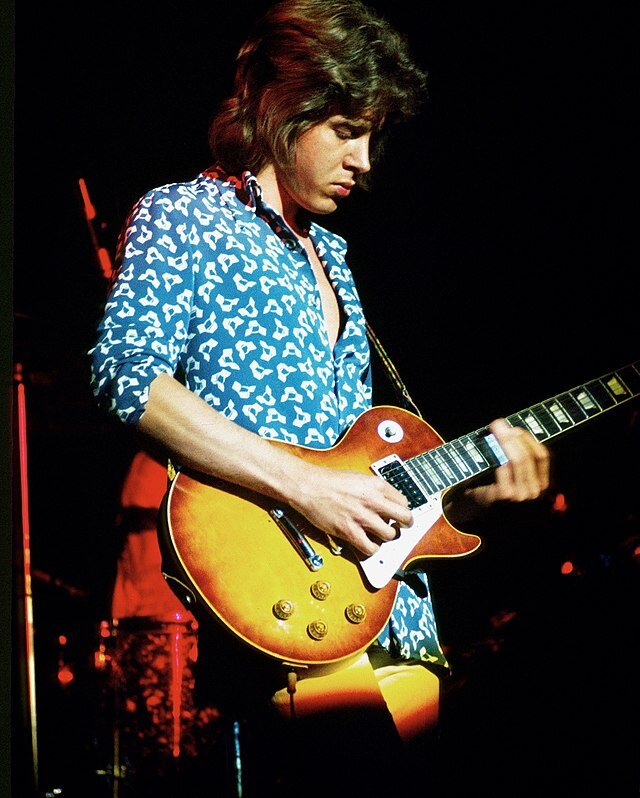
Time Waits For No One - Mick Taylor's Greatest Stones Song
“Time can tear down a building or destroy a woman’s face
Hours are like diamonds, don’t let them waste
Time waits for no one, no favours has he
Time waits for no one, and he won’t wait for me”
The Solo That Bids Goodbye
In the late 80's I wrote a song called 'It's Raining Again'. I used to play it loudly in my rented flat on Montpelier Road, Brighton. It was shit. The only good thing about the song was in the instrumental break where I grafted a sausage fingered version of Mick Taylor’s solo from Time Waits for No One.
Ah, Time Waits for No One. This is the Stones, timeless, standing out of time, looking back at us and beckoning us mere mortals forward. Yes, this is the best track Mick Taylor and the Stones ever recorded. So beautiful. So wistful. And that solo at the end! It was Mick Taylor’s swan song with the band, at once both a calling card and an elongated - but elegant - adieu.
The song’s brilliance however comes from all the players in the group - it’s not just an excuse for Taylor to let rip. That’s the beauty of MT’s time in the Stones, he took them to another level but, without him, the starting point was pretty damn high anyway.
So, credits? Jagger's thoughtful lyrics echo Chaucer (time and tide wait for no man) as the singer muses about the transitory nature of life. Keef's adds the recurring spine tingling riff. Wyman, Watts, the ever ready, ever steady back line, all present and correct. Nicky Hopkins adds his characteristically dramatic piano flourishes whereas Ray Cooper contributes the pervasive metronomic backing that tick-tocks the track into immortality.
The Solo
And then Mick Taylor solos like a bastard for two / three full minutes of magic. He employs Latin influenced runs up and down the fretboard (influenced by a recent trip down the Amazon). Like all the best Mick Taylor solos, this one is fluid and melodic and probably pretty spontaneous. You get the impression that if he were to play it again, do another a take, he’d do it in a completely different - but equally good - fashion.
Each crescendo on the guitar, proceeded by the supporting buttresses of melodic scales, is a highlight. As Mick works his way up the fretboard (though delightfully at one point he reverses) he carries the listener effortlessly to the stars. I believe many die-hard Stones fans request this track to be played at their funeral. It certainly has an ethereal beauty, at once balancing the beauty of life, music, art, nature, love with the fragility of those very qualities.
Listen below if you’ve never heard this track. The Stones could have gone this way. Mick Taylor though was not destined to be with them for long. In Time Waits for No One he’s playing his own exit music and damn fine it is too.
Want to know more?
The five greatest Mick Taylor Stones studio recordings?
Dessine-moi un mouton

Le vieux port - Honfleur. Picture TR. Notice the light?
Honfleur - It’s About the Light
I read once - sometime ago - that Impressionist artists loved the quality of the light in Honfleur, Normandy. The way it arrives sharply from the estuary, dapples on the water, shards through the slate tiled buildings. I think my photograph (above) of the old harbour might actually demonstrate this beautifully. You’re welcome (@Tim Robson - reasonable rates for reproduction rights if you’re a cheap arse and can’t be bothered going yourself).
Yes dear readers, we’re into one of Tim’s infrequent forays into art criticism. But, like some overfed, underbred Yorkshireman holding forth after several pints of frothy ale and a chicken madras, “I know what I like.”* The rest of this article may be a bit rough and ill-focused. Bit like Impressionism, in fact.
Tim’s Impressionism
Normandy plays an important role in the development of impression art. Impressionists, when they weren’t trying to get unemployed actresses to take their clothes off for ‘life studies’, liked to paint out of doors - en plein air - and so light, and the quality of it, was really important. When I was younger I used to claim I liked impressionist artists. It was fashionable. However, as my tastes have matured and become designedly my own, I’m less enamoured these days. I prefer a more literal approach to a painting which can then be interpreted.
My notes from Honfleur are a little more damning - as befitting being written in a bar: “Impressionism seems to be an artist forgetting how to paint and covering this with obfuscation and swirls.”
Yes, I’ve just had a short break in Normandy. Honfleur is where one of the godfathers of impressionism, Eugène Boudin, was born. There’s a pretty good museum in the town dedicated to his work and other Impressionists. Extolling the light thereabouts, Boudin dragged a coterie of young men in the latter part of the nineteenth century to this part of France. Men like Claude Monet. And together they painted - and repainted - seascapes, beaches, harbours and buildings, of Honfleur and other towns along the Côte Fleurie. Outside and capturing the light, you see.
So, wearing my black polo neck sweater, pea coat and artistic flat cap, I visited the Eugène Boudin musée in Honfleur and the somewhat grander Musée des Beaux-Arts de Rouen. Both have large Impressionist collections. Frankly, I’m all Pissarro’d and Sisley’d out. I had the freedom to be slow, to be quick, to linger over paintings I liked and to pass by those that didn’t interest me (basically anything with fruit or tedious biblical allegories). However, both galleries are worth a visit. Each contain copious non-Impressionistic paintings amongst their roster. French art galleries just do it right don’t they?
(Rouen town however is a bit of a clown show. Beggars and drunks acting out their dizzy versions of Les Misérables. Check out my searing Third Battle of Mons for some more of this urban theatre vibe.)
The Bell Tower Honfleur: Tim v Monet
One thing I noticed though about all these Impressionists: Everyone who held a painting stick seems to have had a go at rendering The Bell Tower in Honfleur. Hell, me too… So let’s start by comparing Monet and Tim Robson shall we? First up our old mec Claude:-

Clock tower Honfleur - Monet
Not bad Monet - bit squiggly for my tastes though. More bell-end than bell tower.
Now me… I literally did the drawing opposite in 30 seconds. I bet Monet took days to do his misjudged dab-fest. Piece of piss this art game.
But the gods of talent long ago asked me to choose between art and literary fame. I chose both and so got neither. However, some vestiges of skill still remain. More in the written word than the art world to be honest but - I’m available for commissions. I don’t charge much.
Same goes for my gigalo skills frankly.

Awkward Pivot: Which Paintings to See?
So, what pictures would I actually recommend from (the many) that I saw?

Le Martyre de Sainte Agnes - Joseph Court
The monumental Le Martyre de Sainte Agnes - Joseph Court 1864 (shown above in Rouen, picture TR). Clearly the Roman theme attracted me. Diocletian was one of the better emperors but became a bit of a bastard towards the Christians in his final years. Plug: Read my Roman articles, scholarly and yet still accessible.
Place de la Haut-Vielle Tour a Rouen - Giuseppe Canella 1824.
Rouen Cathedral. Grey - Claude Monet. This one grew on me. As I walked away from it, the indistinct shapes became whole and I - for once - ‘got’ impressionism.
Hetraie a La Côte de Grâce - Eugène Boudin (can’t find this online). One of his better ones. Can’t remember it though. This is a great article, isn’t it? Seek and ye shall find and comment on it below. Why was I right?
François Louise Français - Les Hêtres de La Côte de Grâce (can’t find this online either.) I’ve decided I like pictures of trees. In particular, I like pictures of trees in Autumn. I wrote a poem about this once. Crap but shows I’m sensitive. ‘Want another glass of wine, my dear while I talk about art and, er, what are you doing later?’
Light, shade, impressionism, abstraction and poetry. I’m the worthy shoemaker in the Renaissance looking up from his workbench and shouting “It’s all bollocks, isn’t it?”
But yet I go back every year. Honfleur may be touristy but, go out of season, and the old magic that drew these painters here still works. Works on me anyway. It’s a unique and mysterious place.
And I got through all this without mentioning Satie. He’s got a museum in town too. Never been.
Read On Mes Amis
If you want to pursue the French aspect of my corpus of writing then my Parisienne walkways series - Paris Profond - is the ideal place to start. Try the walk to Opéra or the more magestic walk to Bastille.
Or, sticking to the arty theme, my thoughts on Doisneau’s Le Baiser de l’hôtel de ville. Paris then. Paris now. The Paris of my youth. How art captures a moment.
And a song to finish (you off)
Finally, to round out the Gallic theme, watch one of my favourite French songs below as a well chosen companion piece to accompany this article - the monumental rock masterpiece that is Draw me a Sheep (Dessine-Moi Un Mouton).
Quotidian Notes
1) *Actually, digression alert, I was born in Yorkshire so I can laugh at myself (well, them really, but, whatever). Can’t do the accent though. When I try it sounds like some generic ‘trouble at t’mill’ version of a Northern accent soft southerners do to entertain themselves with at posh dinner parties when the subject of Brexit voters come up.
2) Revised, scabrous’d up in August 2026 along with numerous algorithm-pleasing internal links. Hey Google Bots! I’m a bloody authority on this stuff although I wear my knowledge but lightly. Reader, click on my thoughts on Marcus Aurelius’ Meditations. Stoic does not even come close to describing this head-to-head intellectual cage-match.
Brighton Beach Scumbag
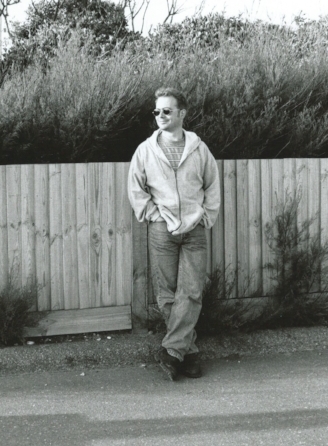
Tim Robson. The modelling years.
“This could be the saddest dusk I’ve ever seen
Turn to a miracle, high-alive
My mind is racing, as it always will
My hands are tired, my heart aches
I’m half a world away.”
Memories of early 90's Brighton
Out of Time
Michael Stipe, singer in REM, once noted that a fan's favourite REM album tended to be the one that came out straight after that fan graduated from college.
My fav REM album is 'Out of Time'- as near a perfect album as ever made. And yes, it came out the year after I graduated. REM have just reissued and repackaged a 25 year anniversary edition of Out of Time. I played it again today. Still sounds good. But I've never drifted away from it. It's one of those very few albums that form the core of my musical taste. I probably consciously play the whole album through once a year - every track (apart from the instrumental Endgame).
When Out of Time originally came out I lived in a small flat in the Kemptown area of Brighton*. On the way home from my job, job, I used to stop off at The Hand in Hand pub, and - in my memory anyway - Out of Time was always playing.
Brighton: Then to Now
Brighton's changed pretty drastically between then and now. Whilst it still maintains the old Regency squares and buildings, the pier and the pebbly beach, it has been infilled, taken over, gentrified, redeveloped, stuffed full of wanky coffee shops and i360's. It always had a certain kind of Bohemian hipness - a jazz age Berlin vibe where anything goes within the bubble. Well not anymore - it's corporately trendy. And that isn't the same thing at all.
Yeah, I know this sounds like a things-were-better-in-my-day drone. Let me carry that burden, readers, for the road is long. With many a winding turn.**
The Brighton of the early 90's was still seedy, much more parochial than now, bathing in the afterglow of Graham Greene, with wide open derelict spaces right in the centre of town (it wasn't yet a city). There were loads of uneven car parks where buildings had been demolished (or bombed) but there was no money to redevelop. Shops were closing down. Even the main shopping centre was falling apart. The UK was in the middle of a recession. Our 'now' culture forgets that stuff happened before Brexit. Yeah - we've had recessions even before 2008. The shock, eh?
Brighton still returned two Tory MPs at the 1992 election, as did Hove.
The pubs in town pretty much still had their original names and weren't the marketing confections they'd later become but real boozers. I remember one - The Bath Arms - still there right in the middle of the Lanes. The furniture was all shabby - I remember always sitting on the same saggy and ripped sofa. Now add to this faded glory the ever present waft of cigarette, pipe, cigar smoke which fugged the air, and clung to your clothes and hair. Yes, pubs had a real atmosphere in those days!
In my mind's eye, Brighton in the early 90’s was either a dreary wet winter's evening or a fabulous summer day. No in between. And I was forever shuffling around in a black denim jacket, through the rain, taking shelter in derelict shop fronts, maybe accompanied home by some girl I'd just met in either The Basement or The Gloucester down on The Steine. Well, the clubs are gone and I never saw the girl again. She was called, er, Anna? Maria? Don't worry she won't mind my confusion; I told her my name was Bryan.***

Hove Lawns and the (near) complete West Pier December 1993 from my balcony.
Grand Avenue. Low Behaviour
For a couple of years I lived in a fabulous - landmark - four bedroom flat at the bottom of Grand Avenue in Hove. Private car park, internal lift, brass fittings, front and side stone balconies overlooking the seafront, two bathrooms, cricket pitch sized internal hall. I paid £137 a month and the landlord - trying to sell the flat - just couldn't give it away. The price was around the £130,000 mark, I seem to remember.
I enrolled in night school and got myself an A level in Theatre Studies. If I have a fault - it never takes much for me to fall into pretentiousness. Now imagine me doing a Theatre Studies course - pursuing a theme through Strindberg, Stanislavsky, and finally Steven Berkoff. I seem to remember being at the premiere of Berkoff's Brighton Beach Scumbags at the Sallis Benney Theatre October 1991... I suspect back then I was tumbling up my own arse at a furious pace.
(My girlfriend at the time complained I was often 'theatrical'. I acted all upset about this and stormed away to write a song about our conversation. What an absolute, horrific nob!)
The Artist Formerly known as Crap
I formed a band. We played the usual venues - The King and Queen, The Hare and Hounds, The Freebutt - for no money. I named us Charlotte's Treat (after Charlotte Street in Kemptown) before changing the name to Tempting Alice. When the band broke up I started - and ended - my solo career on one night in The Great Eastern pub, Trafalgar Street, autumn 1992. As it was next to Brighton college I managed to get quite a few of my drama classmates to attend. Unfortunately for my self esteem, one of the few other blokes on the course chose this exact evening to come out. Selfish bastard; I played on oblivious. No one listened. Or clapped. And I broke a string. Afterwards, I pocketed the £20 and never played a paid solo gig again.
You can read about my experiences gigging in the 90s at many Brighton venues, some still there, some gone: The Freebutt, The Norfolk, The Hare and Hounds and so many more.
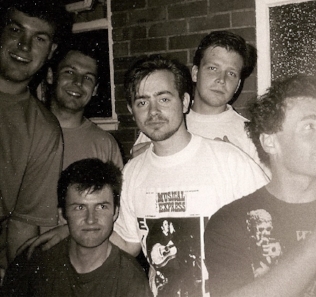
Tempting Alice with Tim Robson centre (stage)
Out of Time?
“There is still a city with the same name, and there are streets with the same name too, in the same locations, but what happens there is so transformed, in thought, word and deed, that it is not the same place. Is it better, or worse? I cannot not really tell. It is certainly different.”
Interesting that Hitchens was writing (beautifully as ever) about Oxford in the context of Leonard Cohen whereas I chose Brighton in context of REM and Out of Time. And my conclusion?
The music still plays. The buildings are (mostly) still there but the streets beat to a different set of people. Who I knew, the relationships I had, gone, absolutely. Failed domesticities. The friends, dispersed, mostly not lamented. The work, ignored at the time, forgotten now completely. Occasionally, turning a corner in Brighton I encounter the shiver of yesteryear's ghost. Just faintly - 'like an ill-remembered character from a novel read years ago, or the strains of a once familiar melody playing softly in another room'.**** But mostly, the past is a different country and, more than that, half a world away.
Read on
Read about gigging in Brighton pubs in the 1990s. Tim Robson says sorry.
Or maybe a nostalgic walk around Kemptown, the Seafront and the Lanes?
Memories of Sussex University in the late 80’s: Morrissey, Mascara and Mary Chain
Quotidian Notes
* When I say Brighton, I mean both Brighton and Hove. Although their characters are quite different, I moved seamlessly between the two. Of course, they are now joined as one city.
** Fun fact - Elton John played piano on The Hollies - He Ain't Heavy He's My Brother. Why I sledgehammered that reference in, who knows. How unsearchable are my judgements.
*** Bryan Robson. Geddit!!! Oh, I was a hoot in those days. For youngsters - he was a footballer and captain of England when I cared about this. Read about my experience with another United Player - Brian Greenhoff in bar in Rochdale.
**** @Tim Robson - The Song of Vivian. I apologise for quoting myself but sometimes - not enough - I dance with greatness as a writer. The song never lasts long though.
Originally published in 2016 but revised 2019/2026 to capture those Google Bots with more links and a better URL. Yes, we’re all whores.
Online Dating: Vegetables, Mannikins and Thieves

Toughest Game in the World
As we know, the online dating world is tough. Toughest game in the world.
‘Nam? For pussies.
Running a marathon under 2 hours? Try fighting a battle against the Persians first, big boy.
Brexit - difficult? Try negotiating a date on Match.com
Both sexes have dating urban myths. About how they are manipulated online.
Unfortunately, what we’re talking about is a hyper exaggerated version of biological and sexual differences. (Yes, I was born into a world where there were just two genders. Apparently, in the last few years, this has increased. Who knew.) Anyway, to sum up profiles and longer arguments: men want to screw anything that moves and women want a relationship. We act out our assigned roles. Clearly there are large areas of overlap between the sexes but, in a brutal market like online dating, it seems it is the differences and not the similarities that get amplified.
We all have our war stories.
Close your eyes. Picture this…
Tim arrives for a date. (Girls; linger on this image for a while. Take your time. Go on - indulge yourselves. You’re worth it!)
So, I’m showered and smelling of - I dunno - David Beckham deodorant and Obsession. Wearing jeans and jacket. Smart shoes. You lucky girl whoever you are! We do the get-a-drink thing and sit down. We talk about our day, how we got here, some random observations about the bar we're in (for it will be a bar). And then. And then.
Pre-rehearsed Questions
Well apparently, there's websites out there that supply approved first date questions. If you run dry of conversation, you're supposed to throw one of these into your date to get things going. For example: -
· Who is the biggest influence on your life?
· What was your favourite movie / song of all time?
· Who is your best friend and why?
· What were you like growing up?
· What's your goal in life right now?*
· What's your bucket list of places to go to?
· Blah - fucking - blah
It's rehearsed spontaneity, the wisdom of a parrot, the 'I'm mad me' humour of the unfunny. In other words, nothing - nothing would turn me off more than some lady asking me to discuss the greatest influence on my life.
Of course, I accept that someone who reeled off some bollox question has probably put some thought into our date which in itself is charming. Or an indication that she goes on a lot of dates and is on auto-pilot. Or boring.
The point stands for blokes though too. Boring bastards with no wit but tall enough to get some girl to agree to a date. If you then rely on pre-scripted bon mots, well I’d have to put you to the sword like Stilicho in Ravenna. No mercy ladies.
This somewhat reminds me of the ‘Chechnya’ scene in Brigitte Jones where Brigitte – in order to impress upon Hugh Grant her seriousness – intones ‘But what about Chechnya’ and he responds ‘I couldn’t give a fuck’ and asks her to talk about her lesbian experiences (or just make shit up).
Je ne regret rien
And the purpose of this curmudgeonly ramble? Advice to a perspective girlfriend? Advice to nervous dates that they just be themselves and let the god of wine be your guide? Perhaps, snidey bitching from life’s sidelines? Yeah, that’ll be it.
So, let me leave you with some real advice:-
No-one regrets what they did. They regret what they didn’t.
Vegetables, mannequins and thieves.
Read On
What about my sapphic misadventures?
Or go to my features page and curate your own experience?
Follow me on Twitter for new articles, a stream of dodgy likes, odd retweets.
* This one always amuses me; what’s my goal in life, right now… Mmm, let me think. Single. On a date. What could I possibly be aspiring?
Yohanna - Funny Thing Is (Song Review)
Yohanna – Funny Thing Is (2008) (Yohanna / Lee Horrocks)

“The funny thing is – that I can see myself
Like a star on the big screen
I guess I’m somebody else
It’s like make-believe in the wrong sized dress
And nobody wants me
Unless I’m somebody else. ”
Funny Thing Is
I must admit – this article didn’t quite go the way I envisaged. It was going to be all about small countries, female diva singers and my usual bucketful of navel gazing, solipsistic bullshit that we all love and enjoy. Actually, that’s precisely what you’re gonna get anyway; old habits die hard in a ditch defending my idiosyncrasies. The difference this time is that bizarrely, I ended up corresponding with the singer, Yohanna, herself.
Anyway, random is the new planned and rambling is the new coherence. And poor snowclones are the new annoying. Sometimes I’m so literary it actually hurts. Anyway, let’s get back on track. Yohanna stands in the wings, her song nervously pacing behind the closed curtain, anxiously awaiting the big reveal to you, my strung out caravan of misfits.
Watch The Funny Thing is Video
So, before you go any further, click on the video link of Yohanna’s song. It’ll help. I like small countries. I’ve found that the people are feisty and funny, conscious of their size but proud of their ‘us against the world’ predicament. When I was a globetrotting relationship manager for a multi national financial services company (try saying that after a few drinks!) I was fortunate enough to visit plenty of small countries, visits, I’m happy to report, paid for by my employers. So, for three years, I used to travel to Brussels every month; prior to that I had frequent (work related) sojourns in Amsterdam. I was summoned to Luxembourg a couple of times to get my butt kicked by a well known global telecommunications company’s in order to explain away a botched implementation. Yeah, Skype – I’m talkin’ ‘bout you. Bastards.
I also once pitched for a global contract with a large pharmaceutical company based in Iceland. I had a couple of days in Reykjavík. It was cold, it was winter and it snowed. It was dark until nearly noon. Perfect conditions in fact for those who view melancholy as but a tiny step down from ecstatic. I succeeded in getting the contract signed with the drugs company - of course – then celebrated with several cocktails in the Reykjavík Hilton feeling pretty good about myself. But, what did I actually know of the country around me?
- I knew, it was cold and that Icelanders did a lot of fishing and were often blonde.
- I knew Blur used to go there in the 90’s and, for a while, Reykjavík was the ‘cool’ place to be.
- I found out in my prep reading that British troops invaded and occupied the country in 1940 (Who knew? Sorry guys!).
- I knew that a beautiful singer called Yohanna represented Iceland in the 2009 Eurovision song contest with her rousing ballad Is It True and was robbed of Brotherhood of Man type fame by tragically, and wrongly, coming second.
And Yohanna, Tim?
It is, of course, to Yohanna that I now pivot and discuss her obscure, but evocative song, Funny Thing Is. It’s an odd choice, I know, but - if this is the joker in the pack of my favourite songs - musically and emotionally, it more than holds it own against the better-known competitors on the list. Scanning my iTunes top 25 most played songs, Funny Thing Is stubbornly remains a permanent fixture in the upper reaches. Others may come and go, but Yohanna’s song, artfully entwining empowerment, insecurity and big-voiced ‘you-go-girl’ choruses, is always there for me to have a surreptitious ‘diva moment’. It is my favourite sing-a-long.
I guess my liking for diva type torch songs was something that only grew gradually. Even though I went to school with Lisa Stansfield* , for years after, I only ever listened to boys thrashing loud guitars, shouting themselves hoarse. This was amplified during my own rock career – yes, I write the word ‘career’ sarcastically – where I consciously crafted a certain rock stereotype; Marshall amp, Epiphone guitar; plenty of feedback. Indeed, the charms of a well-written female ballad beyond, say, The Winner Takes It All or Aretha belting out You Make Me Feel Like A Natural Woman, evaded my playlists for years. My group used to do Walk On By but only because the Stranglers did so first. Dionne Who? Exactly. And then a strange metamorphosis happened…
I started to feminize my tastes and got all metrosexual on-yer-ass. I can even remember the date and the cause. Lucie Silvas and Breath In, 2004. (Lucie Silvas is, by the way, a lost British great, bow your heads in shame, fickle public). From that moment on, I was all about the girls. Classics like Erma Franklin’s Another Piece of My Heart, Etta James’ I’d Rather Go Blind, nestled with anything by Carol King, Jodie Mitchell up to the mid 70’s, early or late period Alison Moyet, some Avril Lavigne, most Taylor Swift, late 80’s Cher, upbeat Mary Chapin Carpenter, bits of Pink… Wearing my apron in the kitchen, I’d blast out girl power ballads, shake my booty and yell into the wooden stirring spoon that there ain’t no mountain high enough. An attractive image, no doubt you will agree.
So I was a prime convert for Yohanna when she sang her heart out representing Iceland on the Moscow stage at 2009’s Eurovision. She was a stunning vision in a full-length blue ball dress, her long blonde hair gently blown in the air like a classy 80’s pop video. Effortlessly she won over the audience – and me - with her heartbreaking ballad Is It True. See the video below. Best 2nd place ever? Click the video below and watch her!
(The UK, as usual, had put up some bollocks that no-one remembers. Why do we, land of pop mastery, always have to be so shit these days at the Eurovision? )
Song Review
So Yohanna. What a voice! What poise! What control! This cello led song gradually ratchets up the emotional tension until the final chorus where Yohanna finally lets rip, singing high and pure over the top of her backing singers; soaring in fact. The combination of a beautiful woman singing about deceit and betrayal universalized the song, the emotion; we’ve all been there. We’ve all loved. We’ve all been hurt. Yohanna should have won the contest. She was the greatest ever second place! I’m convinced that if she had won, I wouldn’t be here six years later trying to explain to you all outside the Nordics who the hell she is. Believe me, you’d know.
But my story doesn’t end here. I downloaded her album Butterflies and Elvis (crazy name, big in Sweden) and here is where the song Funny Thing Is came into my consciousness and onto my list of favourite songs.
It all starts rather peacefully; a piano playing a simple riff, the comforting beginning of many a slow building ballad. After a couple of bars Yohanna comes in, her voice welcoming and pure:
“Life’s a magic wand Dreams will never end”
Already we’re channeling ethereal; music, voice and lyrics perfectly capturing a mood of innocence and hope. But ominously, we’re quickly convinced that this isn’t going to a Disney fantasy, a carpet ride to clichéd emotions: Yohanna, and the musical backdrop are now leading us to a different place:
“When I try to run Somebody pulls me back” And then we’re cantering onto the ‘big’ chorus with drums, bass and guitar signalling this transition. Yohanna takes her voice up an octave and teaches wannabes and never-will-be’s exactly what a fucking chorus should be sung like – powerful, dramatic and yet tuneful. “The funny thing is,” she sings and the listener is drawn in; what is the ‘funny thing’ what is the irony about to be exposed, what journey are we heading on? We have the mental image of Yohanna gazing at herself, commenting on who she is, how she is perceived, maybe whom she is expected to be in order to get on in life. Her vocals and her passion drive us ever forward, drawing us in. She means it, man. She really means it.
Drop a level to verse two.
“I wanna be myself // And nobody else//It’s no fun being what you’re not //So just forget about it.”
We’re now inexorably building to the second chorus. We know already, learning from the first chorus, that this song has got ‘big finish’ written all over it. We know we are in the capable hands of strong voice, a passionate singer who loves to let go and this is all gonna end with the listener inevitably joining in, bellowing out, inexpertly perhaps, the hook line. Actually I do a good counterpart harmony myself at this point. If I have one criticism of the song it’s that I’m not on it.
Second chorus complete, Yohanna repeats and repeats ‘The funny thing is, that I can see myself” - the tension building with each repetition; you know she’s holding back and that at any moment she’s going to release her powerful voice, start ad-libbing the tune and break out into some kick-ass vocal improvisation. This is the ending that all good ballad/torch songs should possess – passion, guts, drive; the vocalist tunefully riffing over a crescendo of musicians and chanting backing singers. It’s what I’ve always wanted to do – soul singer style – Oh Happy Day type call and response sort of thing – but never have. Yohanna succeeds, channeling her heroes – Whitney, Celine, Aretha – but still remaining unique.
If I want an uplifting song where I can join in, feel the power of the music, ponder over the lyrics, envy the vocalist, then Funny Thing Is has to be the song. Criminally, hardly anyone knows about it here in the UK. Yohanna, though still young, is cruelly under-appreciated here (though check out her Facebook.
I wish her well in the future, with writing new material and new successes. Speaking personally however, with Funny thing Is, Yohanna is already up there with the best in my opinion. The very best. My list of great songs includes such untouchable artists as The Rolling Stones, Neil Diamond, The Byrds; The Eurythmics. The Beatles, and Elvis.
Yohanna; you are the Iceland of this group; small, feisty, independent – but holding your head up high against the big guys. You’ve earned your place on my list of greats. Which all goes to show, you don’t have to be perceived as a commercial success to be an artistic success (see Lucie Silvas).
Of course Yohanna should be more famous, of course her tracks should be in the international charts but, selfishly, I’m glad I found her and know her. She is my diva guilty secret. But I’ve just let that secret out of the bag. In a way, I’m glad. You go girl!
• Not lying – I really did go to school with Lisa Stansfield – it was Oulderhill School, Rochdale, early 1980’s. Yes, we sang together in the school play, yes she became more famous than me; no we never had a romantic relationship (though who turned down who, I’m too much of a gentleman to say!). But I’m here for the long haul. She may have been around the world but I’m still rockin’, still rollin’, still writing. One day her Wikipedia entry will say – ‘Lisa went to school with Tim Robson’. It will also show she’s a few years older than me. Mee-ow!
The Gracchus and Brexit and political murder

The Gracchus would have supported Brexit. Hell yeah.
REPOST from June 2016 but more relevant than ever following the dragging of poor Jo Cox into the Brexit debate.
Some thoughts about the referendum as we move into the last few days.
It's a strange atmosphere - after months of getting pummelled, Leave had started to pull away from Remain. I watched as poll after poll starting giving the 'right' result, hardly believing what I was seeing, crossing my fingers so as not to jinx the result. And then a madman murderers a remain MP and - though the facts are hazy - seems to be right-wing nut.
Let's just say straight off - and this isn't pro-forma bullshit - as a democrat and patriot - this act, like the murders in the recent past - Airy Neave, Ian Gow and Sir Anthony Berry - takes a little bit of our soul, our democracy. It steals something from all us. Like tribunes in Ancient Rome - elected to serve and counter-balance the patrician Senate - MP's work for and represent us and should be inviolate. Jo Cox seems to have been liked by all who met her. Additionally she leaves behind a husband, three children and many friends and constituents who will all now miss her.
But, she was obscure and I think I probably disagree with most things she espoused. Terrible and tragic though her murder was, we have an important decision to make on Thursday. The affairs of a great nation shouldn't turn on emotionality, even in 2016. No amount of shroud waving and mawkish sentimentality can put this decision off, nor, if Jo was half the great democrat I'm sure she was - should we.
Politics is passionate and better when, verbally, the gloves are off and arguments get aired and debated. I have no tolerance for 'safe spaces', for passive-aggressive diatribes against tone, subject matter or 'the science is settled' closing-down mechanisms. Fuck that. If Farage wants to talks about immigration let him. If Osborne and Cameron want to bull-shit about WW3 and financial armageddon, then be my guest. If Will Straw and the Remain campaign want to get in the dirt and use a dead woman to shut down their opponents arguments then, tasteless and base as they are, go for it but be prepared to be called out on it.
As ever, Rome provides many illustrative examples from the Gracchus Brothers, to the clashes between the generals of the later republic, the bread and circuses of the Julio-Claudians onwards, the lassitude of the third century, the grit of the Danubian Emperors, the re-invention under Diocletian and Constantine. It was often violent and not pretty. We've - hopefully - lost the murderous end-game, but, nutters aside, kept the passion
So calls for restraint and civilised debate should always be viewed with a sceptical eye. If not physical or murderous - and please don't debase this threshold - then argue away. Why curtail free-speech, should always be the question. Who benefits from shutting down debate? Who gets shut out? Arguments need to be tested on merit, not locked away.
As I've quoted before, I think the most realistic song on politics is The Who's 'Won't Get Fooled Again'. Unlike most political songs it's written from the standpoint of the powerless, the little person observing that the heat of political battle is often just froth (for them). Things just have a habit of working out.
I pick up my guitar and play // just like yesterday// and get on my knees and pray// We don't get fooled again // Meet the new boss // Same as the old boss
Anyway, the debate is screwed up currently. Hopefully, the good sense of the British people will see past the tragic murder of an MP - who was a mother and politics professional, who had dodgy views - and make a decision.
I almost wrote informed there. But informed is not where we're at. It's in the instinct, the gut; this is no technocratic X in a box. This is about YOU as a person.
I will return to this.
RIP Jo Cox
Tim
NEIL DIAMOND – SOLITARY MAN (1966)

The Solitary Man, Neil Diamond
Belinda was mine, until the time that I found her - holding Jim. Loving him.
And Sue came along, loved me strong, that’s what I thought.
Me and Sue. But that died too.
Neil Diamond’s Beard
In the 1990’s I wrote a novel called ‘Neil Diamond’s Beard’. I employed this slightly off kilter title to try and grab the attention of the Henry and Henrietta’s who work as the gatekeepers of publishing companies. Of course, if I had been serious about success I should have called it – ‘My Dad was Head of Publishing at Random House’ – but to me the Neil Diamond reference was more than quirky. It was personal. This ruse didn’t work, of course. The book remains a great, lost piece of literary history.
Back in the early 1990’s, you can’t imagine how unpopular Neil Diamond was. He struck fewer chords with the rock establishment than a benefit gig for child molesters. Being a Neil fan in those days was the definition of walking the hard yards. Cool kids would ignore you, girls would laugh at you; friends just shake their heads and wonder where it all went wrong.
But Neil was worth the withering condescension, the social ostracism. I suppose in a way my book title - referencing Neil - was a statement of defiance. Sometimes in life – as Huey Lewis sort of said – it’s more hip to be square. He was so out, I liked him, so fuck you and feel my inner strength. A bit like Abba. Now in the Smiths-Bunnymen-Jesus and Mary Chain world of the late 80’s university, this made my fellow students view me with suspicion; “See that guy? He just asked for Cracklin’ Rosie!” But, unlike St Peter, I never hid or denied my like of Neil or Abba. In these post Mama Mia and 12 Songs times, where a more balanced viewpoint is taken of both artists, I do feel somewhat vindicated.
The Jazz Singer Context
But why did I call my first proper novel, Neil Diamond’s Beard? There are two reasons. Firstly, The Jazz Singer. Yes, it’s an update of a 20’s classic. Yes, it was Neil’s first and last film. Yes, Larry Olivier hams his way through it like a leg of pork in the window of a tapas bar off Las Ramblas. But, but, it does have some good songs in it (Love on the Rocks, obviously, but America’s pretty good too). Not only this, but there’s a scene where Neil’s rock star character goes off the rails, abandons his girlfriend and baby and lives like a bum in rural America, scratching a living as a singer/guitarist in small town bars. He wears the Stetson. He wears the boots. He wears the cool 70’s shades. And he grows a beard. So, what? Well, it could be argued that the beard was Neil’s character’s physical manifestation of inner turmoil, of being a man on the loose, a man being, well, a man.
This defiance (misogyny, stupidity, whatever) does have its attractive side, an appeal that makes cutting your nose off to spite your face seem heroic. So, I called my book, which dealt with male issues and was a nascent cri de coeur, Neil Diamond’s Beard. Yeah. Let’s hope the second reason is better, Tim.
The Greatness of Solitary Man
Reason two, and the ostensible purpose of this article, is the song Solitary Man. This was Neil Diamond’s first hit in the US. For years he’d been a Tin Pan Alley songwriter, hustling songs around the Brill Building and not really getting anywhere. Finally though, in 1966, dressed in black, he was signed as an artist by Bang records. (Pedants note – he also wrote I’m a Believer and A Little Bit me, A Little Bit You for the Monkees at the same time. That can’t have hurt.)
Being born in… - I know, I know I’m timeless - I didn’t hear Solitary Man until much, much later. Late 80’s in fact. By that time I already loved Sweet Caroline, Cracklin’ Rosie, Song Sung Blue – the obvious ones. But hearing a live version of Solitary Man for the first time on a compilation tape of his other hits was a revelation. I suppose it was the combination of minor chords in the verse breaking out into a major chord chorus that was appealing. Light and shade. Night and day. Contrast. Trombones. Whatever.
Nascent Libertarianism
The song structure is quite a complex one and, certainly for a guy who was nicknamed Eadae by his band (loads of Neil songs at one point – like Cherry Cherry - use the E-A-D-A-E chord structure), it was a surprising but welcome find. But more particularly, there’s the title itself and the worldview it represents: Solitary Man. Now that sounds interesting, I thought. The lyrics are relentlessly downbeat; all about a guy’s struggle to find and hold a relationship but beset on all sides by hordes of fickle women who are waiting just to dump him and get off with his mates. Along with perhaps I Am…I Said the verses in Solitary Man contain some of Neil’s most personal and introspective lyrics.
But then we get to the chorus and major chords. Here Neil says it’s all right; until he meets the right girl he’s still got himself. He can be who he is – a ‘solitary man’. Powerful stuff! We can all rally around the flag on that one. It could even be argued that Neil is singing about self-empowerment (You go, girl!), but I like to think that he’s groping towards the fully formed libertarianism of his later song The Boat That I Row:-
“There ain’t men alive who can tell me what to say. I choose my own side and I like it that way.”
Best Version. It’s Live
Now the best version of Solitary Man – I think – is the live take from Neil Diamond Gold (Not Stages or the overrated Live at the Greek but the live album of early songs Uni put out as a spoiler when Bang released a Best of compilation just after Neil changed labels). This live version is even more moody than the recorded take; Neil and a female backing singer harmonise perfectly and replicate with vocals the studio record’s trombone part. The effect is – well – slightly Jewish to be honest, a good decade before he explored this more fully in The Jazz Singer film. Whatever Neil summoned up on stage that night in Hollywood is audio gold. Worth a listen.
Cover Versions
Although it’s not the best-known Neil Diamond song, other artists have covered Solitary Man occasionally. B.J. Thomas (of Raindrops Keep Fallin’ On My Head fame) did an organ heavy cover in 1969 that is well worth a listen. Chris Isaak’s version was MOR crap and best avoided. Norwegian Goth Metal band HIM did a spikey version with heavy guitars, which is interesting. It is said, perhaps maliciously, that my group Shambolic murdered the song back in the 90’s playing dive bars in Brighton. Not true; Solitary Man is robust enough to withstand this sort of attack. So; Solitary Man – Neil Diamond’s first hit, lots of trombones and those moody chords and lyrics. What’s not to like? Neil - you’re a legend!
Comment below if you agree.
BTW - good luck Neil fighting Parkinsons. It’s a fucker of a disease which destroys lives to a relentless and grim drumbeat. You fight Frogking.
Further Reading
Song Review: What about Annie Lennox being Savage with the Eurythmics?
Tim was a solitary man on a rainy night experiencing The Darkness of Bruges.
All Music reviews and thoughts can be found in the Music section of my Features Page
London Walks : A Guide

Too many people just get on a tube and so miss overland London. The stories, the streets, the layout. The full pie and mash.
So I started writing a series of articles recently about London Walks that I enjoy. Reading them you get some history, walk past some landmarks, learn some obscure stuff, and most definitely find some great pub recommendations. All are illustrated with some great pictures taken along the route!
To remind ourselves, here are links to the various walks:
St James's - Haymarket to Victoria Station
Lavender Hill - Up and down this Battersea highway
London Bridge Circular - Old and new London
Harrods to Victoria Station - Belgravia, mews and embassies. Hidden pubs.
Look out for some new walks coming soon!
Laters
Julian: The Great or The Apostate?

Julian - notice ‘Greek’ facial hair
Julian and his wicked cousin Constantius
(Here Tim discusses fourth century Roman history. Note, at this time, the Empire was well used to having more than one Emperor with often a senior (Augustus) and junior (Caesar).)
The Emperor Constantius II was a right bastard. For example, the massacre of the princes - where he killed off his male relatives in Constantinople during a family gathering following the death of his father Constantine The Great in 337 - was just the sort of ‘real’ history that gives Game of Thrones legitimacy.
One nephew that survived the cull was Julian. A bookish and pious prince, he was spared because he was so young and, well, a bit of a nerd. But ten years later - following the overthrow of Western emperor Constans – cousin Constantius needed a partner to share in the burden of the imperial purple. Turning first to Gallus, Julian's older brother – who he later killed - Constantius eventually elevated Julian into the family business as Caesar of the West in 355.
Caesar in Gaul
Here, in Gaul, the boy became a man. After kicking some serious German butt at The Battle of Strasbourg and other conflicts, Julian became popular with his legions. Cousin Constantius became jealous and there followed lots of 'come and have a go if you think you're hard enough' correspondence between the two emperors until Julian marched East at the head of an army in 361. And then – miraculously - Cousin Constantius died suddenly leaving young Julian the sole master of the Roman world. What to do?
Sole Emperor
Well, what Julian did - in his brief two year reign – was attempt to turn the clock back on Christianity and try to re-establish the old gods. You know, get rid of all this Christian rubbish legitimised by his uncle Constantine. He also thought Persia was up for a bit of Roman steel and so marched off deep into the Sassanian Empire, never to return. Killed by a random spear, Julian left his troops miles from safety on the Euphrates and in the feeble hands of his short-lived successor Jovian. Ultimately, on religion and war, he must be judged a failure.
So why do I tell the story of Julian the Apostate?
Can one man change history?
Well, unlike his uncle Constantine (the Great), he only had 2 years to make his mark. Constantine had 31 – with the 13 years in sole charge of the Empire. Constantine changed the course of history. Julian however flamed out quickly and his successors Valentinian, Valens and Theodosius reaffirmed the Christian hegemony (give or take the odd Arian, or semi Arian, heresy). Julian was an anomaly in Western history where Constantine looms large but Julian does not.
Can one person change the course of history? Or – as in this case – a solitary spear? What if Julian had lived and reigned twenty years? Would he have quashed Christianity and reduced it into a cult, one of many, like Isis, Mithra or Sol Invictus, that bubbled around in the later Roman Empire? It’s possible that Christianity could have gone underground only to re-emerge stronger, much as it did during the persecution of Diocletian sixty years earlier. It’s impossible to say. It’s a little like powerful newspapers; do they lead opinion or merely reflect it?
What’s of interest though for those who seek parallels in history, who look for patterns to help with understanding the present day, is the theory that there are turning points – yes kings and emperors – but social, religious, military too, that alter the course of history. The trick is to spot whether events have produced a Constantine the Great or a Julian The Apostate.
Read more 4th century history as I discuss the five landmark battles that defined this climatic era in Roman history.
Or maybe read all my Roman articles - from Hannibal to Theodosius.
The Devil's Margarita

Come and have a go if you think you’re hard enough.
Discovered a new drink this week; The Devil’s Margarita.
Fresh lime juice, sugar syrup and tequila, shaken with ice, poured into a glass with a topping of red wine.
The red wine floats on top.
What’s not to like?
This advert has been brought to you courtesy of 2-1 cocktails down in South London.
I thank you.
Savage - Eurythmics (Song Review)
“She said, “I have this unhappiness
To wear around my neck
It’s a pretty piece of jewellery
To show what I protect.”
You fall into patterns within relationships so very easily. You assume roles within the couple’s dynamic - what you do, what you believe and what you enthuse about. It’s kind of a domestic shorthand that describes, but soon imprisons, the full richness of each other’s personality.
With me, I’ve always been the ‘music’ guy. My girlfriends have pretty much been less interested in music than me. It is my thing. I know what year a song came out, who played on it and who wrote it. Whilst there are women who are every bit as obsessive in this area, I think it’s safe to say that this lauding of the ephemera of music tends to be a predominantly male trait. This characteristic plays itself out within a relationship by ownership of the playlists, control of the music; a pedantic, but ultimately futile, need to teach, to explain, each and every song. Love of something subjective becomes a dry lesson in the objective. Savage is the honourable exception.
Listening to this slow building song, I’m forever taken back by its gentle rhythm to a time in the late 80’s when life seem optimistic and everything seemed to matter. A shy girl, who loved me, said that I should listen to this track, as it was just the sort of music I’d enjoy. Like all good recommendations this was built from a solid foundation of what that person knew about me and then went off at a tangent. No-one needs to be told something obvious – it’s the unobvious and obscure, the great find, that really chimes within the soul. And so it was with Savage. The gentle girl was right, it is ever one of my favourites.
The slow, ethereal intro frames the piece; with each gentle wave of chords from the keyboard - more breathed than played - you know it’s going to be one of Annie Lennox’s betrayal songs. No one, other than Alison Moyet perhaps, does betrayal better than our Annie. The sparse backing provides a backdrop to some of Annie’s best lines. The images she plays with are disjointed, violent even – the sun displays its teeth - but her words convey a mood rather than any literal meaning. There is a brooding air of savagery hanging over the song, more vivid because it is unexpressed and waiting menacingly in the shadows.
But the Eurythmics were a duo and never more so than on this track. As the tension builds through the first two verses / choruses, a release is needed; all this musical foreplay must have its climax and this is stunningly achieved by a simple - but oh so right - solo from Dave Stewart. It’s as much about the notes that aren’t played as those that are. He puts himself into his guitar and feels his way through his solo. There is an un-80’s rawness in that guitar break, a sullen control, that matches Annie’s lyrics note for note. Other than Graham Coxon’s solo on Blur’s This is A Low, I can’t think of a guitar solo more appropriate, more understanding, of a song than this one.
Annie and Dave produced many great songs – Who’s That Girl, Julia, Here Comes The Rain Again come to mind – but I don’t believe they combine so perfectly than their collaboration on Savage. I wrote earlier about the glad-happy morning of the late 80’s. You can’t choose your time and neither can you control your era’s personal soundtrack. Of course, you filter what you hear through personal choice – which records to buy, which radio stations to listen to – but no one lives in a vacuum. My university days were the late 80’s. When so much of what was popular at the time – Kylie, Stock Aitken and Waterman, house music – retreats into the unopened drawer of memory, I’m happy that the gentle girl with the sad eyes, told me to listen to Savage. There’s a dignity in this evocation, both defiant and tender, that seems appropriate somehow.
The girl’s long gone, of course but I’ll leave it to Annie to provide the postscript:
“She said, “Everything is fiction
All cynic to the bone
So don’t ask me to stay with you
Don’t ask to see me home””
Start the video at 1.30 for a live version of Savage.